Preservation news: some eighteenth century minute books

Years of use take their toll on books and manuscripts. Even with the most careful handling, moving documents from shelf to trolley, transporting them from the strongroom to the readers’ table or simply opening and closing volumes all put a strain on bindings. Paper and parchment may develop small tears, dog-eared corners or creases. And those small areas of damage just get worse over time.

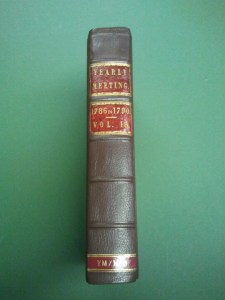
London YM Minutes 1786-1790

London Yearly Meeting Minutes 1786-1790

Conservation work is necessary to ensure that items in the collection can be preserved for future use. It’s a slow, painstaking business, requiring the experience and skill of qualified conservators, who know how much to intervene, what materials (papers, glues) can safely be used to prevent further damage, and the importance of preserving what can be preserved. Thanks to donors to our BeFriend a Book appeal and other special funding sources, we’re lucky enough to be able to use the services of expert conservators, whose conservation work has allowed us to keep some of the Library’s treasures available to readers.

A prime candidate for conservation is the series of bound minute books of London Yearly Meeting, dating from 1672 onwards. With BeFriend a Book funds we have been able to conserve most of the eighteenth century minute books from the series. The latest to be conserved are the minute books for the years 1778–1781 and 1786–1790. The volumes have been taken down into loose folios, repaired and rebound in half goatskin, with raised bands.

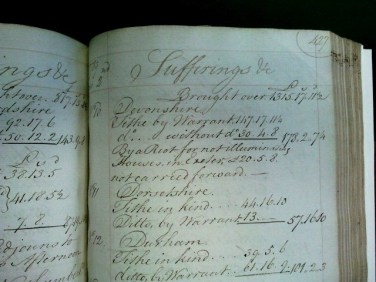
Devonshire sufferings reported to London Yearly Meeting 1789

Devonshire sufferings, including losses caused by a “Riot for not illuminating Houses in Exeter”, reported to London Yearly Meeting in 1789 (London Yearly Meeting Minutes 1786-1790, p. 427)

The business recorded in the minute books includes reports and totals of money forfeited by members of each quarterly meeting around the country for “sufferings” – tithes in kind, tithes by warrant or without warrant, money confiscated for church rates or similar, and “sufferings on account of the militia” (payments for refusing to serve in the militia). Friends also reported the cost of damages to their property by rioters incensed at Friends’ refusal to light up their houses and shut up their shops on public occasions. At a time when grand national celebrations were widely marked by great shows of light (at considerable expense), and public holidays, Quakers continued to observe their testimony against observing “times and seasons”, even though it might mean ill will and broken windows. An example of the costs incurred was reported by Devonshire Quarterly Meeting in 1789  – “By a Riot for not illuminating Houses in Exeter, £20.5.8 [i.e. £20 5s 8d]” (London Yearly Meeting Minutes, 2.vi.1789 p. 427). Answers to the queries from each meeting were also recorded, along with other Yearly Meeting business, and the written and printed epistles to meetings.

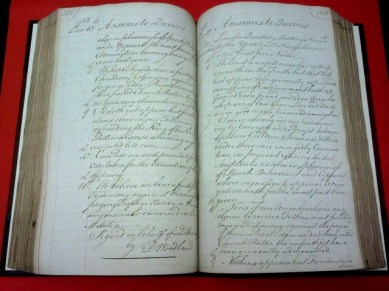
Lincolnshire QM answers to queries 1788

Lincolnshire Quarterly Meeting answers to queries 1788 (London Yearly Meeting Minutes 1786-1790, p. 332-3)

The small Quaker colony in Dunkirk is also mentioned in the Yearly Meeting minutes for these years. William Rotch and other Quaker whalers from Nantucket had moved there in 1786: it was a turbulent time to settle in France. You can read more about the short-lived settlement in Kenneth L. Carroll’s article, “An American Quaker colony in France, 1787-1812” (Historic Nantucket, Vol. 24, No. 2, October, 1976, p. 16–29) and Henry J. Cadbury’s “The Dunkirk colony in 1797” (Proceedings of the Nantucket Historical Association, 50th and 51st annual meetings, 1944–1945, p. 44–47).

Thanks to all our BeFriend a Book supporters for making the conservation of these volumes possible. To read more about how we’re preserving the Library’s collections for the future, keep watching the blog, or enter your details in the “Follow us” box at the top right of this page to receive updates by email.

If you’d like to find out more about the BeFriend a Book appeal, or to donate, please visit the BeFriend a Book webpage or write to BeFriend a Book (Library), Freepost, Friends House, 173 Euston Road, London NW1 2BJ.

Posted in Collection care | Tagged , , , | Leave a comment

Quaker sufferings records: an “embarras de richesse”

Readers of early Quaker literature cannot fail to be aware of the history of religious persecution of the Quakers in the seventeenth century. Although the Act of Toleration of 1689 marked the end of its most extreme forms, Quakers continued to be subject to confiscation of goods, fines and imprisonment for refusing to pay church tithes or take oaths, and to be excluded from public office. Friends assiduously recorded these “sufferings” at a local and national level from early on. These accounts were both a record of conformity to Quaker public testimonies, and grist to the mill of an energetic campaign for legislative change. The Library holds a profusion of published and unpublished sources on Quaker sufferings, described by one historian as an “embarras de richesse”: this post is an outline of some of the most important.

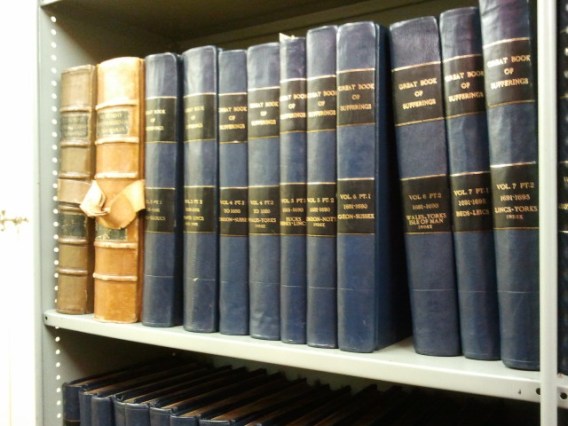
The Great Books of Sufferings are a series of 44 “elephant folio” sized manuscript volumes ranged along six metres of sturdy metal shelving in the Library strongrooms. Many volumes in the series were rebound in handsome blue leather in the twentieth century, but others retain their earlier bindings – the first two (currently available only on microfilm, for conservation reasons) furnished with massive leather spine straps for hauling off the shelves.

Great Books of Sufferings

The Great Books of Sufferings

These meticulous records of prosecutions of Quakers in civil, criminal and church courts from the 1650s up to the mid 19th century, along with accounts of unjust treatment at the hands of persecutors, were compiled by the Society of Friends’ Recording Clerk in London from letters and reports sent in by each quarterly meeting around the country.

Great Books of Sufferings Cambridgeshire 1682

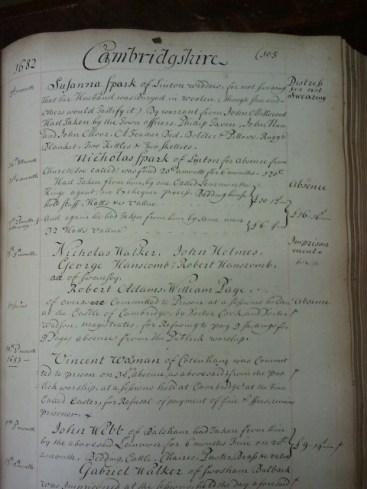
Great Books of Sufferings. Entry for Cambridgeshire 1682

They provide detailed contemporary accounts of imprisonments, distraints (seizure of property to discharge fines) and other penalties levied on Quakers for crimes such as non-attendance at church, illegal meetings, refusal to take oaths or pay tithes. Often individual persecutors (magistrates, parsons, bailiffs and others involved) are named. Organised chronologically by county, the records are a remarkable source for social and economic historians and those researching local and family history, as well as historians of Quakerism.

Indexes of people (both Quakers and their persecutors) and of places were made when the books were compiled, and are bound in with the text: these are now being supplemented by modern indexes and contents lists compiled by our Library volunteers.

Less well known than the Great Books of Sufferings is a series of volumes in the Yearly Meeting archives known as the Original Records of Sufferings, consisting of original accounts of sufferings sent up to London by individuals or meetings during the period 1655–1766. A listing of the contents of these eight volumes is available, compiled by Craig W. Horle, a former member of staff.

Monthly meetings around the country were exhorted to submit accounts of religious persecution to be recorded by Friends in London. Often, but not invariably, these were also written into local “books of sufferings”. These volumes remain with local Quaker records, mainly now deposited in county record offices. There are many examples of these volumes among the extensive records of London & Middlesex monthly meetings (which we hold here in the Library), as you’ll see from this list showing the individual monthly meetings and the years covered:

  • Westminster Monthly Meeting. Sufferings 1670–1872
  • Hammersmith Monthly Meeting. Sufferings 1682–1747
  • Enfield Monthly Meeting. Sufferings 1682–1851
  • Longford Monthly Meeting. Sufferings 1683–1850
  • Devonshire House Monthly Meeting. Sufferings 1684–1871
  • Hendon Monthly Meeting. Sufferings 1691–1694
  • Wandsworth Monthly Meeting. Sufferings 1694–1724
  • Ratcliff Monthly Meeting. Sufferings 1763–1856
  • Peel Monthly Meeting. Sufferings 1782–1860
  • Southwark (formerly Horsleydown) Monthly Meeting. Sufferings 1795–1866
  • Kingston Monthly Meeting. Sufferings 1816–1848
  • Gracechurch Street Monthly Meeting. Sufferings 1825–1849

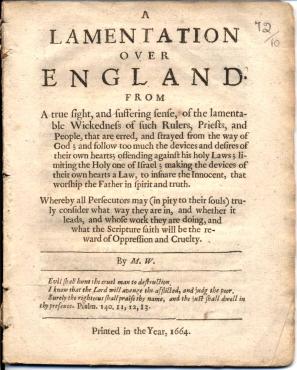
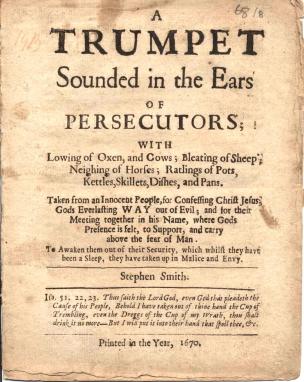
Quaker sufferings also appeared in print early on. Searching our online catalogue by subject “religious persecution” yields a large number of book and pamphlet records which can be sorted by date, including vigorous attacks on those responsible for rude treatment of Quakers, accounts of persecution, refutations and appeals to authority. Here are title pages of a few of the publications:

Saul's errand to Damascus (1653)

Fox, George. Saul’s errand to Damascus: with his packet of letters from the high-priests, against the disciples of the Lord [etc.] (London : printed for Giles Calvert…, 1653). – [10], 38 p. ; (4to)

A true testimony of the zeal of Oxford-professors and university-men (1654)

Richard Hubberthorne. A true testimony of the zeal of Oxford-professors and university-men who for zeal persecute the servants of the living God, following the example of their brethren of Cambridge (London: printed for Giles Calvert, at the Black Spread-Eagle neer the west-end of Pauls, 1654). – [2], 14 p. ; (4to)

A true declaration of the suffering of the innocent (1655)

Anne Audland. A true declaration of the suffering of the innocent, who is hated and persecuted without a cause. Wherein is discovered the zeale of the magistrates and people of Banbury [etc.] (London : printed, and are to be sold by Giles Calvert at the sign of the Black Spread-Eagle at the west-end of Pauls, 1655). – [2], 6 p. ; (4to)

A  true relation of the unjust proceedings ... in Southwark (1662)

John Chandler. A true relation of the unjust proceedings, verdict (so called) & sentence of the Court of Sessions, at Margarets Hill in Southvvark, against divers of the Lord’s people called Quakers, on the 30th. day of the 8th. month, 1662 ([London : s.n.], Printed in the year, 1662). – 22, [2] p. ; (4to)

A lamentation over England (1664)

Morgan Watkins. A lamentation over England· From a true sight, and suffering sense, of the lamentable wickedness of such rulers, priests, and people, that are erred, and strayed from the way of God [etc.] ([London : s.n.], Printed in the year, 1664). – [4], 48 p. ; (4to)

A trumpet sounded in the ears of persecutors (1670)

Stephen Smith. A trumpet sounded in the ears of persecutors; with lowing of oxen, and cows; bleating of sheep; neighing of horses; ratlings of pots, kettles, skillets, dishes, and pans. Taken from an innocent people, for confessing Christ Jesus, Gods everlasting way out of evil; and for their meeting together in his name, where Gods presence is felt, to support, and carry above the fear of man [etc.] ([London? : s.n.], Printed in the year, 1670). – 7, [1] p. ; (4to)

Although the volume of published pamphlets on the subject of sufferings decreased and their tone became less strident over the years, Quakers continued to use the medium of print to condemn persecution and argue the case against injustice.

Joseph Besse (1683?-1757) was one of the many eighteenth century Friends who publicised the Quaker case against tithes. His writings from the 1730s to the 1750s directed these arguments to Parliament, and against the ecclesiastical powers,  culminating in a long laboured over two volume historical account of the earlier times: A collection of the sufferings of the people called Quakers (London: Luke Hinde, 1753). Besse’s compendious work drew on the Great Books of Sufferings and accounts submitted by meetings, supplemented by additional sources, to remind his audience of the thousands of Quakers jailed, and the 400 or more who died, as a result of their persecution before the passing of the Act of Toleration in 1689. It is also a valued source for local and family historians. Modern facsimiles have been published in parts, with new indexes, by Sessions Book Trust (now out of print, but many of the parts are still available from the Quaker Bookshop).

Besse's Sufferings

Joseph Besse. A collection of the sufferings of the people called Quakers (London, 1753). Title page of volume I

Richard Vann gives a good account of the long pre-publication history of Besse’s Sufferings and its complicated relationship with the Great Books of Sufferings , the Original Records of Sufferings, quarterly meeting records and other sources in “Friends sufferings – collected and recollected” (Quaker history, vol.61/1 (Spring 1972), p. 24-35). For a literary analysis, see John Knott’s chapter “Joseph Besse and the Quaker culture of suffering” in Thomas N. Corns and David Loewenstein, The emergence of Quaker writing: dissenting literature in seventeenth-century England (1995).

The word “sufferings” continues in use in the name of Meeting for Sufferings, the standing representative committee of the Society of Friends in Britain, originally set up in 1675 to seek redress for Friends in cases of religious persecution and to lobby for religious toleration, particularly through legislation. The idea of suffering for religious principles finds resonance still, most notably in the twentieth century experiences of Quakers who have maintained their testimony against war and militarism.

Posted in Highlights | Tagged , , | 5 Comments

Rachel Eveline Wilson papers and our new exhibition: an insight into the life of a World War I Friends Ambulance Unit nurse

Nurses at Queen Alexandra Hospital (TEMP MSS 1000)

Photograph of nurses at Queen Alexandra Hospital taken between October 1917 and December 1918. Rachel Wilson is standing at the back, second from the right (Lib. Ref. TEMP MSS 1000)

An interesting recent addition to the Library’s collections has been the papers of Rachel Eveline Wilson (1894–1993) of Kidderminster, which primarily relate to her time in the Friends Ambulance Unit (FAU) as a nurse at Queen Alexandra Hospital, Malo–les–Bains, Dunkirk, during World War I (TEMP MSS 1000).

The FAU was a volunteer ambulance service, founded by members of the Society of Friends as a practical expression of the Quaker peace testimony. It operated from 1914 to 1919, 1939 to 1946 and 1946 to 1959 in 25 countries around the world, and its members were chiefly registered conscientious objectors. The FAU provided most of the staff at Queen Alexandra Hospital which had been opened in March 1915 and was one of the largest and best known military hospitals attached to the French Eighth Army. An account of the hospital and its work is given in the official history of the Unit, Meaburn Tatham and James E. Miles, The Friends’ Ambulance Unit 1914–1919: a record (London, 1920), pp. 68–85.

After training at Kidderminster Infirmary, Rachel Wilson became a staff nurse at Kidderminster Red Cross, and worked for nine months at Uffculme Hospital, Birmingham, for the Voluntary Aid Detachment (VAD), a volunteer organisation founded in 1909 to provide field nursing services. On 8 January 1917 she joined the FAU and was stationed at Queen Alexandra Hospital. She was there from October 1917 until it closed in December 1918.

Friends Ambulance Unit armlet (Lib. Ref. TEMP MSS 999)

Friends Ambulance Unit armlet (Lib. Ref. TEMP MSS 999)

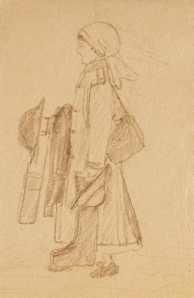
The papers of Rachel Wilson document her time as a nurse in World War I and include photographs, sketches, poems and writings about her experiences. There is also a small diary entitled, ‘Dunkirk 1918 – A record of five eventful nights & days’ (20–27 March 1918), which provides a valuable personal record of her experiences and includes observations of life on the ward accompanied by the deafening noise of the “cracking and whizzing of shells”.

“Going on duty”, c. 1918 (Lib. Ref. TEMP MSS 1000)

Sketch by Rachel Wilson entitled, “Going on duty”, c. 1918 (Lib. Ref. TEMP MSS 1000)

The Library also holds the papers of Rachel Wilson’s husband, Paul S. Cadbury (1895–1984) of Birmingham, later chairman of Cadbury Brothers, whom she met at the Queen Alexandra Hospital and married on 24 June 1919 (TEMP MSS 999). He joined the FAU on 1 November  1915 and was later given absolute exemption from military service on the grounds of conscientious objection. Before joining the FAU, he had been a member of the Friends Emergency and War Victims Relief Committee (FEWVRC), a committee organised by British Quakers to provide help for refugees and victims during World War I. The collection relates to his service in the FEWVRC and FAU and includes diaries, reports, a passport and even his FAU uniform. It also contains Rachel Wilson’s nursing uniform (apron, cuffs, collars, sleeves, cap) and numerous photographs and drawings.

Both the papers of Rachel Wilson and those of Paul S. Cadbury complement the official archives of the FAU (TEMP MSS 881), documenting, as they do, the experiences of individual members of the unit.

Opening in time for Yearly Meeting, our new exhibition, Rachel Wilson, World War I Friends Ambulance Unit nurse, includes a selection of items from the Rachel E. Wilson and Paul S. Cadbury collections. You can see part of the uniform worn by Rachel Wilson while working at Queen Alexandra Hospital, her drawings and watercolours, FAU badges and photographs showing life at the hospital. The exhibition will still be on display after Yearly Meeting (during Library opening hours) – so do come in and have a look.

Posted in Exhibitions, New accessions, News | Tagged , , , , , , , | 9 Comments

Attending Yearly Meeting: the unofficial record

The last weekend in May will see a transformation of Friends House, as Quakers from all over the country arrive for the annual assembly known as Yearly Meeting. Friends have gathered together yearly from 1688 onwards, and the records of those meetings are here in the Library.

The minutes and epistles of London Yearly Meeting (as it was known until 1995 when the name changed to Britain Yearly Meeting) provided the material for the earliest “books of discipline” – forerunners of the modern Quaker faith and practice. They are the official records of the Meeting, which oversees the work and concerns of the Society of Friends, educates, inspires and fosters the community of Quakers in Britain.

But what of the individual Friends who have attended Yearly Meeting over the years? As a spiritual highlight and a social gathering (and, for country Friends, the attraction of an annual visit to London), the Yearly Meeting was an important event, to be noted in diaries, letters and memoranda. The Library has a wealth of these personal accounts of Yearly Meeting, few of them published.

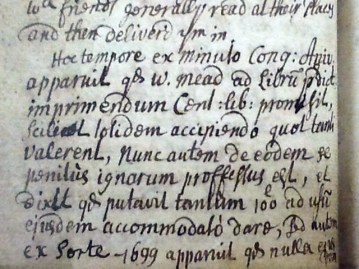
John Kelsall (1683–1743), schoolteacher and sometime manager of one of the Darby families’ iron foundries, an active Friend in Wales and England, was one of the earlier private diarists of the Yearly Meeting. Among his papers in the Library is a daily account of the Yearly Meeting for 1704: “a journal of the s[ai]d Yearly Meeting as I then writ it day to day”. It occupies ten pages of a small notebook, including passages in Latin (MS VOL S 193/4, p. 29ff).

John Kelsall's account of Yearly Meeting 1704 (MS VOL S 193/4)

A passage in Latin in John Kelsall’s account of Yearly Meeting 1704, describing the “warm debate” over the editing and publication of George Fox’s Doctrinals (Lib. Ref. MS VOL S 193/4)

Several generations later, James Jenkins (1753-1831) attended many Yearly Meetings. His diaries are a plain speaking font of information on hundreds of contemporary Quakers and non-Quakers. Here he makes some characteristically frank and penetrating comments on the abilities of one recently deceased Yearly Meeting clerk, not known for the “brightness of his intellectual endowments”:

I have heard it asked – how did a man so moderately gifted, get through that office: – the answer (I think) was, pretty well; for on his right hand he had Jer[emia]h Waring, and on his left another Friend conversant with the routine of Yearly Meeting business. – they instructed him in the order of procedure, & assisted him in making the needful minutes. (MS VOL S 195, p. 756, also published in his Records and Recollections of James Jenkins, ed. Jerry W. Frost, 1984, pp. 483–484)

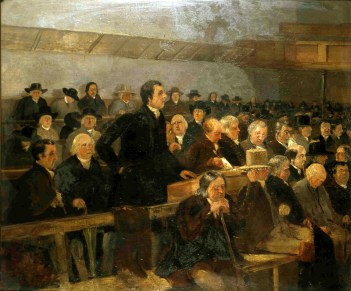
Samuel Lucas (1805-1870) London Yearly Meeting (ca. 1840). (Lib. Ref. PIC/F035)

Samuel Lucas (1805-1870) London Yearly Meeting (ca. 1840). Oil on canvas. (Lib. Ref. PIC/F035)

For every acute observation such as this, there are quieter passages in diaries and memoirs, recording the spiritual experience of attending a large national gathering. Susanna Boone (1731–1789), in her unpublished Memoirs of the life… written by herself, states, for 14 May 1775:

The first day of the yearly meeting which was larger than the year before & the Lord was pleased to qualify his servants to hand forth good advice and counsel, O saith my soul that it was but more minded! I there met with some good friends of my acquaintance … it is exceedingly comfortable to be near to them that are good, O that I and very many more may come to be of that happy number… (MS BOX E 3/7, p. 100: this passage may refer to attendance at the Circular Yearly Meeting for the Western counties).

The experience was not always so uplifting, however:

After dinner we attended our Women’s Meeting at four o’clock which lasted until nearly eight o’clock; it was to me very long and tedious; indeed it may be and I doubt not is in great part my own weakness, but to hold fast my faith I found in this Yearly Meeting no instrument ought to be looked to. (MS VOL S 260, part 1, oversize pages, Elizabeth Fry diary entry for May 29 1801)

Some personal accounts ponder matters raised at Yearly Meeting. Margaret Woods (1748–1821) considers the effects on Friends of their social relations with the “world’s people” in her diary entry for 28 May 1812:

We had some remarks, this Yearly Meeting, on the danger of associating much with those not of our Society, not from attributing particular holiness to ourselves, but as it leads to an assimilation with the customs, manners and spirit of the world, which the principles of our Society testify against. Observation must convince us, that it rarely happens that those of our Society who mingle much with others, retain that simplicity of dress and behaviour… (MS BOX O3/7, pp. 176ff, later published in Extracts from the journal &c of the late Margaret Woods, 1829, p. 386)

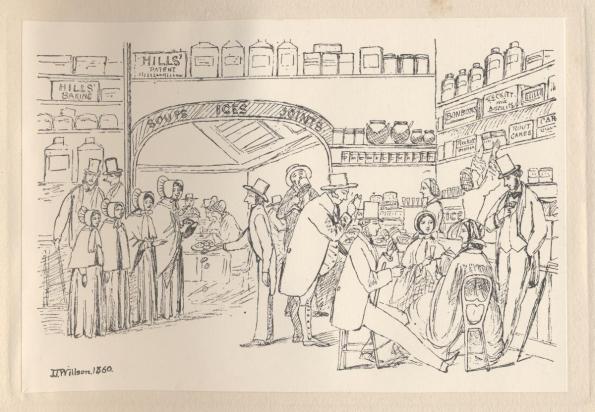
Friends at Hills the Confectioners

Friends visiting Hills the Confectioners while up in London for Yearly Meeting. From J. J. Willson, Yearly Meeting 1860 (London: Headley Brothers, 1906)

Other references to Yearly Meeting business are simply passing diary entries, brief, scribbled notes that confirm what we might have expected. Bevan Lean (1865–1947), lifelong teacher and for many years headmaster of Sidcot School, attended Yearly Meeting in 1902, noting: “Discussion on Education Bill … I lead the opposition to the report of the Meeting of Sufferings [sic]”. In fact a report was sent by the Yearly Meeting to the government, but many Friends, like other nonconformists, did oppose the 1902 Education Act before and after it was passed (Bevan Lean, Diaries, MS VOL S 374, 27 May 1902. See also Meeting for Sufferings minutes YM/MfS/M53, and Yearly Meeting, 1907, minute 50).

The Library holds so many other journals and private documents on past Yearly Meetings it would be impossible to summarise or list all of them here. Many prominent 18th and 19th century Friends would be on that list though, as you will see from the list at the end of this post.

So if you’re one of the Quakers attending Yearly Meeting in 2012, what sort of record will you leave behind you? Will it be a spiritual diary, email, letter or blogpost? Perhaps your experiences too will be the subject of historical study in years to come.

Select list of manuscript accounts of Yearly Meeting held by the Library

Joseph Bevan Braithwaite (1818–1905), once called the “Bishop of English Quakerism” (though probably not in his hearing). Private memorandum books,1865-1905. MS VOL 293-296

Richard Cockin (1753–1845). Notes on Yearly Meetings 1789–1833. MS BOX Q1/4 and MS BOX Y1. Part published as Pen Pictures of Yearly Meeting, ed. Norman Penney (Journal of the Friends Historical Society supplements 16–17),1929–1930

Henry Ferris (1883–1950), for some time “the Society’s unofficial statistician”. Notes and statistics of attendance at London Yearly Meeting, 1907–1912, 1920–1950. MS VOL S 473. Attendance statistics were kept officially from about 1940, now preserved in the Recording Clerk’s archives.

Josiah Forster (1782–1870). Memoranda of London Yearly Meeting proceedings 1828-1870 with some exceptions. MS VOL S 26

Elihu Robinson (1734–1809), meteorologist. Account of his stay in London for the Yearly Meetings of 1762 and 1765. MS BOX R3/1

Elizabeth Robson (1771–1843). Journal 1830–1831, describing the Yearly Meeting of 1831. MS VOL S 138

John S. Rowntree (1834–1907). Diaries of Yearly Meetings 1854–1871 various. MS VOL S 366-370

Joseph Rowntree (1836–1925). Notes on Yearly Meeting 1855, 1857-1858. MS VOL S 126-128

Thomas Story (c1662–1742).  Speech to Yearly Meeting 1716. MS VOL 340/528 (Gibson MSS)

John Woolman (1720–1772). Sea diary for 1772 – his journey to England on the way to attend London Yearly Meeting. MS VOL 150/27


Posted in Highlights | Tagged , , , | 1 Comment

News: Yearly Meeting 2012

In a week’s time, the annual assembly of Quakers in Britain will take place in Friends House (Friday 25 to Monday 28 May). The place will be buzzing, thronged with Friends from all over the country and abroad. It will be a packed programme of business, and there’s plenty taking place in the intervals too, including a group fair and the Salter and Swarthmore lectures.

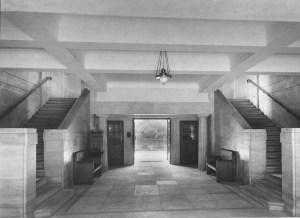
Friends House garden entrance. Hubert Lidbetter photograph album 1925-1927 (Ref. 93/AL/12)

The Library will be closed the week before, but open to Friends attending the Yearly Meeting over those four days. As usual, we’ll be open between sessions. If you’re attending Yearly Meeting come into the Library for some quiet reading, to ask questions, or just to have a look around – you’ll be most welcome! We’ll also be taking the wraps off our new Library exhibition, a display of artefacts and documents about relief work during World War I. More about this in a future post.

To help Friends attending Yearly Meeting prepare for the two major themes this year, some preparatory learning resources were suggested in Documents in advance for sessions two and five. These  resource lists are below. If you want to refresh your memory, or if you just haven’t had a chance to read them all yet, you’ll find copies of all the books and pamphlets available in the Library reading room during Yearly Meeting.

Resource list for session 2 Economic justice and sustainability

  • Living Witness, Quaker Peace & Social Witness Sustainability & Peace Programme. Sustainability toolkit. London: Quaker Life, 2011
  •  Minute 36 of Britain Yearly Meeting 2011.
  •  Jonathan Dale. Beyond the spirit of the age (Swarthmore Lecture 1996). London: Quaker Home Service, 1996
  • Cave, Elizabeth and Ros Morley (eds). Faith in Action: Quaker Social Testimony. Reprinted 2007. London: Quaker Books, 2007
  • Pam Lunn. Costing not less than everything: Sustainability and spirituality in challenging times (Swarthmore Lecture 2011). London: Quaker Books, 2011
  • Wilkinson, Richard and Kate Pickett: The spirit level. Allen Lane, 2010.

Resource list for session 5 What it means to be a Quaker today

  • Quaker identity and the heart of our faith. Study material based on a Quaker Life conference in 2008. London: Quaker Life, 2008. Also available online at http://www.quaker.org.uk/files/Faith-and-practice-proceeding.pdf
  • Committee on Eldership and Oversight. Moving into membership. Revised 2011. London: Quaker Books, 2011
  • Ashworth, Timothy and Alex Wildwood. Rooted in Christianity, open to new light: Quaker spiritual diversity. London: Pronoun Press, 2009
  • Boulton, David. Real like the daisies or real like I love you? Essays in radical Quakerism. Dent: Dales Historical Monographs, 2002
  • Dandelion, Ben Pink. Celebrating the Quaker way. 2nd ed. London: Quaker Books, 2010
  • Durham, Geoffrey. Being a Quaker: a guide for newcomers. London: Quaker Quest, 2011
  • Halliday, Robert. Mind the oneness: the foundation of good Quaker business method (George Gorman Memorial Lecture 1989). London: Quaker Books, 2010
  • Quaker Quest. Twelve Quakers and… series. London: Quaker Quest, 2004–2007. Also published in New light: 12 Quaker voices, ed. Jennifer Kavanagh (2008)
  • Kavanagh, Jennifer (ed). New light: 12 Quaker voices. Winchester: O Books, 2008
  • Winning essays in Friends quarterly May 2010, also available online at http://www.thefriend.co.uk/fq/
  • Best, Simon. “Sustainable, radical Quakerism: a faith for the twenty-first century” (George Gorman Memorial Lecture 2011) in Friends quarterly (January 2012)

Closed week

We’ll be closed to everyone next week (21–25 May), open for those attending Yearly Meeting, and re-opening for all our readers on Tuesday 29 May. Full details are on our website.

Posted in News | Tagged , | Leave a comment

Welcome to Quaker Strongrooms, a blog from the Library of the Society of Friends.

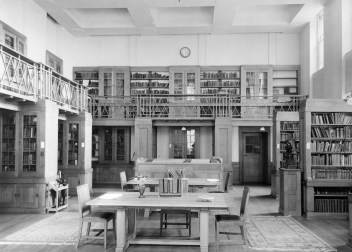
Library reading room, 1925-1927 (Lib. Ref. 93/AL/12)

Photograph by Hubert Lidbetter, Architect, of the Library reading room at Friends House, 1925-1927
(Lib. Ref. 93/AL/12)

Follow our new blog for insights into the Library’s wide-ranging collections of print, archive and visual materials relating to Quakers and Quaker activities from the 17th century to the present day, and for news about our work, exhibitions and events. We aim to entertain and inform in equal measure.

You’ll be able to read here about some of the Library’s treasures, and also about some of the less well known but fascinating items in our collections. There will be updates on interesting new arrivals in the Library and a chance to see many more images from our rich visual resources. We will blog about reading room exhibitions and Quaker history events, to give those of you who can’t make it to Friends House a taste of what’s going on. And we plan to bring you posts on what happens behind the scenes, tips for research, and reader experiences of the Library and its services.

Why Quaker Strongrooms? We chose the title as a nod to Caroline Stephen’s classic introduction to Quakerism, Quaker strongholds (1890).  Most of the Library’s holdings are stored in strongrooms purpose made for them when Friends House was built to Hubert Lidbetter’s design in 1927. Library users see the reading room with its open access books, and any items ordered up, but not the full extent of what lies below. Just as Caroline Stephen aimed to make the “Quaker strongholds, those principles which cannot fail” more widely known, we hope to shine a light into our collections for readers of this blog.
Publishing a blog is an exciting new way for us to communicate with our users and supporters. We aim to build on and develop the kind of content you enjoyed in the former Library newsletter, by making the most of the blog format – more up-to-date news, images, and scope for your feedback.

You can subscribe to Quaker Strongrooms by clicking on “Follow us” to receive regular updates, and previous posts will stay here for you to read later. Feel free to make comments on posts – we want to hear your views on the blog.

Posted in News | 10 Comments