
This blog post has been written by Samuel Barber, a PhD candidate, who completed a two-month research project in 2025 into the links between Radcliffe Monthly Meeting and the transatlantic slave trade up to 1700. This was undertaken as part of the University of Manchester’s PGR Placement scheme for 2025.
For at least four hundred years, the history of East London has been characterised by immigration, emigration and diversity. The history of the Quakers in East London is no exception to this. Shortly after Quakerism spread into the area from northern England, newly ‘convinced’ (converted) local Quakers began to emigrate, often to the New World. Meanwhile, immigrants continued to arrive, a small number of whom became involved in the Religious Society of Friends. As Justin Meggitt has recently discovered, this included Bartholemew Cole, who was labelled a ‘Turk’, which suggests that he was of North African or Asian heritage.[1] However, being a Quaker in the late seventeenth century was not easy. Until 1689, Quakers experienced severe persecution by local authorities, who sought to disperse their ‘illegal’ meetings. Radcliffe (alternatively spelled Radcliff or Ratcliff) Quaker meeting was attended by Bartholemew Cole in East London. It was harassed with fines, arrests and violent harassment for over twenty years.
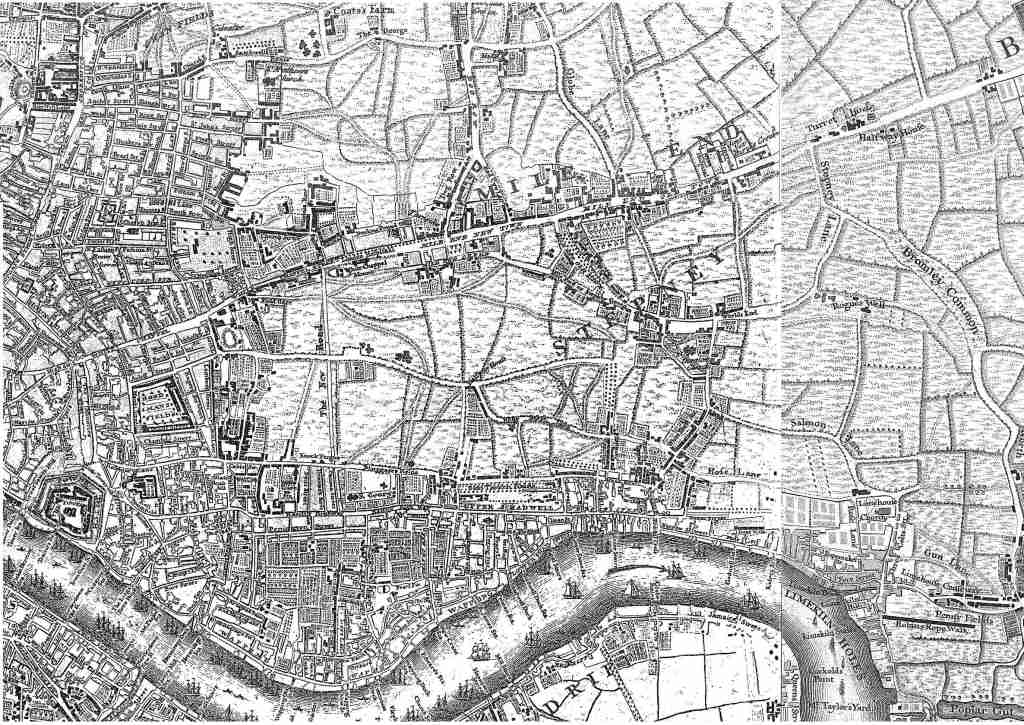
John Rocque’s An Exact Survey of the city’s of London Westminster ye Borough of Southwark and the Country near ten miles round / begun in 1741 & ended in 1745 by John Rocque Land Surveyor; & Engrav’d by Richard Parr
Traditional narratives about the early Quakers, particularly those written by the Quakers themselves, view the plight of early Friends in a sympathetic manner. However, recent studies have shown that early Quakers were noticeably involved in the transatlantic slave trade until the mid-eighteenth century. This included many Friends in London, including East London, which was then technically outside the City proper. Evidence pertaining to Radcliffe Monthly Meeting, housed at the Library of the Society of Friends, reveals that Friends were benefitting from the expanding slave economy in the Caribbean. A variety of Quaker businesses, meetings and philanthropic schemes were implicated in this regard. The records show that money from various Caribbean islands was left, most often in wills, by Quaker emigrants for ‘poor Friends’ back in East London. For example, Richard Jarnall, a merchant who travelled between London, Madeira, Nevis and Barbados, bequeathed a portion of his wealth to poor Friends of Radcliffe in the 1680s.
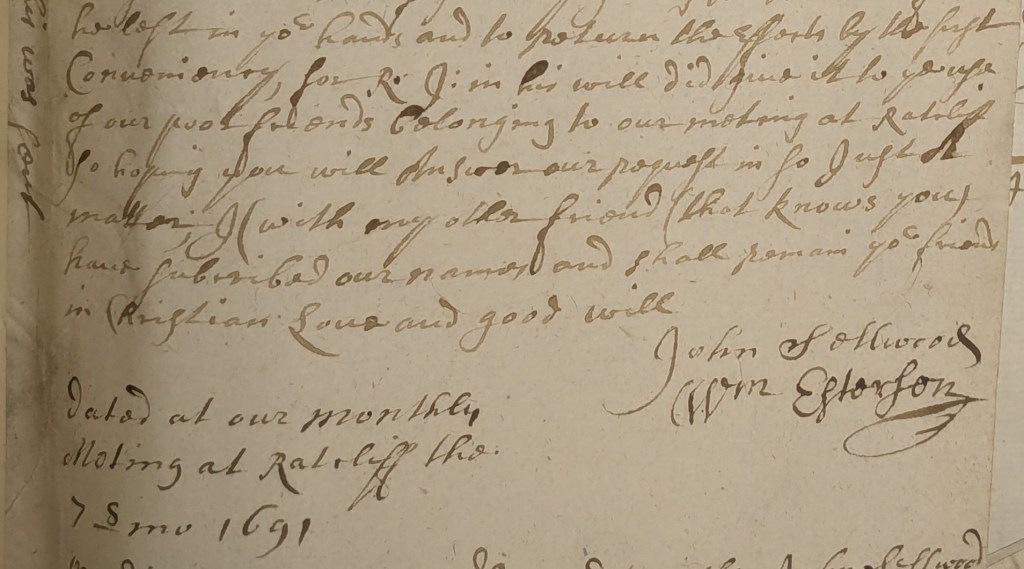
Records of Ratcliff & Barking Monthly Meeting, MGR 11b6, Miscellaneous MSS, vol. 1
Transcription: ‘ …the best in your hands and to return the Effects by the first Conveniency, for R J in his will did give it to the use of our poor Friends belonging to our meeting at Radcliff so hoping you will Answer our request in so just A matter I (with my other friend (that knows you) have subscribed our names and shall remain your friends in Christian Love and good will’.
In other cases, Friends in East London would purchase raw materials, such as sugar and tobacco, from contacts in the Caribbean. They would then utilise them in their own businesses, the profits from which would be given to poor Friends. The Mayleigh family, for example, were involved in such a process. The family ran an apothecary business in Wapping that depended on imports from large plantations in the Caribbean, which exploited hundreds of enslaved African people.[2] One of the family’s most prominent suppliers was Jonas Langford, a slave owner who had travelled to Antigua from East London in the 1650s.[3] Thomas Mayleigh Sr., the original owner of the Wapping business, donated regularly to support poor Friends and also provided money for the construction of a Quaker meeting house in Wapping. This means that even Quakers living in abject poverty benefitted, albeit unknowingly, from the profits of the slave economy.
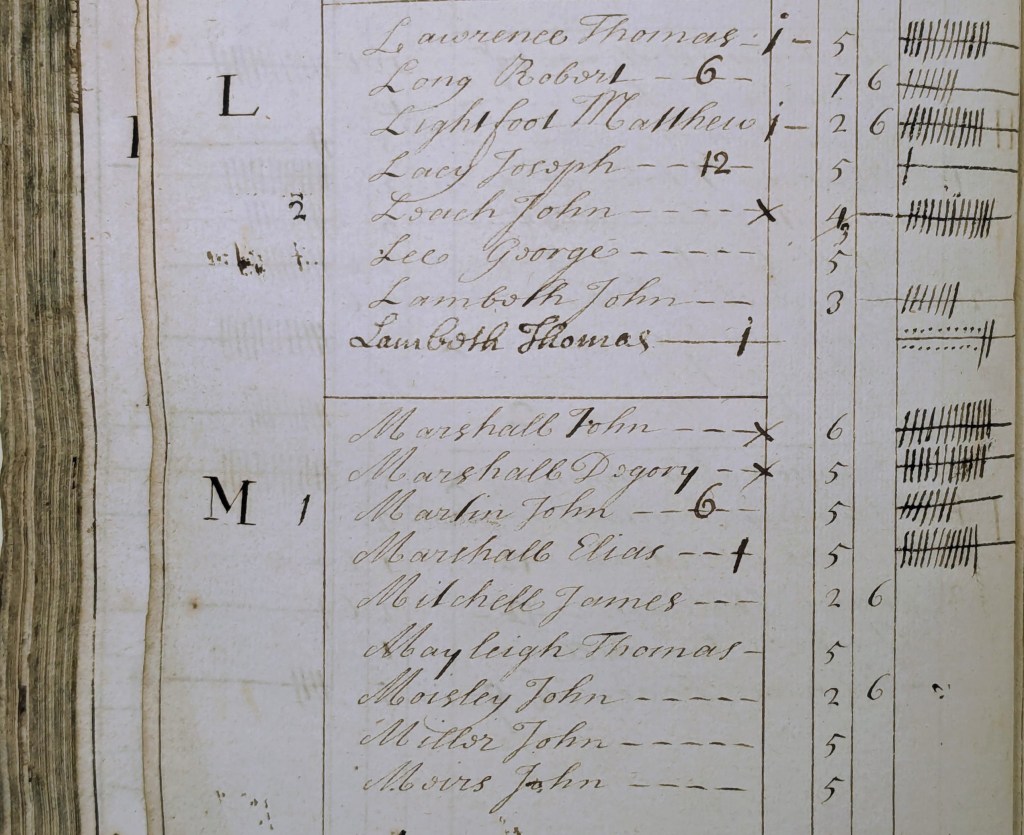
Records of Ratcliff & Barking Monthly Meeting, MGR 11b6, Collecting Books vol. 1
Slavery in British colonies during this time was characterised by an increasingly repressive, racialised system of exploitation. This was deemed necessary for the continuation of sugar cultivation, which involved particularly arduous manual labour.[4] This meant that living and working conditions for enslaved African people became significantly worse. At the same time, it is important to remember that simple narratives of victimisation can become misleading. To depict enslaved African people as passive victims in their own oppression, whose lives only consisted of suffering and submission, is problematic. Indeed, there were increasing concerns among white colonists about potential slave revolts by 1700. These concerns were fuelled in part by the persistent struggle of enslaved people to liberate themselves, either as individuals or en masse. The existence of ‘fugitive’ communities, particularly in Jamaica, undermined the entire political and economic project of the colonial authorities. In Antigua, the colonial assembly voiced concerns about Africans who had escaped and ‘lurked in the woods’. This had been a problem for Jonas Langford, who had to deal with five escape attempts in his Antiguan plantations.[5]
As is well-known, Quakers in Britain became committed to reparations for the transatlantic slave trade in 2022. It is hoped that difficult histories like this will inform and complicate the discussions around reparations, for which careful discernment is required.
Further reading
Dixon, Simon, ‘Quaker Communities in London, 1667-c1714’ (PhD thesis: Royal Holloway, University of London, 2005).
Durham, Harriet Frorer, Caribbean Quakers (Hollywood, Florida: Dukane Press, 1972).
Freedman, Katherine, ‘A Tangled Web: Quakers and the Atlantic Slave System, 1625-1770’ (PhD thesis: University of Massachusetts Amherst, 2018).
Gragg, Larry, Quaker Community on Barbados: Challenging the Culture of the Planter Class, (Columbia: University of Missouri Press, 2009).
Landes, Jordan, London Quakers in the Trans-Atlantic World: The Creation of an Early Modern Community, (London: Palgrave Macmillan, 2015).
Morris, Derek B. and Ken Cozens, London’s Sailortown, 1600-1800: a social history of Shadwell and Ratcliff, an early modern London riverside suburb (London: East London History Society, 2014).
Roads, Judith, Minute Book of the Monthly and Quarterly Meetings of Ratcliff Quakers, 1681-1701, (Cambridge: Mutual Academic, 2025).
[1] Justin Meggitt, ‘A Turke Turn’d Quaker: Conversion from Islam to Radical Dissent in Early Modern England’ The Seventeenth century 34 (2019), pp. 353–380.
[2] Nicholas L. Wood, ‘Private lives, Quaker connections and overseas trading: The family journal and account book of Thomas Mayleigh (1671-1732)’ Pharmaceutical Historian 51 (2021), pp. 106-117.
[3] Katherine Freedman, ‘A Tangled Web: Quakers and the Atlantic Slave System, 1625-1770’ (PhD thesis: University of Massachusetts Amherst, 2018).
[4] Jeremy Black, The Atlantic Slave Trade in World History, (New York: Routledge, 2024), particularly pp. 44-57.
[5] Katherine Freedman, ‘A Tangled Web’, pp. 103-104.

