Readers’ stories: 18th century London – a foreign country

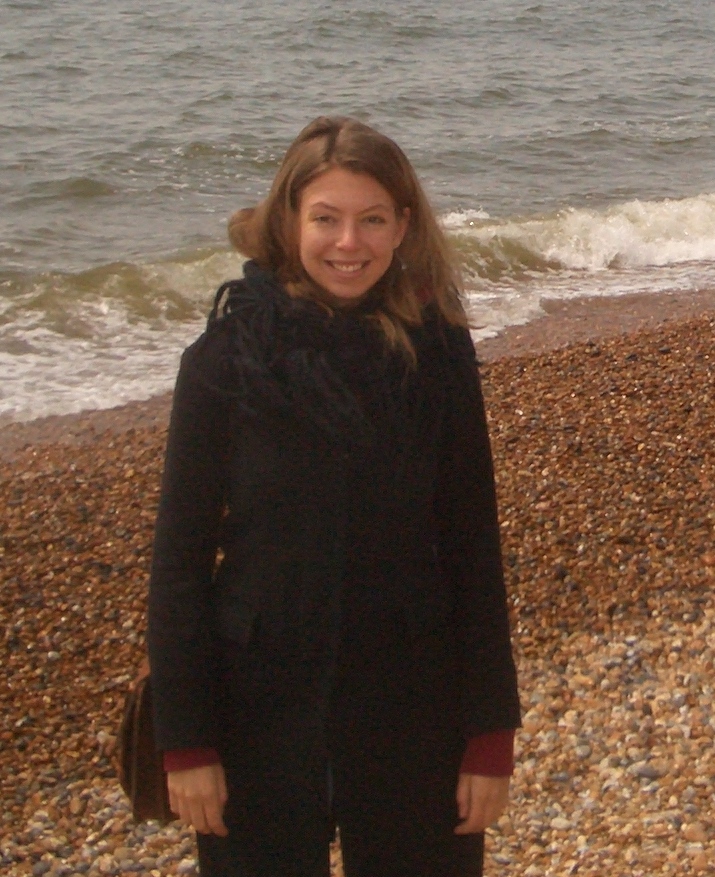
Esther SahleThe third in our series of readers’ stories comes from Esther Sahle who is currently researching early modern Quaker merchants for a PhD at London School of Economics.

I have been asked to write about my experience of using the Library of the Society of Friends. I could give a very short answer to this…it’s great. It’s everything you could wish for as a researcher, a friendly, peaceful place. I’m working towards a PhD about early modern Quaker merchants, and in the three years that I’ve been doing research, I have received more support here than at any other institution. I’ve been visiting the Library regularly and it’s always been a very pleasant experience.

I knew very little about Quakers when I started. Visiting the Library changed this very quickly. It appears to contain copies of everything ever written by and about Quakers, from the 17th century until today. And it’s so easily accessible. There are friendly and expert staff who appear to know everything about Quaker history. It’s great to be able to ask a librarian about literature on a certain subject and, from off the top of their head, be directed to relevant resources. The cherry on top is that when you need a break from reading, the café at Friends House does excellent cappuccinos.

The Library is a place that provides knowledge and wisdom on everything to do with Quaker history. However, it does much more than that. Quakers formed an important part of society in early modern London. Even though small in numbers, the community played an important part in the social and economic development of the city. The manuscripts held by the Library on the lives and businesses of London Quakers allow the reader to view early modern London through the prism of Quaker experience. I traced the lives and activities of merchants from the late 17th to 18th centuries. From the minutes of Quaker meetings, I followed how young Friends moved from other parts of the UK to London, in order to take up apprenticeships with city merchants; how they later got married to women whose families resided in Pennsylvania or Barbados; how they took their young children on daytrips to the countryside; how their careers developed; and how they appeared as officers in their meetings, and after them their places were taken over by their sons and grandsons.

I saw how communities dealt with fraud and theft. An enlightening case is that of George Roberts of Ratcliff Monthly Meeting, who in 1729 lured several respectable citizens into investing in his laboratory in Southwark, where he planned to turn base metals into gold. The investors lost their money and Roberts was disowned for falsely pretending to have skills in alchemy. No comment was made on the fact that alchemy in general might not work.
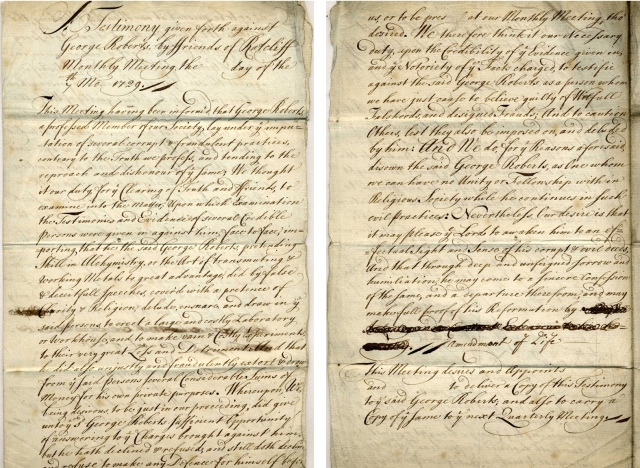
Testimony of George Roberts
Testimony of George Roberts by Ratcliff Monthly Meeting, 7mo 1729 (11 b 6 copies of some disownments)
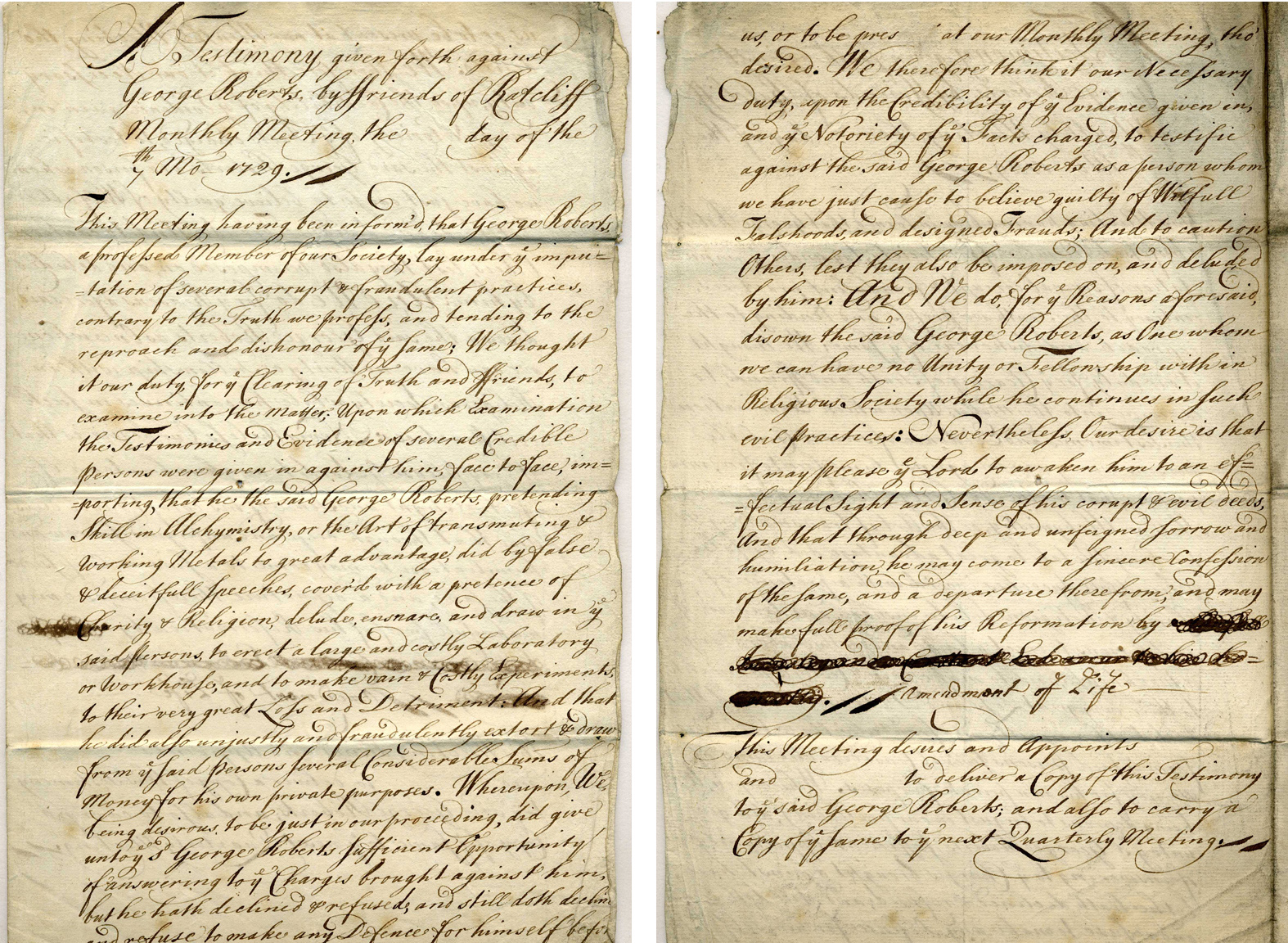
During my research, I found that I recognized addresses, places and family names, and found that their concerns were similar to ours today. They worried about their families, current affairs, and the challenges of an increasingly materialistic society. They were sometimes bored at work, as indicated by the doodles on the margins of the 17th century manuscripts. But they also lived in a world in which alchemy was a possibility. This reveals their London, however familiar, simultaneously to be like a foreign country, with a distinct culture, which is hard for us to understand. The manuscripts held at the Library provide us with the opportunity to get as close to this place as possible. The handwriting we read in 2013 consists of ink applied to paper by individuals, 300 years ago. It puts us in touch with them, with the London of 1700. We see the differences, but also the astonishing amount of similarities, between their lives, and ours. Between the London of then, and of today. And thereby, the Library becomes not just a source of academic knowledge, but an immediate access point to our own past and the roots of our own culture and identity.
Posted in Readers' stories | Tagged , | 2 Comments

A life of Quaker service in England and Germany from World War I to II: cataloguing the papers of Dorothy Henkel (1886-1983)

We’re pleased to present a guest blog post from Hannah Ratford, who recently spent two weeks at the Library as part of her archives and records management training.

As part of the M.A. course in Archives and Records Management at University College London, students are required to undertake a two-week cataloguing placement. Having requested that I complete my placement at a religious archive, I was fortunate to have been placed with the Library of the Society of Friends. Upon arrival I was provided with a collection consisting of five boxes and was set the task of arranging, appraising and cataloguing the material inside. I soon discovered that I had been handed an interesting collection consisting of the personal papers of Dorothy Henkel, a member of the Society of Friends.

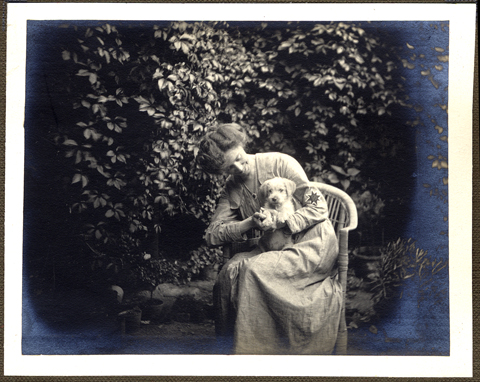
Photograph of Dorothy Henkel (TEMP MSS 1003/1/1/8)

Photograph of Dorothy Henkel with the family dog, no date (TEMP MSS 1003/1/1/8)

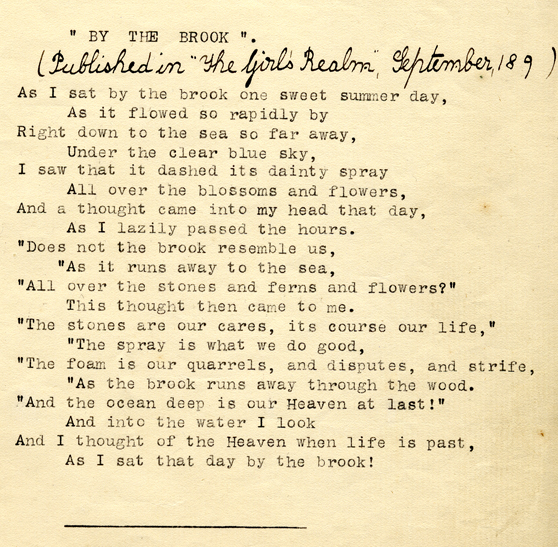
Dorothy Henkel, daughter of the professional German musician, Karl Henkel, and English mother, Rose Henkel, was born on the 24th March 1886. Dorothy was raised in London and became fluent in English, French and German languages. The collection contains items relating to Dorothy’s younger years and family life, including notebooks, diaries, poems and letters regarding her parents’ silver anniversary in 1910, which indicate a sense of reminiscence by Dorothy of her youth.

Poem by Dorothy Henkel (TEMP MSS 1003/1/4/1)

Poem by Dorothy Henkel, “By the Brook”, 1897 (TEMP MSS 1003/1/4/1)

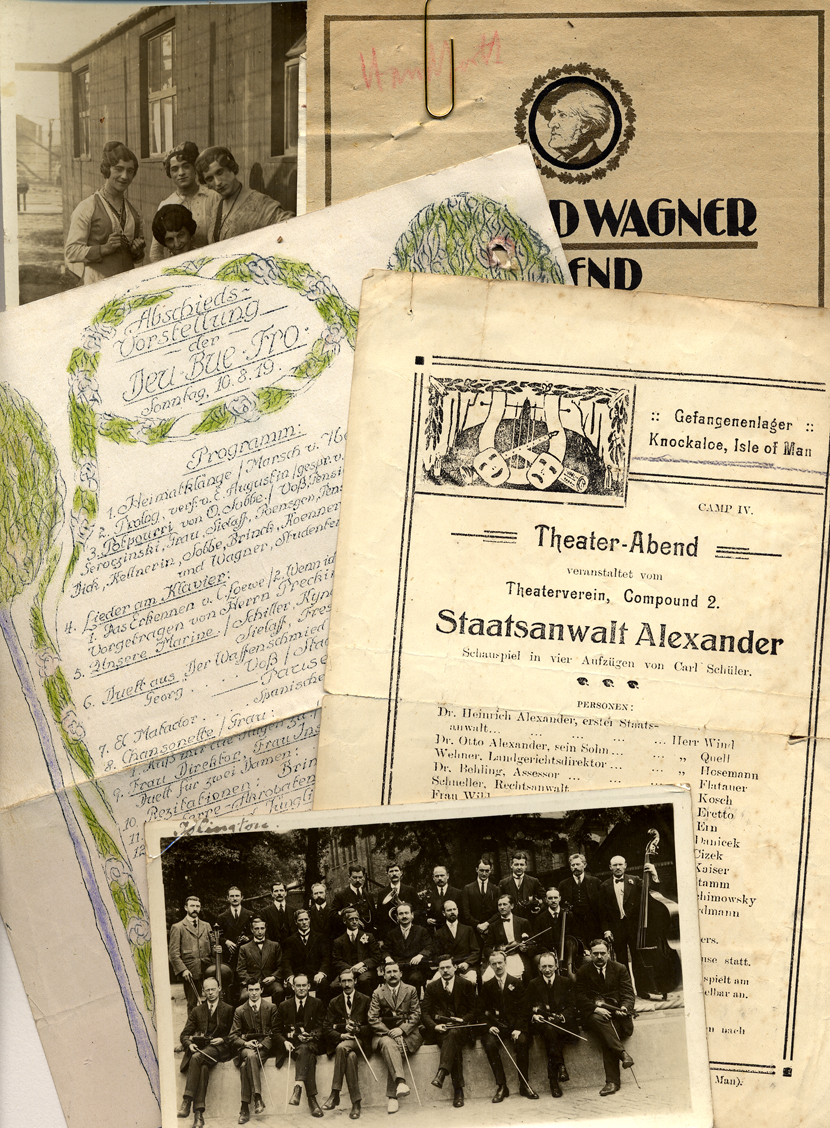
The collection also includes concert programmes and correspondence relating to World War I Prisoners of War held in Knockaloe Camp on the Isle of Man. They relate to the relief work carried out by Dorothy’s father, who provided prisoners with sheet music. Perhaps inspired by her father’s work, and following the devastation of the War and the loss of her fiancé in the subsequent flu epidemic, Dorothy attended a meeting held in Albert Hall with her parents in 1920 to consider the relief of famine in Germany. Upon enquiring as to how she could help, Dorothy was advised to go to the Quakers. Two days after this instruction she had an interview and was informed that assistance was required in Frankfurt am Main. Dorothy leapt at the opportunity presented to her, as whilst in Frankfurt she would be able to stay with her Aunt Sophie.

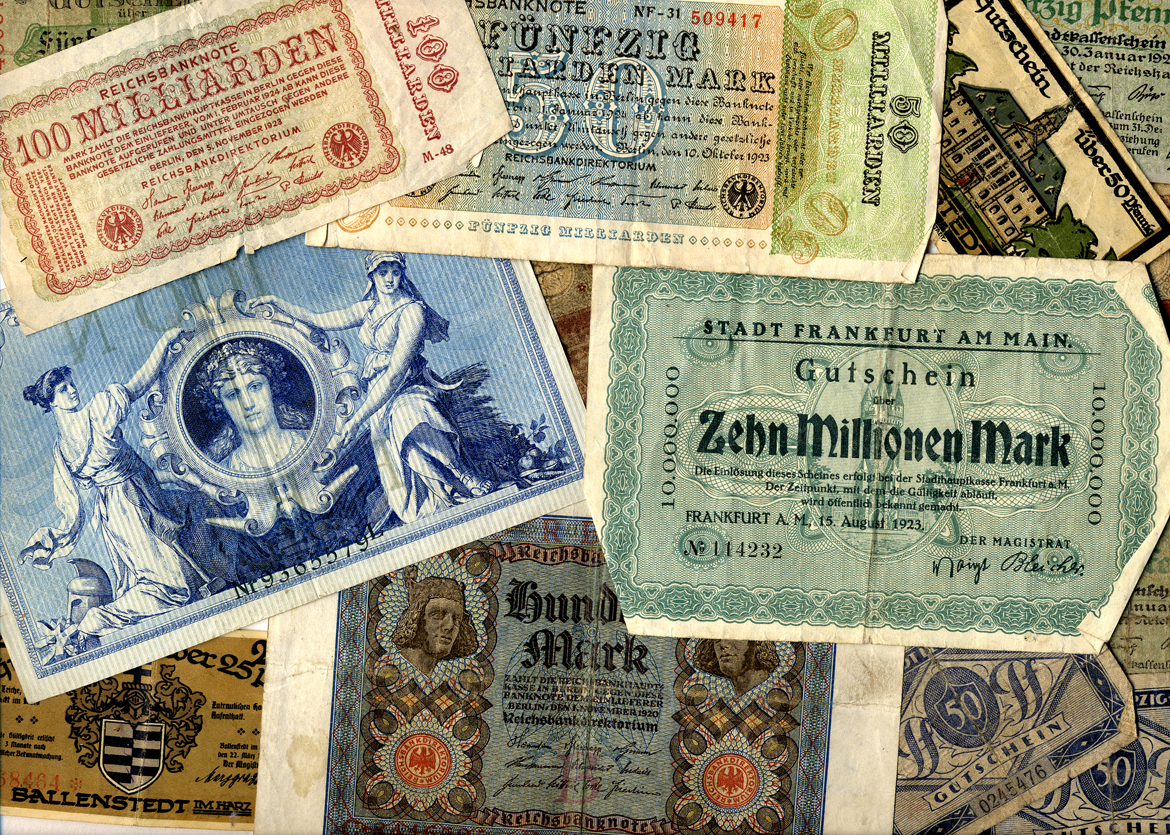
From June 1920, Dorothy worked in Frankfurt through the years of German hyperinflation, assisting in a new relief project known as “the Depot” with Friends’ Emergency and War Victims Relief Committee. This project supplied rationed quantities to a selected group at prices lower than those offered by shops. Her relief work alongside the Quakers eventually led her to apply for membership into the Society of Friends. Papers in the collection include her certificate of membership and letters of congratulation from her contemporaries upon her acceptance into the Society in 1925.

Deutschmarks, 1922-1923 (TEMP MSS 1003/7)

Deutschmarks issued during hyperinflation in Germany, 1922-1923 (TEMP MSS 1003/7)

Following the end of the Depot project, Dorothy continued with her relief work and became involved in a scheme that placed impoverished children with families in Alsace for six weeks hospitality so that they could feel the benefit of better food. During this time, Dorothy began to witness the effects of the Nuremberg Laws on Jewish communities and individuals, and to assist those who were seeking to emigrate to escape persecution. By 1935, Dorothy had returned to London and was involved with Quaker work helping refugees seeking to come to Britain. The collection contains correspondence concerning this work. Around this time, Dorothy was requested by Helen Dixon to assist her in opening a Rest Home, where people who had suffered under the Nazi regime could find rest and refreshment. This home was set up in the Frankfurter Hof in Falkenstein, Taunus, with Dorothy focusing in particular on this work for the use of her memoirs (Dorothy Henkel, Memoirs, Frankfurt am Main, 1983 (092 [Biog.20/4]).

In 1939, Dorothy and her parents returned to Germany to visit family. During this period, World War II broke out, and the family was forced to stay in Germany for the entirety of the war. During this time, both of Dorothy’s parents died within eight weeks of each other. Following the end of the war, Dorothy remained in Germany for a while, eventually travelling back to England in the 1950s. She still travelled regularly to Frankfurt, continuing with her relief work and taking part in a project to support a Neighbourhood Centre in Bockenheim.

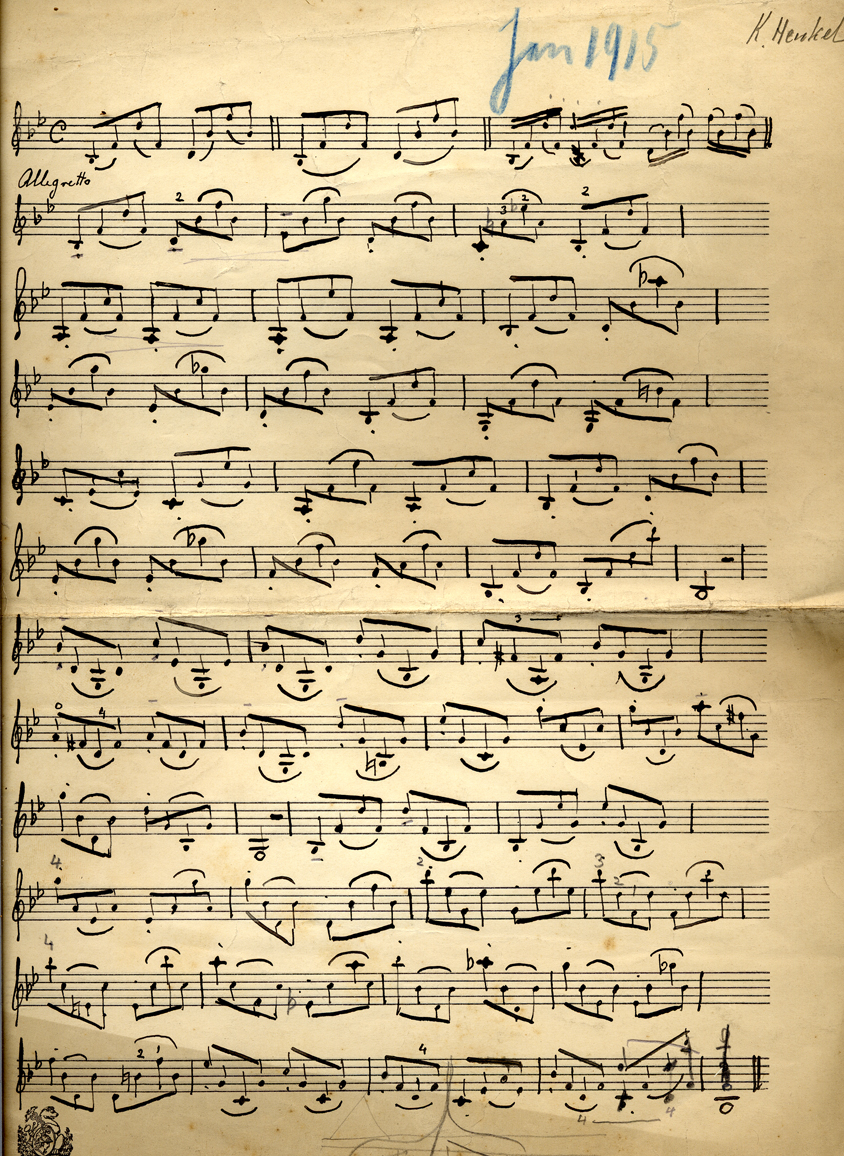
Violin music written by Karl Henkel, 1915 (TEMP MSS 1/3/1)

Violin music written by Karl Henkel, 1915 (TEMP MSS 1/3/1)

Dorothy spent her last years in a nursing home in Frankfurt due to an accident. Here, she completed the task of writing her memoirs, the notes of which are included in the collection, before her death in 1983.

Prisoners of war camp performances, 1915-1919 (TEMP MSS 1003/2/1-2)

Photographs and concert programmes for prisoners of war camp performances, 1915-1919 (TEMP MSS 1003/2/1-2)

The collection (Temp MSS 1003) is an example of how personal papers can provide a good sense of a person and their life. In this instance, I was presented with a woman who survived both World War I and II, the Great Depression and the Nazi regime, and yet suffered great personal loss with the death of members of her family. Despite the death of loved ones, she continued with her relief work, determined to improve the lives of others who were suffering under oppressive regimes. She was heavily involved in her role as an elder in the Society of Friends, and reflects upon the importance of her Quaker work throughout her memoirs. The collection is a fascinating insight into the life of a woman who dedicated her life to others.

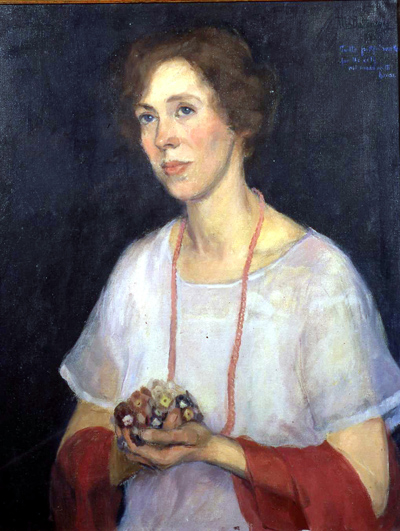
Painting of Dorothy Henkel

Oil painting of Dorothy Henkel by Mathilde Battenburg (1878-1936) (Pic F 041). On display in the Library reading room.

Posted in Guest posts | Tagged , , , , , , | 5 Comments

A glimpse into the strongrooms

Way back in May 2012, commenting on the blog’s very first post, a reader asked “how about a picture of what the strongrooms look like today?” Perhaps rashly, we promised a peek.

One year on, at last we have some snaps for you – a glimpse into the subterranean vaults where the Society of Friends’ archives, manuscripts, rare books and museum objects are stored. They’re not pretty, but they are cool and solid with a stable temperature and humidity. Formerly four separate rooms, they have now been reorganised into three areas, joined by a long corridor, retaining only two of the original barred metal internal doors. The massive original main door is no longer in use, but is too heavy to remove: it remains as a splendid visual reminder of the value the Society of Friends sets on its historic collections. In recent years modern fire-proof security doors have been installed and the lift shaft from the earlier book hoist incorporated into the strongroom area.

We can’t bring you the real-life atmosphere of the strongrooms – cool, silent (though the rumble of a tube train is occasionally detected), with that unmistakable smell of paper and leather. And they are tricky to photograph since there’s not much space for the long shot. Here though is our offering – a gallery of images from underground.

Note: the gallery is best viewed on the website, so if you’re reading this post in an email, or on a phone, click on the title link at the top of the email to go to the full web version. To view an image at full size in a gallery, click on it;  to close the gallery down again and go back to the blogpost, click the x in the top left hand corner.

Posted in Collection care | Tagged , | 3 Comments

Commonplace books: collections of precious gems

Have you ever kept a scrapbook, jotted things of interest in a notebook, or clipped extracts from webpages? Then you have been “commonplacing”. For centuries, writers, philosophers, theologians, scholars, poets, artists and others have gathered together passages from prose, quotations, proverbs, ideas and memoranda into commonplace books, often organised under headings for ready reference.

Why are these commonplace books so called? The idea of loci communes or “common places” where knowledge could be organised, dates back to classical antiquity. It owes a debt to Aristotelian topoi (topics), and to Cicero, who urged lawyers to collect information on general topics and principles to be recalled as needed.
In mediaeval times, students and scholars were encouraged to keep them as aides-memoires, storing information and organising it methodically for use in their studies. By the 17th century, commonplacing had become a recognised practice taught in universities,  a popular study technique persisting until the early 20th century.

The Library has in its collections commonplace books dating from the 17th to the 20th century. They are treasure troves of knowledge, preserving quotations, letters, prayers, anecdotes, verses, maxims and medicinal recipes. As personal selections, they reveal the interests, personalities and concerns of their compilers. They range in size from small notebooks to larger leather bound volumes, and in type (spiritual, theological, genealogical, artistic, literary, medical and more: often a combination of these). Unlike journals or notebooks, they anthologise the works of other authors, occasionally preserving the only copy of an original text. Matching transcriptions to their original source would be a research project in itself.
The commonplace books of John Catchpool (1777-1847), Sarah Robson (1799-1885) and Lucy Violet Holdsworth (1869-1954) are just three examples of the widely differing commonplace books held by the Library.

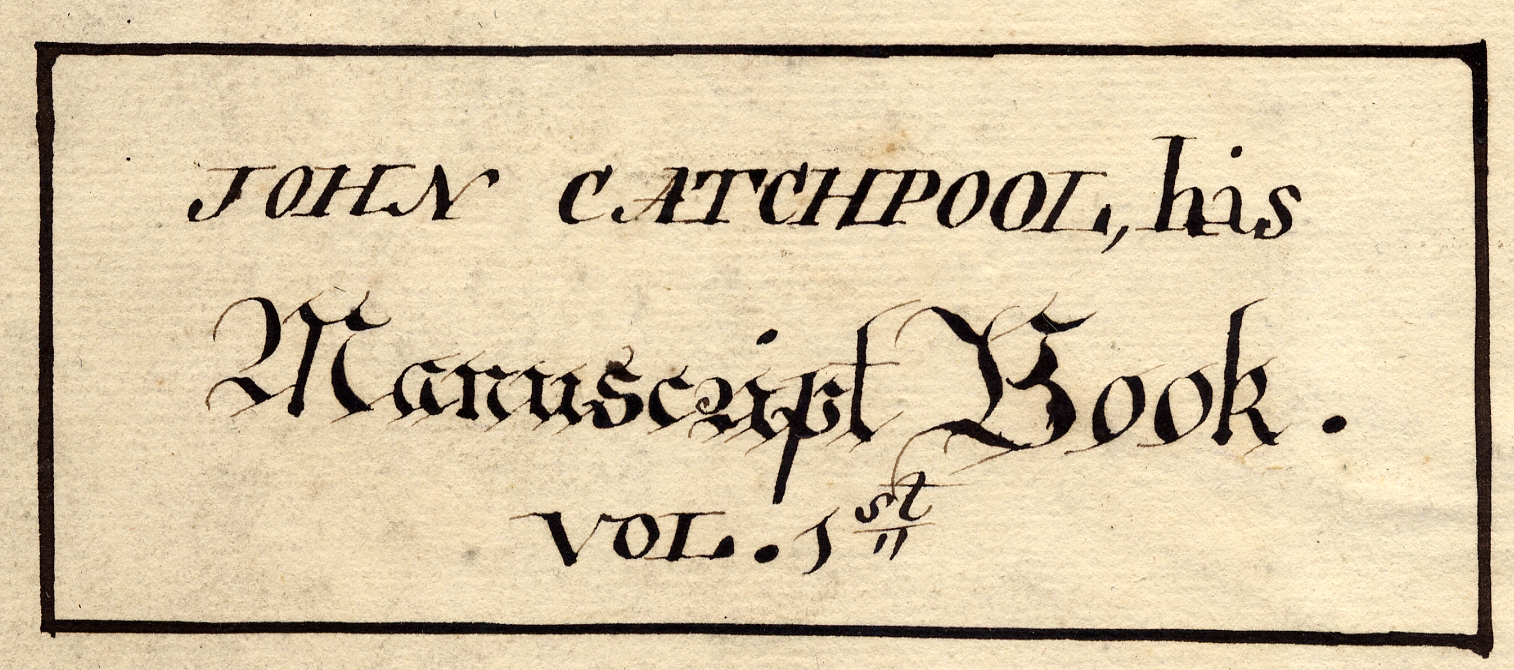
Commonplace books of John Catchpool (MS BOX Y3/1-4)

Title page, John Catchpool’s commonplace book

Title page, John Catchpool’s commonplace book, volume 1, 1777-1797 (MS BOX Y3/1)

The four commonplace books of John Catchpool, Doncaster Quaker, and later baker and corn dealer of Winchmore Hill, London, are primarily theological and include transcriptions of the religious experiences and thoughts of early Friends. Volume one begins with a transcription of The Messiah by Alexander Pope (1688-1744),

“Ye Nymphs of Solyma, begin the Song, To heavenly Themes, sublimer Strains belong. The mossy fountains, and the sylvan Shades, The dreams of Pindus and the Aonian Maids, Delight no more…”

The volumes also contain carefully transcribed poems and visions, “A Poem on the Death of that faithfull and laborious Minister of the Gospel, Benjamin Kidd” and “The Prediction of Christopher Love, Minister at London, who was beheaded on Tower Hill in the Time of Oliver Cromwell, Government of England”; transcriptions of dreams and visions by Friends such as Samuel Fothergill and John Oxley, amongst others; and hymns and songs such as “A hymn composed by Catherine Evans when imprisoned at Malta in the year 1661” and “Religion the highest and happiest End of Man in a petitioning Song to the Divine Being”.

There are also a number of “Reflections” on society. “Reflections occasioned by being at Scarborough Spaw in the Summer of 1768 by Mary Miles” provides a rather vivid picture of Scarborough in the 18th century:

“Being at Scarborough my Mind was affected with various Reflections and Considerations from observing how many both of the Gentry and common people spent their Time in outward amusements, Plays, assemblies, Music and Dress…and divers of the lower Class pursuing Smuggling and other Wickedness, even to the committing two Murders while I was in that place…”

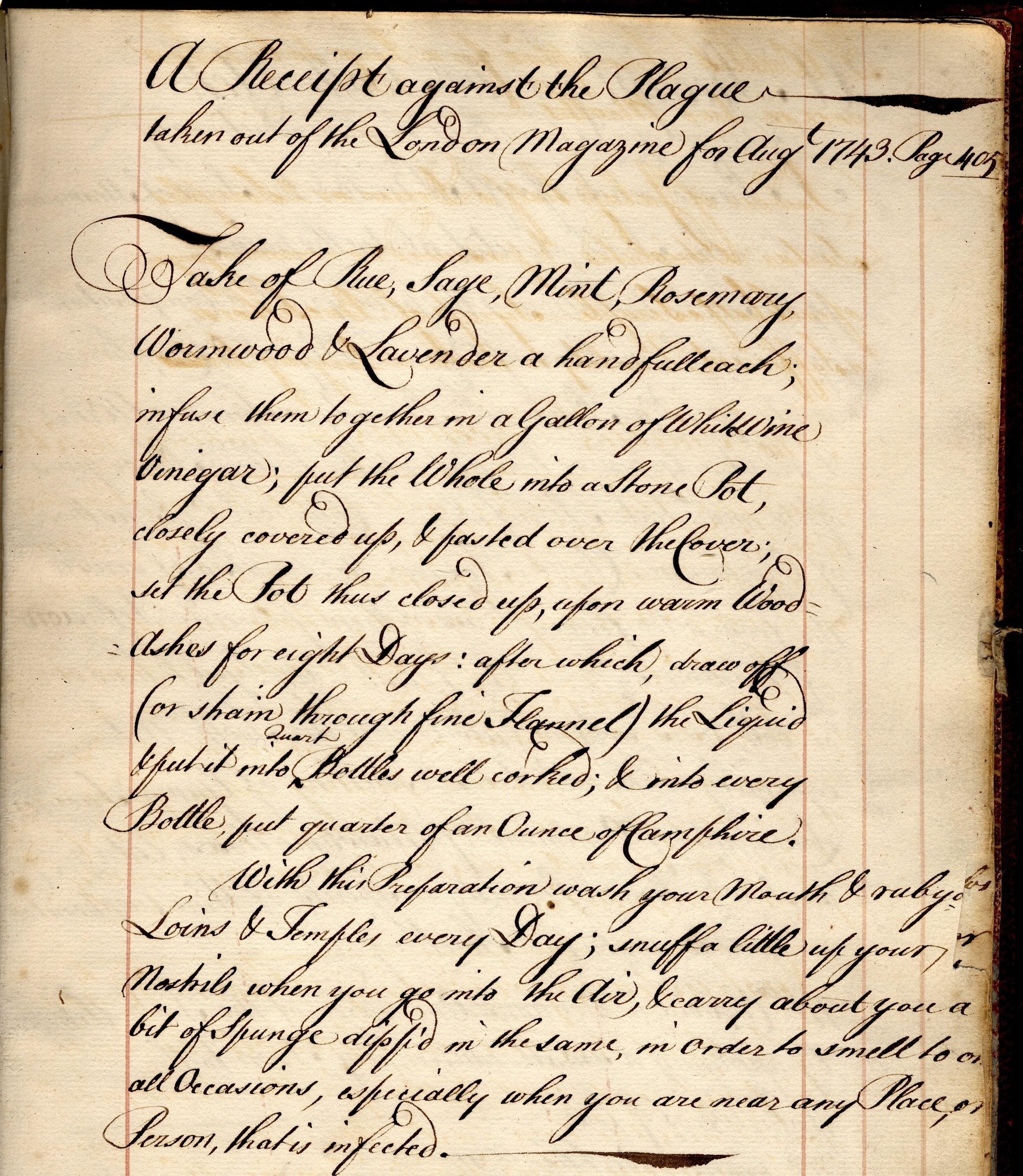
At the back of volume one, there are recipes for lotions and potions to relieve various illnesses, including “A Receipt against the Plague…” and “Receipt for the Tooth ach”.

“A Receipe against the Plague…”, John Catchpool’s commonplace book

“A Receipt against the Plague taken out of the London Magazine for August 1743 Page 405”, John Catchpool’s commonplace book, volume 1, 1777-1797 (MS BOX Y3/1, p. 347)

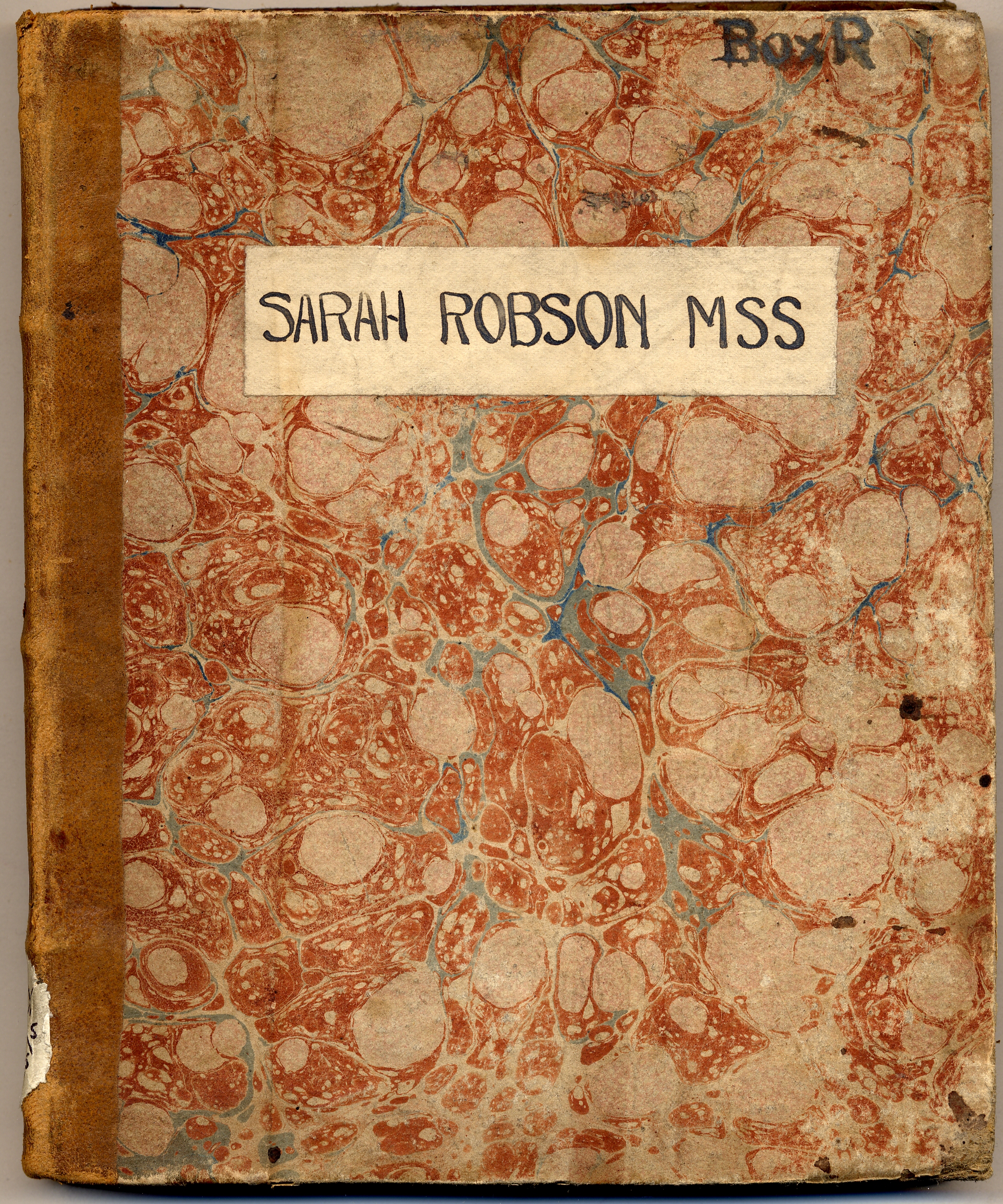
Commonplace book of Sarah Robson, 1815-1885 (MS BOX R5/5)

Cover, Sarah Robson’s commonplace book

Cover, Sarah Robson’s commonplace book, 1815-1885 (MS BOX R5/5)

Sarah Robson was a founder of the Women’s First-Day School, Huddersfield, and the wife of Isaac Robson (1800-1885), a tea dealer of Liverpool. Her commonplace book is beautifully written. In it she records hymns and poems on the subject of death, including “The affusions of a mother’s [Ann Alexander] heart. Composed while sitting by the precious remains of a beloved child who departed this life at school at Broughton, Lincolnshire, the 18th of 9th month 1810 of typhus fever aged 9 years and 3 months”, and  accounts of religious visits to America:

“Lines composed by A. A., whilst on a religious engagement in America to her sister Mabel; written on a small piece of the bark of the birch tree with this direction: To be presented to Mabel Tuke on the day of her union with John Hipsley to bring into view her absent sister A.A. who had this bark taken from the white birch tree when walking on the banks of Kennebeck River, in the Eastern parts of New England 2nd 5th mo. 1804”.

There are interesting accounts of Friends, for example, “An account of some remarkable visions of John Adams of Yorkshire”. At the end of the volume someone else has written a version of the Golden Rule: “To do unto all men, as we would that they, in similar circumstances, should do unto us constitutes the great principle of virtue” and “The deceitfulness of riches or the cares of this life have choked the seeds of virtue in many a promising youth”.

“Rule 1st”, Sarah Robson’s commonplace book

“Rule 1st”, Sarah Robson’s commonplace book, 1815-1885 (MS BOX R5/5, reverse p. 1)

Commonplace book of Lucy Violet Holdsworth,  1916-1925 (TEMP MSS 37/3)

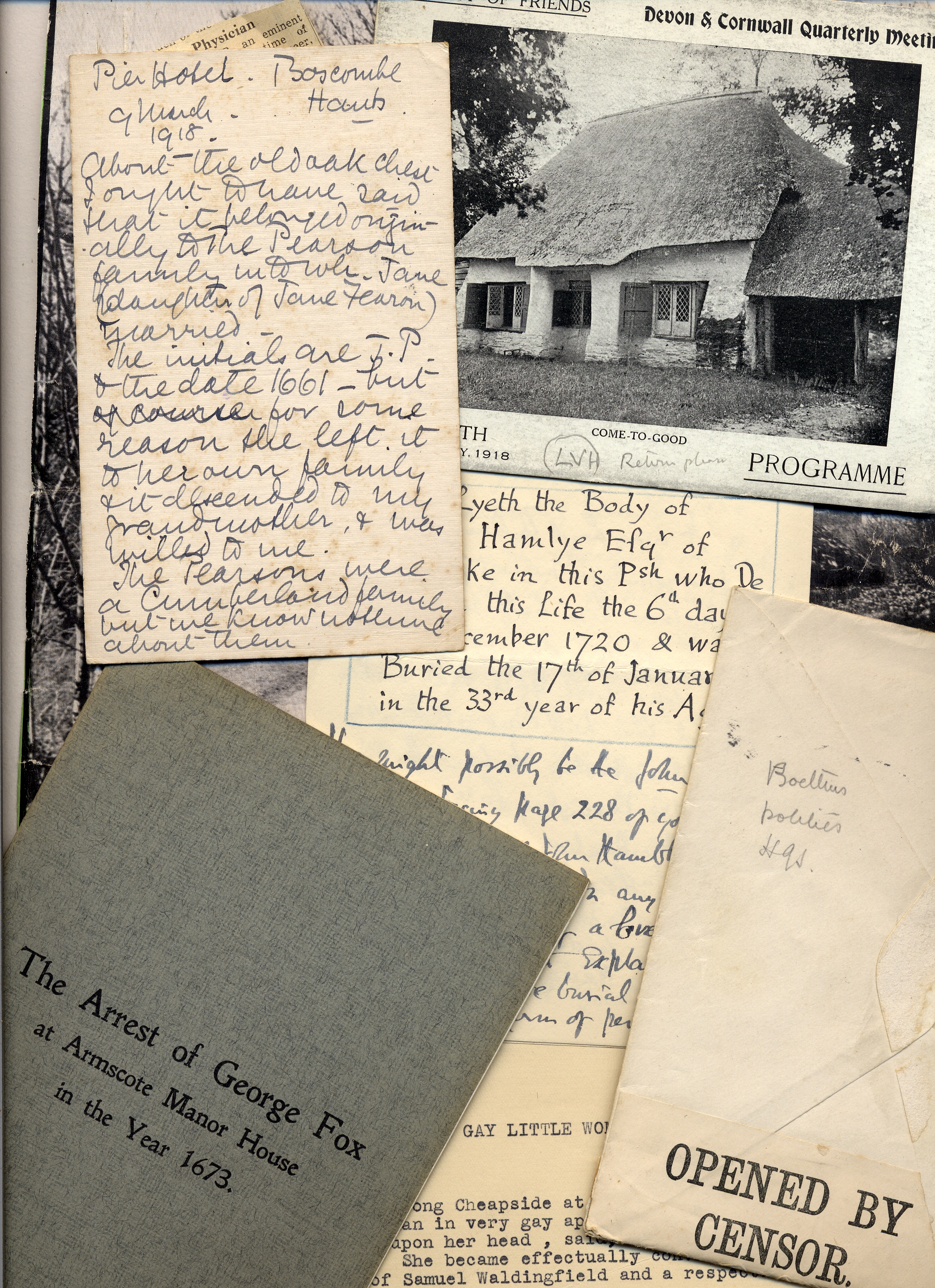
Cuttings and inserts, Lucy Violet Holdsworth’s commonplace book

Cuttings and inserts, Lucy Violet Holdsworth’s commonplace book, 1916-1925 (TEMP MSS 37/3)

Lucy Violet Holdsworth, author and Swarthmore lecturer, inscribed her book:

“I should like this book to be offered to the Friends’ Reference Library, after my death, in case they may care to have it. L. Violet Holdsworth September 1925”

It contains transcriptions of early manuscripts, epistles, testimonies and private letters (many held by the Library), which she had made for The Romance of the inward light (1932).

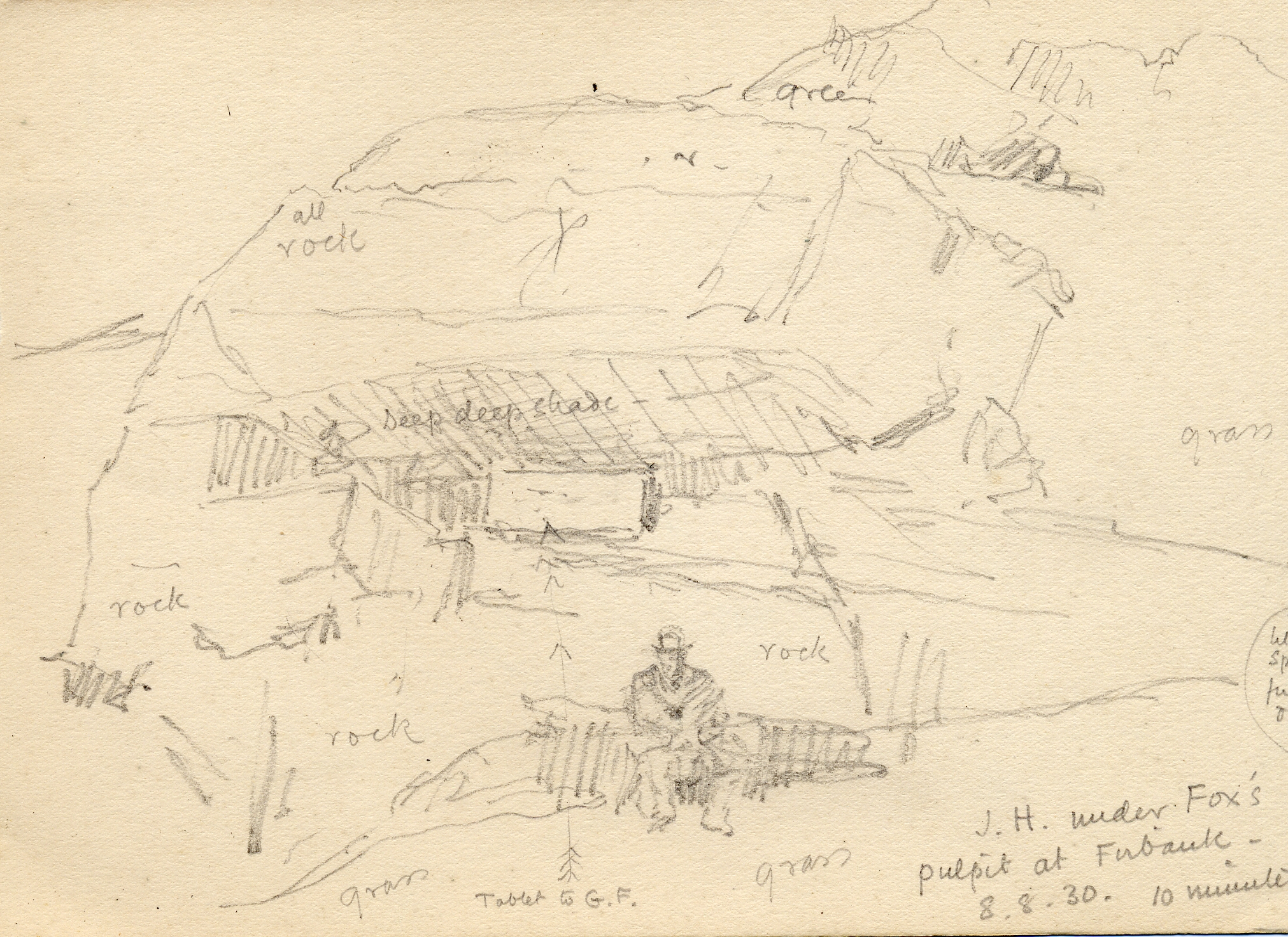
The pages are interspersed with news cuttings and leaflets concerning Quaker meeting houses, letters, articles for The Friend and Quakeriana, and a booklet entitled, “The Arrest of George Fox at Armscote Manor House in the Year 1673”. She made pencil sketches of Derwentwater (September 1931), Wayside Cottage, Cheshire (August 1930), Pendle Hill (6 September 1930), “Fox’s Pulpit”, Sedbergh (8 August 1930) and “St John’s from London”.

“John Hodgkin (?) under Fox’s pulpit at Fairbank 8.8.30”, Lucy Violet Holdsworth’s commonplace book

“John Hodgkin under Fox’s pulpit at Fairbank 8.8.30”, Lucy Violet Holdsworth’s commonplace book, 1916-1925 (TEMP MSS 37/3)

Commonplacing is like making a collection of precious gems, or gathering flowers for a garland – a very personal selection of inspiring and fruitful resources. What kind of things would you include in your commonplace book?

Posted in Highlights | Tagged , , | 2 Comments

Playing with shadows: silhouette portraits and how to make them

Richard Dykes Alexander (1788-1866)

Richard Dykes Alexander (1788-1866)
by Samuel Metford
(Pic. Vol. II)

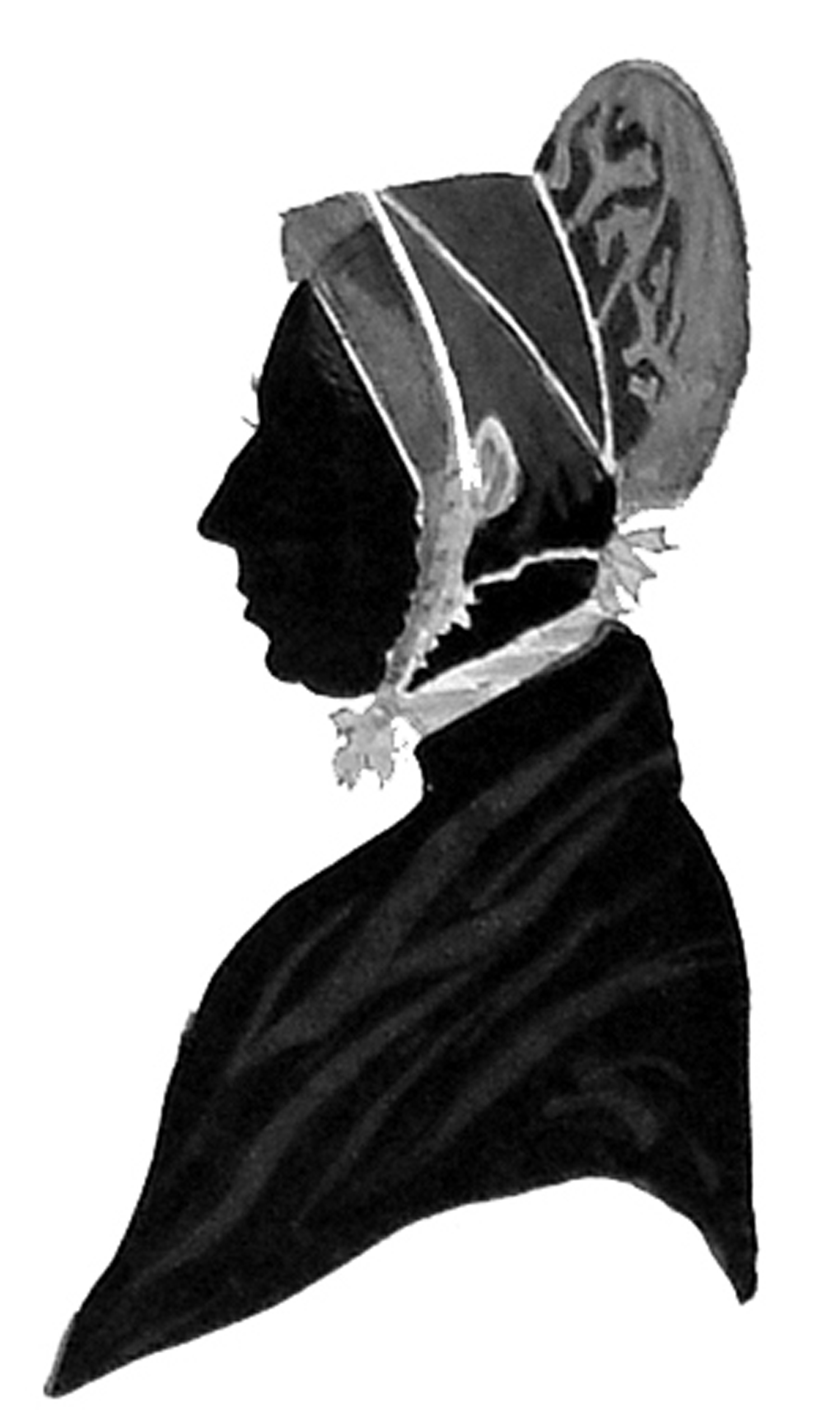
Silhouettes – solid profile images – have long been a popular form of portraiture, though the name itself only dates back a couple of hundred years. The side or profile view of a subject, whether on coins and medals or cut from paper, provides an instantly recognisable likeness. Visitors to the Library in 2011 saw a selection of fine silhouettes from our collections in the reading room display, “The Face of Quakerism”, curated by Joanna Clark, our former picture librarian. In this blogpost we bring some of our silhouettes to a wider audience, and, at the end, instructions on how you can “do it yourself”!

From the late 18th century, the art of cutting paper profiles became something of a craze. Known as “shades”, “black profiles”, “shadow portraits” or “scissor-types”, the name that caught on was “silhouette” (derived from the austerity measures of the French finance minister, Etienne de Silhouette, whose surname had become synonymous with anything done cheaply). Whether as amateur pastime or professional portraiture, silhouettes were both cheap and immensely popular, dwindling only in popularity after the late 1850s, when photography became more affordable.

Quakers and silhouettes

By 1800 the “scissors art” or cutting of silhouettes was already a popular hobby among Quakers. One of the most prolific and notable of the earlier silhouettists was Thomas Pole (1759-1823), who was born in Philadelphia but practised as a physician in England. A generation later, Samuel Metford of Glastonbury (1810-96) became the first Quaker to practise as a professional silhouette artist.  He too had learned the art when in America on business, and from the 1830s to 1860s he travelled as a “profilist” around Britain, often using the local Quaker meeting as his source of custom. The Library holds quite a few of his elegant silhouette portraits, and his work is highly respected among modern collectors.

Thomas and Elizabeth Pole

Thomas and Elizabeth Pole by Thomas Pole
(Pic. Vol. II, p. 34)

Joshua Metford (1755-1833)

Joshua Metford (1755-1833) by Samuel Metford (F.187)

Elizabeth Heyrick (1769-1931)

Elizabeth Heyrick (1769-1931)
(MS VOL 239/237)

The Sturge Family, ca. 1820.

The Sturge Family, ca. 1820. From William R. Hughes, Sophia Sturge: a memoir (London, 1940) (092.4 STU/HUG)

The making of silhouettes – or “scissors art”

The traditional method of creating silhouette portraits is to cut them from lightweight black cardboard, and mount them on a pale (usually white) background. However, silhouettes can also be “hollow cut”, where the figure is cut away from the paper thereby leaving a negative image.  The paper outline is then backed with a contrasting colour of paper or fabric.

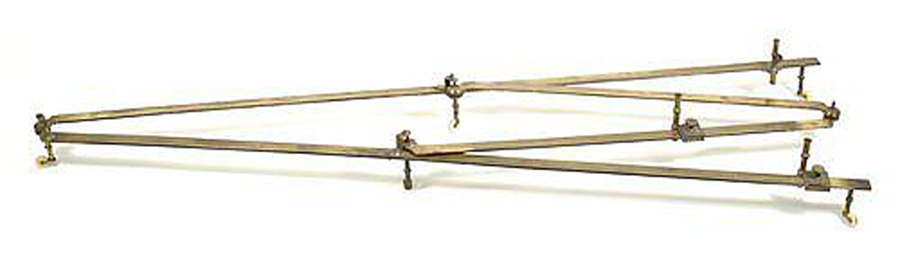
The traditional silhouette portrait artist or “profilist” could cut the likeness of a person, freehand, within a few minutes. However, by the 1820s some English profilists favoured the aid of a camera obscura, which casts a shadow of the person on paper, to provide an outline. This life-sized outline served as the artist’s cartoon or draft. The finished miniature silhouette could then be made using a reducing instrument known as a pantograph. Skilled artists would add detail afterwards – pastels might be used to create light and shade, and occasionally scraps of fabric were added to create a realistic bonnet or collar.  Artists would talk of “taking” a silhouette in much the same way that photographers “take” a photograph.

English Pantograph, 19th century

English Pantograph, 19th century

Silhouette cutting: do it yourself

In the interests of historical research we decided to have a go at making silhouettes ourselves. The results were … interesting!

Silhouette DI 201303Silhouette JH 201303 Silhouette JM 201303  Silhouette MA 201303 Silhouette PR 201303 Silhouette TD 201303 Silhouette_DB

If you’d like to try it yourself, here’s how we did it (takes about 15-20 minutes):

Materials

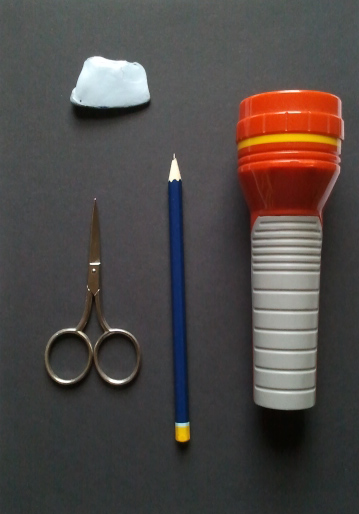
Silhouette_Equipment1 A3 sheet white paper
1 A4 sheet black paper or light card
1 A4 sheet white/cream paper for mounting the silhouette
1 photocopier (there was no pantograph to hand) with A4 paper
2B pencil
Torch or bright lamp
Glue stick
Blu-tack
Embroidery scissors

Instructions

1. Sit or stand the subject sideways next to a smooth wall surface in a dark room. Position the torch or bright lamp 3 or 4 metres away so that the sitter’s shadow falls sharply on the wall. Position the A3 sheet of white paper where shadow falls, and fix it with Blu-tack.

2. Adjust the sitter so that her/his head and neck shadow lies within the area of the paper. At this point, reduce any other light in the room, if you haven’t already. Standing beside the sitter, draw round the shadow as quickly and carefully as possible.

3. Take the drawing on the A3 sheet and photocopy it to reduce the image size onto A4 (or smaller if you like).

4. Lightly glue the outer margins of your A4 photocopy on the reverse, with a blob in the middle of the paper and position it on top of the A4 sheet of black paper or light card. Carefully cut around the profile (through both white and black paper), taking particular care to cut smoothly around the nose, lips and chin.

5. Discard outer pieces, peel off the white paper and voilà, one beautiful silhouette ready for mounting!

Posted in Highlights | Tagged , | 14 Comments

The Macaroni Jester – an antidote to melancholy

To mark April Fool’s Day, we’re not going to spin a yarn about Quakers and kilts or how George Fox invented porridge while in jail. Instead, here’s part of the true tale of an 18th century joke book recently added to our online catalogue. It may read like a shaggy dog story, but – believe us – there was plenty more that could have been said.

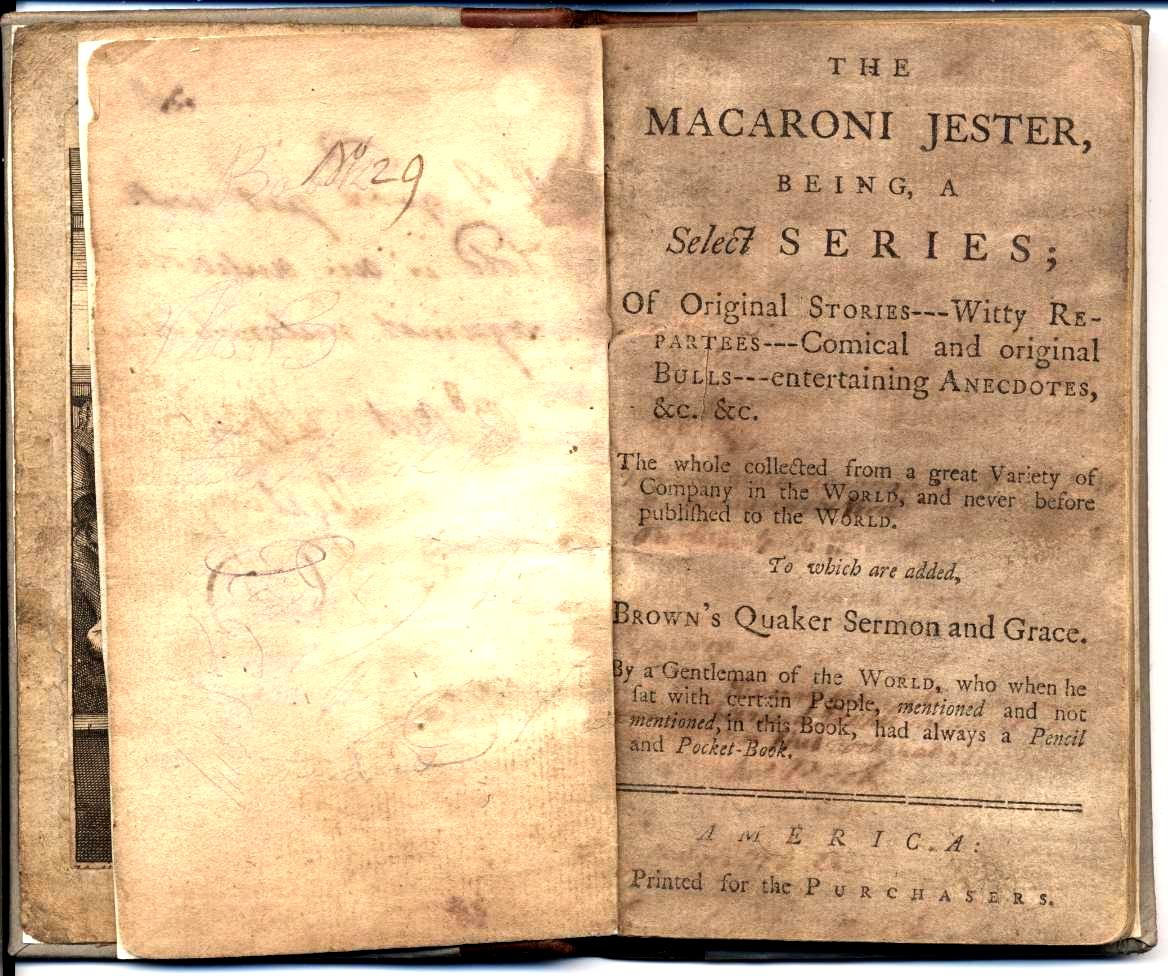
The Macaroni Jester, being, a select series of original stories – witty repartees – comical and original bulls – entertaining anecdotes &c. … by a gentleman of the world, and never before published to the world. To which are added Brown’s Quaker sermon and grace, was published around 1768 in Philadelphia, probably by Robert Jackson. Jackson was a Scottish printer who had worked in Dublin (where he had heated disputes with fellow printers over his “piratical editions”, and went bankrupt) before emigrating to America and building up a successful printing business publishing all kinds of books, including the first edition of Thomas Paine’s Common sense – a bestseller if ever there was one.

Macaroni Jester title page

The Macaroni Jester (ca. 1768)

What, or who, on earth was a Macaroni Jester? Dismiss from your mind that image of a motley fool standing in a steaming pile of pasta, and conjure up an amusing fellow – elegant, sharp and mercilessly satirical. Macaronis were self-identified witty sophisticates, eventually lampooned for excessively foppish fashions and manners, personifications of an 18th century craze that spawned songs, plays and above all cartoons.

Philip Dawe, The Macaroni. A Real Character at the Late Masquerade (1773)

The Macaroni. A Real Character at the Late Masquerade, by Philip Dawe (Printed for John Bowles 1773). Copy in Lewis Walpole Library. Via Wikimedia Commons

Although our small volume includes a ditty on “The Origin of Macaronies”, there’s little else of the Macaroni in it: the word has been used simply as a synonym for humour, satire and above all absurdity.

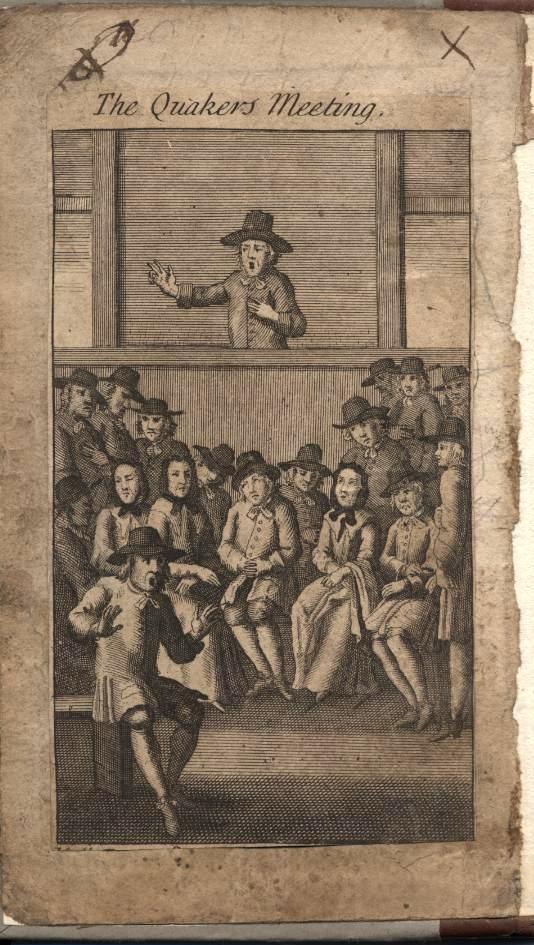
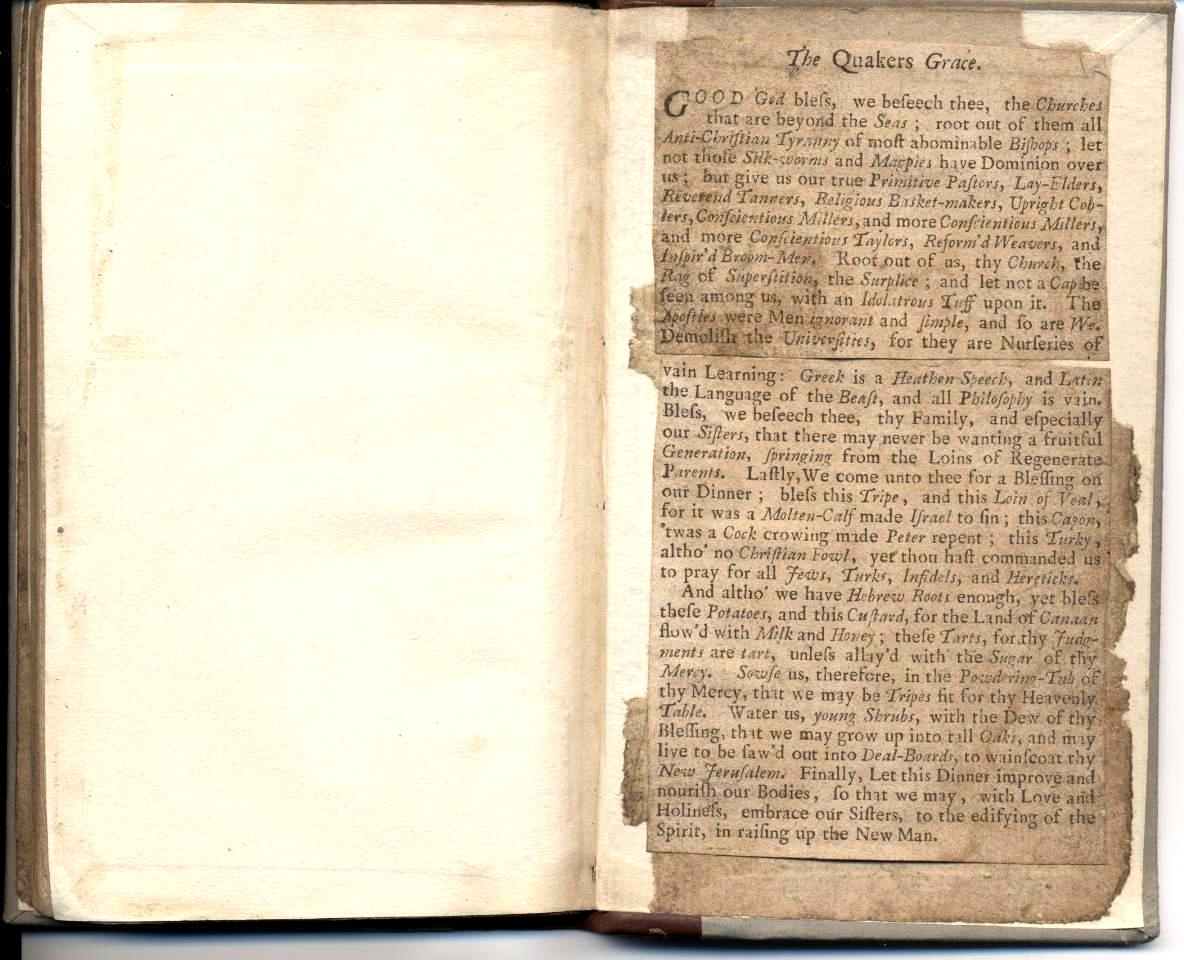
The jokes in the body of The Macaroni Jester poke fun at many stock figures, among them Quakers, but the real reason for the book’s presence in the Library was probably “Brown’s Quaker sermon and grace”, on the final two leaves (pages 97-100). Ironically, those very pages are missing from our copy (being the vulnerable outer leaves they probably simply became detached long ago). Instead, there are two additions to the original book. Inside the front board is pasted in a small satirical print, entitled The Quakers meeting; inside the back is pasted in a copy of “The Quakers [sic] grace” cut from a different work. Comparison with other copies shows that neither of these additions were part of the book as originally printed.

Our copy of The Macaroni Jester was purchased for 5 shillings from James Tregaskis, the London bookseller, at an unknown date, accessioned in 1933, and rebound in quarter leather.  Did Tregaskis sell the print and “The Quakers grace” along with the deficient copy of The Macaroni Jester, or were they already combined by a previous owner? It’s a mystery, but the interest for our researchers lies in the two pasted-in additions.

The first of these, The Quakers meeting, is an eighteenth century satirical print, showing a group of Quaker men and women in their meeting house. Up in the gallery behind them a speaker is in full flow: their eyes are rolled up to him. In the foreground another open-mouthed figure raises his hands apparently in shock or religious transport. At each side stand shadowy broad-brimmed figures,  looking particularly sinister. The artist has endowed his Quaker subjects with a horrible mixture of religious enthusiasm and absurdity. Another copy of this print is pasted into volume VI of the Gibson Manuscripts (Library reference MS Vol. 339/279).

Quakers Meeting

The Quakers Meeting. Print pasted inside front board of The Macaroni Jester

As for the “Quakers grace”, the second addition to our book, and its missing companion, “Brown’s Quaker sermon” – far from being the latest witticisms, these were hoary old chestnuts (still, the old ones are the best, or so they say). Their supposed author, Tom Brown “of facetious memory”, famed for his wit and licentious lifestyle, had died in 1704, decades before our Macaroni Jester saw the light of day. Both sermon and grace were included in various posthumous collections of his works from 1708 onwards, apart and together. They were also published together anonymously as Azarias: a sermon held forth in a Quakers meeting, immediately after Aminadab’s vision. With a prayer for rooting out the church and university, and blessing tripe and custard (London, 1710) (not held by the Library, but available online here). The satirical “sermon” addressed to the “dear brethren and loving sisters” at a Quaker meeting, is an absurd sophistical argument based on an amorous encounter between one Azarias of Twittenham and a Quakeress called Ruth. The “grace”, a thanksgiving prayer before a meal, is a satire on Quaker language with heavy gluttonous overtones (“bless this tripe and this loin of veal”), ending in a final bawdy double entendre.

Quakers Grace

The Quakers Grace. Pasted into The Macaroni Jester

The crude “Quaker sermon and grace” may or may not have been written by Tom Brown, but Brown certainly didn’t omit the Quakers from his many satirical observations of contemporary London life (for example, see the modern reprint, Amusements serious and comical and other works (1927) – featuring his visit to a Quaker meeting in the company of an imaginary Indian). For Brown, just as for his contemporaries Jonathan Swift and Daniel Defoe, religion was as likely a target for mockery as politics or manners.

We have to confess that the witty repartees and comical and original bulls purveyed by The Macaroni Jester failed to tickle us in the way they might have amused an eighteenth century reader. Nor was there rolling in the aisles after reading the “Quaker sermon and grace”.  Humour does not always translate well between eras and cultures. Nevertheless, viewing another society through a contemporary satirical lens may afford invaluable historical and literary insights for the modern reader.

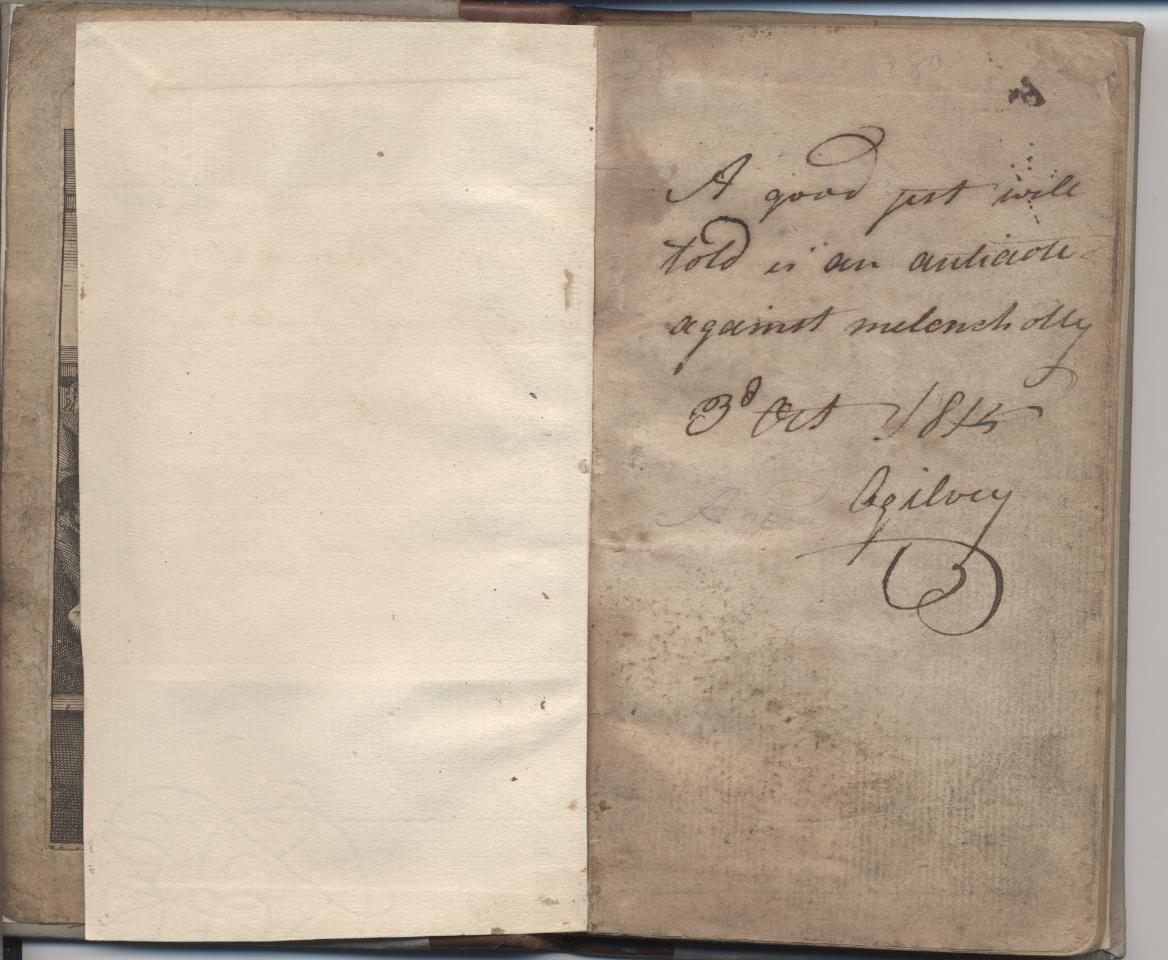
At all events, whether you’ve played an April fool prank yourself this year, or been the victim of one, we hope you will agree that laughter is an excellent thing, and that humour is, as a former owner of our little book opined, a fine “antidote against melancholy”.

Macaroni Jester owner's annotation

A former owner’s inscription on the flyleaf of our Macaroni Jester: “A good jest well told is an antidote against melancholly. 3d Oct 1815 [or 1814], Ogilvey”

>

Posted in Highlights | Tagged , , , | 3 Comments

Football with the Foxes

Mention ‘Quakers’ to the average football fan and the response is likely to be something to do with Darlington. Darlington FC, founded in 1883, received its nickname because of the importance of Quakerism in the town, and its crest includes a stylised Quaker hat

Joseph Whitwell Pease (1828-1903) (Wikimedia Commons)

However, it wasn’t the only football club with Quaker associations. Two years earlier, in March 1881, the Foxes Football Club was founded at the Friends Institute in Bishopsgate. Although based in London,  it too had a Darlington connection: its President for many years was Joseph Whitwell Pease (1828-1903), MP for South Darlington (left).

The Library has two volumes of the Club’s minute books (1881-1908 and 1919-1927. MS VOLS. 276-277), which provide a fascinating insight into the social and sporting life of Friends at the time. The Club didn’t function from 1915 to 1919 because of the First World War.

Foxes Football Club Minute Book 1881-1908

Foxes Football Club Minute Book 1881-1908 (MS VOL 276)

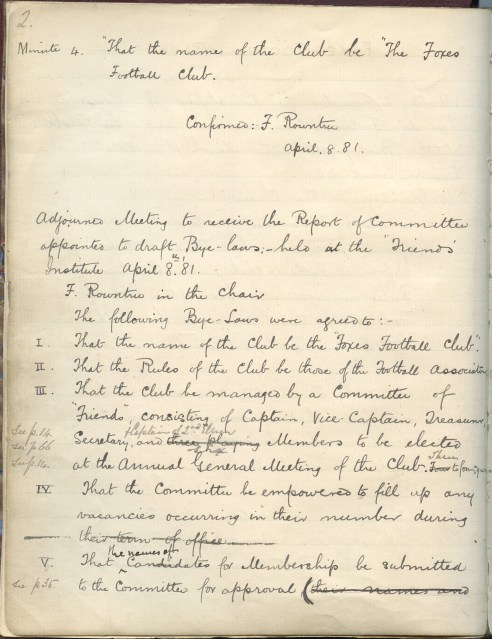
At first members of the Club had to be members of the Society of Friends or connected in some way with it. The 14 byelaws agreed in 1881 included rule 12, “that any member making himself obnoxious or refusing to conform to the rules of the club be liable to expulsion”, and rule 14, which decreed that “the Club provide no intoxicants”. Any member who was selected and then didn’t play was fined a shilling. The kit was white flannel shirts and trousers with a red band on each arm between the shoulder and elbow.

Foxes Football Club Byelaws

Foxes Football Club Byelaws, 8 April 1881
(MS VOL 276)

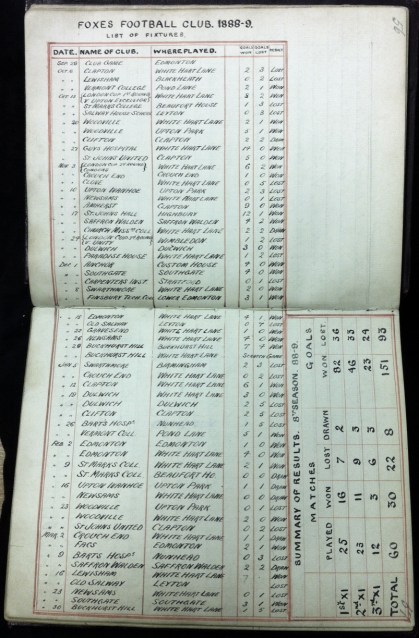
To the best of our knowledge, no history of the Club exists. The minute books give a vivid picture of its activities, including details of new members, officers and finances, and fixture lists. From them we learn that in October 1889 the Foxes beat Tottenham at West Green 15-0 (just plain Tottenham, not Tottenham Hotspur although they did play against the latter on several occasions). That year they also beat Kensington Rangers 10-2 in the first round of the London Cup held at Acton and in the previous year they were victorious against Guys Hospital 15-0 at White Hart Lane.

Foxes Football Club List of Fixtures

Foxes Football Club List of Fixtures, 1888-1889
(MS VOL 276)

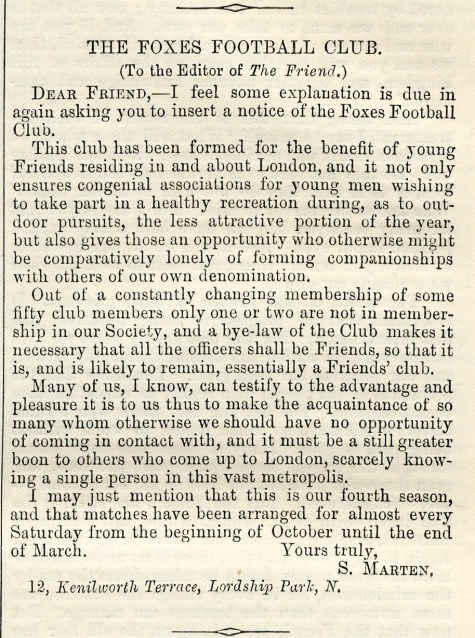
The Club was clearly seen as an important social meeting place for many young Friends. Its captain in the early days, Septimus Marten, wrote to the Quaker newspaper, The Friend, to encourage young Quakers to become members, and the minute books are dotted with details of social events.

The Foxes Football Club from 'The Friend'

‘The Foxes Football Club’, The Friend, volume XXIV,
number 288 (1 October 1884) p. 259

In 1888 there were long drawn–­out plans to hold a soirée “which should consist in the main of a farce and a comedy”. The event was to be held at either the Friends Institute or the Devonshire Hotel, with “a considerable interval for social intercourse and the inspection of interesting objects”. The event was postponed for lack of a suitable venue, and debate about what form it should take continued, with one group wanting “a play in two or three acts interspersed with songs etc., if possible preceded by a tea” and another preferring “more of a social opportunity … [consisting of] a conversazione etc”. In October 1893 the Club planned to entertain the Swarthmore team at the Small Hall of the Highbury Athenaeum, but this was too costly and they instead approached the Institute Committee for permission to hold the event at Devonshire House “with a view of putting the Club to as little expense as possible.” One year the minutes record a simple decision not to admit women to the Club, and on another occasion a proposal that ”female talent be admitted” [their underlining] was lost by 12 votes to 14. The Swarthmore team were not the Club’s only Quaker opponents. They also played against many of the Quaker schools, including Ackworth, Bootham, Saffron Walden and Sibford.

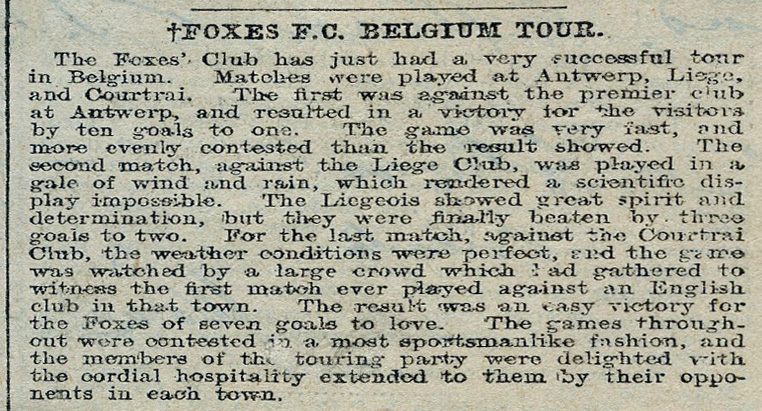
The Club featured in the wider press, particularly in London, as well as the pages of The Friend. The Sportsman records their 1901 tour of Belgium, where they played against Liège, Antwerp and Courtrai.

'Foxes F. C. Belgium Tour'

‘Foxes F. C. Belgium Tour’, The Sportsman, 11 April 1901 (MS VOL 276)

And in 1892 the Evening News and Post reported a fascinating encounter between the Quaker Foxes and the Scots Guards football team:

“The tie between the 1st Scots Guards and the Foxes ended in a victory for the soldiers by 5-2. This may be a bit of a surprise, but I am told that the Foxes for a number of reasons had to play no less than five of their reserves. In spite of this the score was two all at half time. Then the three half backs of the Foxes were all crippled and the referee allowed a palpably offside goal. I regret to say that the Guards played anything but a gentlemanly match. One of their players who was twice cautioned by the referee for tripping should have been ordered off the field. The referee seems hardly to have known his business. He acknowledged he had made a mistake about allowing one goal. And infringed rule 11 by not appointing neutral linesman in the face of a protest. The Foxes have good grounds for a protest, but as I have had occasion to remark before, they are too good sportsmen for that kind of thing.”

Posted in Highlights | Tagged , , , | 4 Comments

The Ploughshare, voice of Quaker Socialism

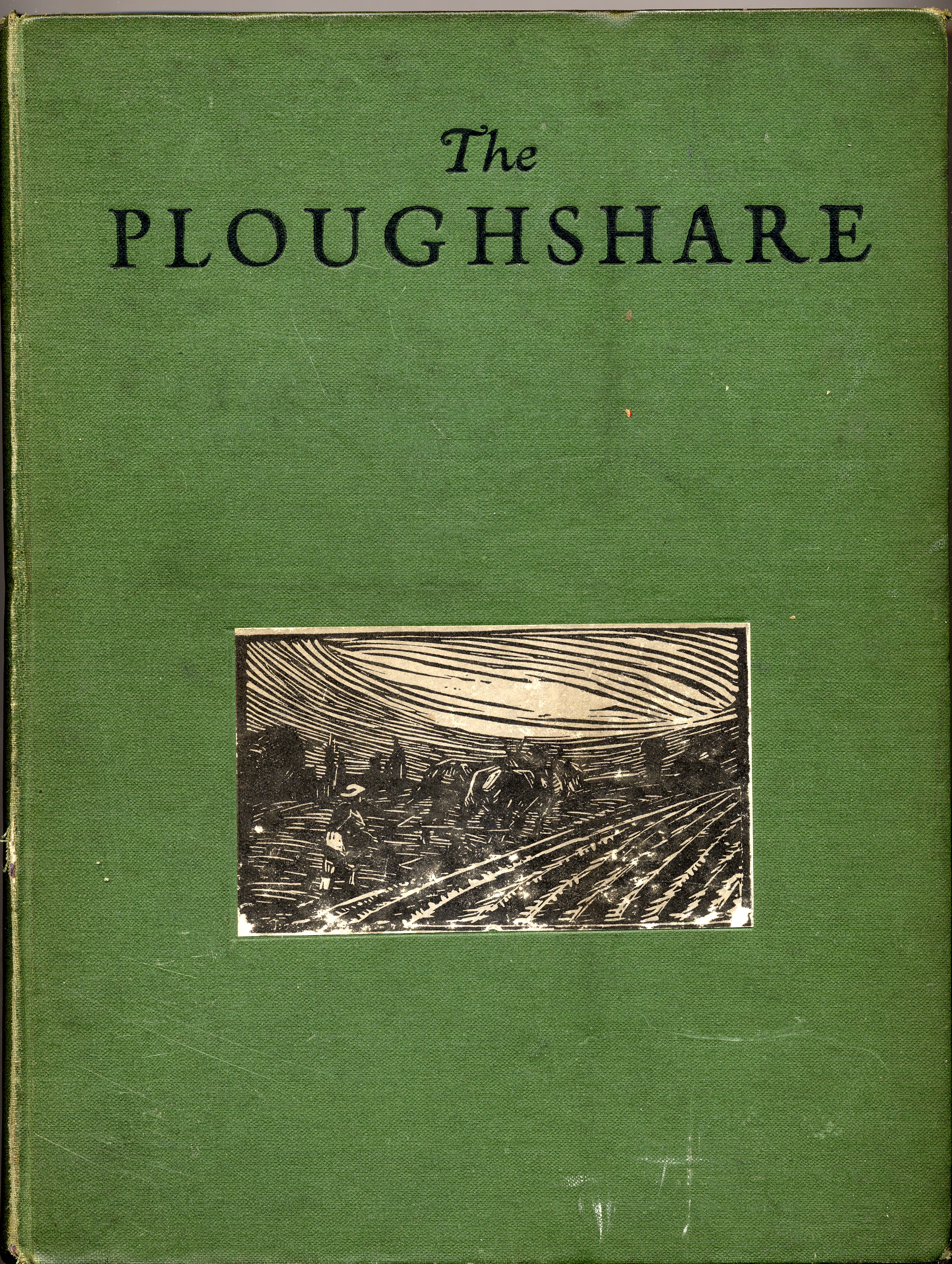
Bound volume of The Ploughshare

Bound volume II of The Ploughshare (1917)

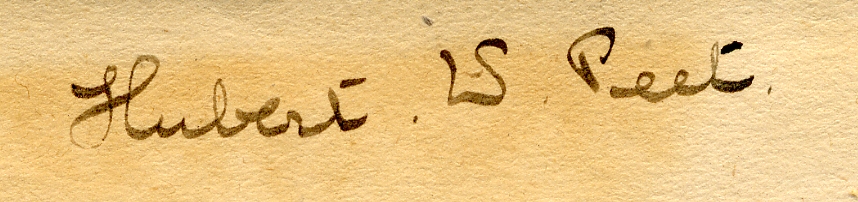
The Ploughshare was a quarterly, later monthly, journal published by the Socialist Quaker Society (SQS) between 1912 and 1919. It was edited by William Loftus Hare (1868–1943) and Hubert W. Peet, (1886–1951), who was so committed to the journal and its cause that he continued to be involved in its production even when he was imprisoned as a conscientious objector during the First World War from 1916 to 1919.

Signature of Hubert W. Peet

Signature of Hubert W. Peet from The Ploughshare, volume II (1916)

In the later 19th and early 20th century, Friends became ever more concerned with issues of social inequality and militarism. It was against this background that the Socialist Quaker Society (SQS) was founded on 2 April 1898 when Mary O’Brien, James Theodore Harris, Thomas Dent (1867–1943), H. G. Dalton and five other Friends met at 27 Yonge Park, London.  The SQS aimed to educate Friends about socialism and promote it as a solution to the problems of the day.

The Ploughshare, as well as being the official journal of the SQS, played an important role as a platform for anti-war sentiments during the First World War. Floyd Dell (1887–1969), editor of the New York Marxist paper Masses, wrote to The Ploughshare describing it as “a beautifully printed, admirably written [and] very impressive paper” (Three Letters. The Ploughshare, volume I, number 6 (1916) p. 196).

At the sign of the Plough

‘At the Sign of the Plough : where current matters are discussed’ section title, The Ploughshare, volume II, number 8 (September 1917), p. 251

The history of The Ploughshare can be divided into three distinct periods. Issues 1 to 12 (1912–1915) were published quarterly with the subtitle, “Organ of the Quaker Socialist Society”. From 1916 it started a new series, published monthly in a larger format, with the subtitle, “A Quaker Organ of Social Reconstruction”. Finally, after the SQS ended its association with The Ploughshare in 1919, it would continue for one more volume as an independent publication (this volume is not held at the Library).

As well as publishing articles by the likes of Stephen Hobhouse, peace activist, prison reformer and religious writer (1881–1961), Alfred Salter, medical practitioner and Labour Party politician (1873–1945), and Horace Bertram Pointing, artist and playwright (1891–1976), The Ploughshare counted Dorothy Richardson, writer (1873–1957), Bertrand Russell, philosopher (1872–1970), and Fenner Brockway, anti–war activist and politician (1888–1988) among its contributors.

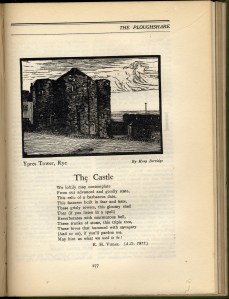
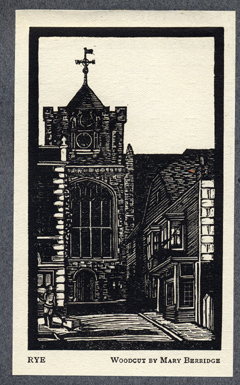
The Castle, a poem by E. H. Visiak, 1917

The Castle, a poem by E. H. Visiak, 1917, with woodcut of Ypres Tower, Rye, by Mary Berridge. The Ploughshare, volume II, number 9 (October 1917), p. 255

The journal also included poetry, book reviews, news of other “progressive movements” and lively correspondence under the heading “Let Us Reason Together”. It regularly ran essays on mysticism and religious thought, and Quaker pacifist principles. This perhaps placed it in a unique position among anti–war publications.

Let Us Reason Together, 1917

‘Let Us Reason Together’. The Ploughshare, volume II, number 2 (March 1917), p. 33

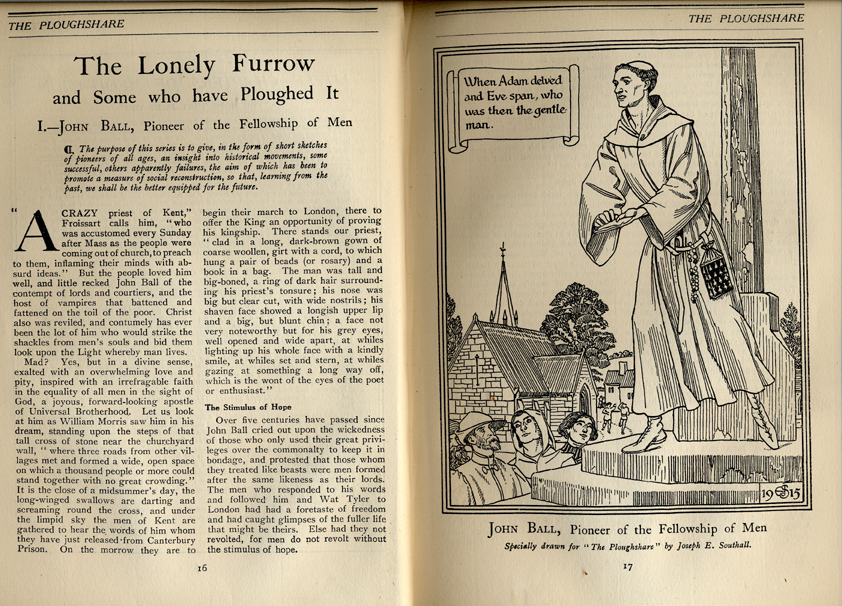
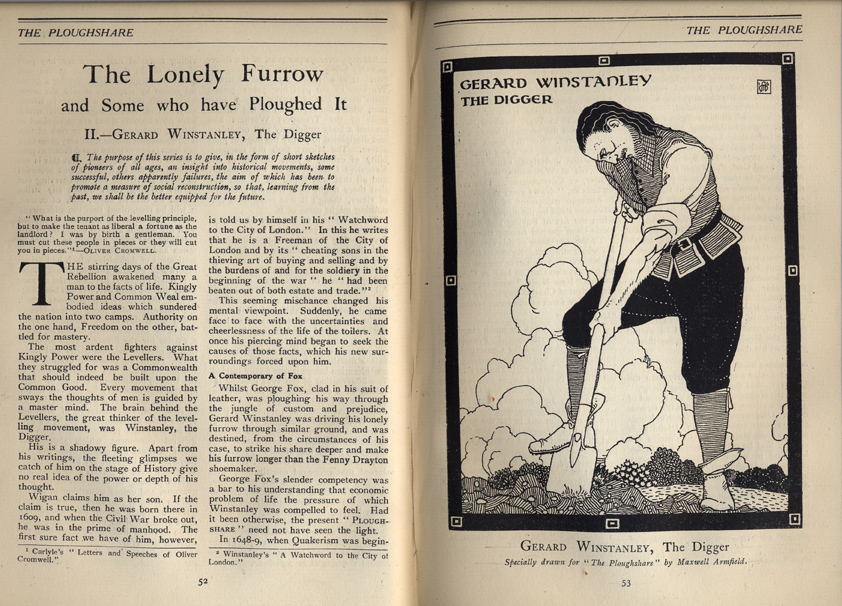
The series, “The lonely furrow and some who have ploughed” not only includes biographical overviews of prominent Friends such as George Fox (1624–1691), William Penn (1644–1718) and John Woolman (1720–1772), but also  thinkers such as Socrates, Confucius and Erasmus, recent pacifists such as Francis Sheehy Skeffington (1878–1916) and Clifford Allen (1889–1939), and historical figures such as John Ball, the 14th century Lollard priest, and Gerrard Winstanley, Digger (1609–1676). These articles included beautiful illustrations by the likes of Joseph Southall (1861–1944). The journal frequently carried both commissioned and reproduced artwork (particularly woodcuts) from 1916 onwards.

John Ball, Pioneer of the Fellowship of Men, February 1916

William J. Holland. John Ball, Pioneer of the Fellowship of Men. The Ploughshare, volume I, number 1 (February 1916), p. 16-17

Gerard Winstanley, the Digger, March 1916

L. H. Wedmore. Gerard Winstanley, the Digger. The Ploughshare, volume I, number 2 (March 1916), p. 52-53

The Ploughshare had several women on its advisory council and regularly ran articles on women’s rights (using the term “feminism” in the title of articles on at least two occasions) and had a large number of female contributors. Dorothy M. Richardson, The Reality of Feminism (The Ploughshare, volume II, number 8 (September 1917), pp. 241-246) and Emily Hobhouse, Comforting the Enemy and Coals of Fire (The Ploughshare, volume I, number 11 (December 1916), pp. 339-341) being just two examples.

Woodcut of Ypres Tower, Rye, by Mary Berridge, September 1917

Woodcut of Ypres Tower, Rye, by Mary Berridge. The Ploughshare, volume II, number 8 (September 1917), opposite p. 223

The paper addressed issues of the day, such as Irish nationalism. It was sympathetic to the subject of Indian home rule and generally took an internationalist stance. An article from October 1919 took a critical line on the behaviour of Britain and other “great powers” in Iran.

The Ploughshare is a fascinating periodical for those interested in early 20th century Quakerism, Christian socialism and the development of the British socialist and anti-war movements in general.

Posted in Highlights | Tagged , , , | 5 Comments

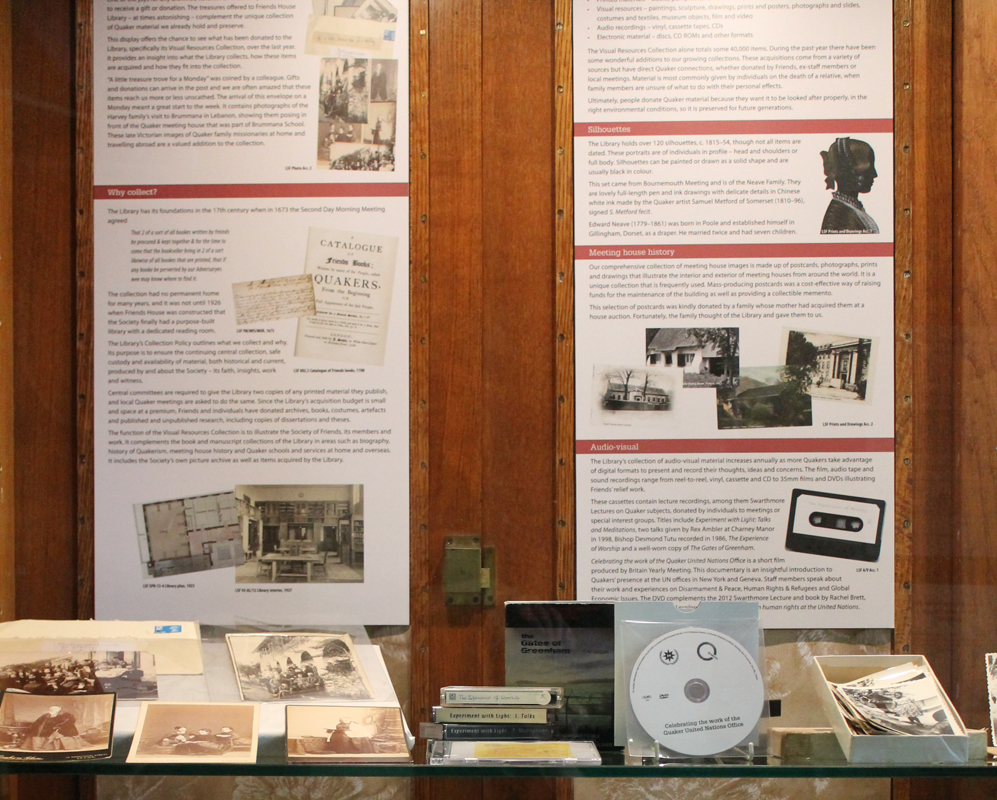
A little treasure trove for a Monday: some highlights from our latest display

detail of display panel and photosOur latest display in the reading room is something of a salmagundi. We decided to pick out a selection of the items donated to the Library’s visual resources collection over the past twelve months, just to demonstrate the wide range of the collection. We chose the title “A little treasure trove for a Monday” to capture the excitement of unpacking a new accession for the first time – often an unexpected delight. You can see the display until Friday 17 May during Library opening hours, but if you can’t make it, here are some highlights.

The visual resources collection (photographs, including a substantial collection of lantern slides, paintings, drawings, prints, posters, costumes and three dimensional artefacts) complements the Library’s printed and manuscript collections for all sorts of Quaker biographical, historical, local, and architectural research, and for research on Quaker work in Britain and overseas. It includes the Society’s own picture archive as well as items acquired by the Library – altogether a total of roughly 40,000 items.

During the past year there have been some wonderful additions to this growing collection. These acquisitions come from a variety of sources but most have direct Quaker connections, whether Friends, ex-staff members or local meetings. Material is sometimes received as a bequest after the owner’s death or from families sorting out a relative’s personal effects.

Ultimately, people donate Quaker material because they want it to be accessible, and looked after properly, in the right environmental conditions, so it is preserved for future generations.

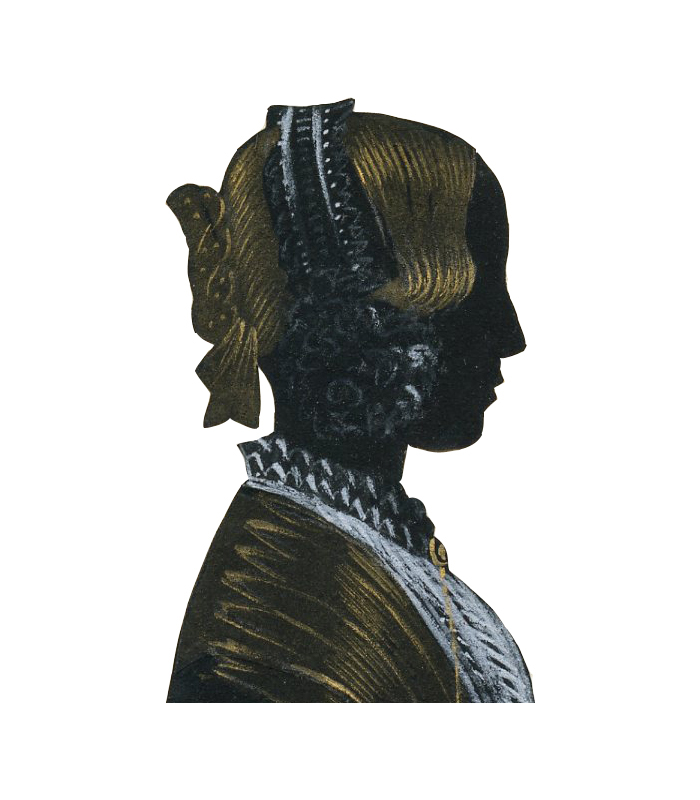
Silhouettes of the Neave family

The Library holds over 120 silhouettes, dating mainly from the first half of the 19th century. These portraits are of individuals in profile – head and shoulders or full body. Silhouettes can be painted or drawn as a solid shape and are usually black in colour. The Library holds several books about Quaker silhouettes – you can find out more by searching for the subject “silhouettes” on our online catalogue.

This set came from Bournemouth Meeting and is of the Neave Family. They are lovely full-length pen and ink drawings with delicate details in Chinese white ink made by the Quaker artist Samuel Metford of Somerset (1810–1896), signed S. Metford fecit.
Edward Neave (1779–1861) was born in Poole and established himself in Gillingham, Dorset, as a draper. He married twice and had seven children.

Silhouette of Mary Neave

Silhouette of Mary Neave (born Hunt), 1814 (Lib. Ref. LSF Prints and Drawings Acc. 1)

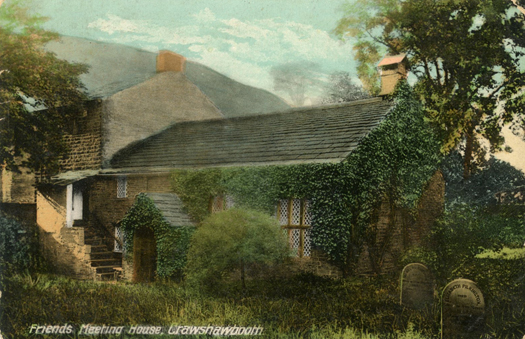
Meeting house postcards

Our comprehensive collection of meeting house images is made up of paintings, drawings, photographs, prints and postcards illustrating the interior and exterior of meeting houses from around the world. It is a unique and frequently used collection. Mass-producing postcards were a cost–effective way of raising funds for building maintenance as well as providing a collectible memento.

This selection of postcards was kindly donated by a family whose mother had acquired them at a house auction.

Crawshawbooth Meeting House

Crawshawbooth Meeting House (Lib. Ref. LSF MH)

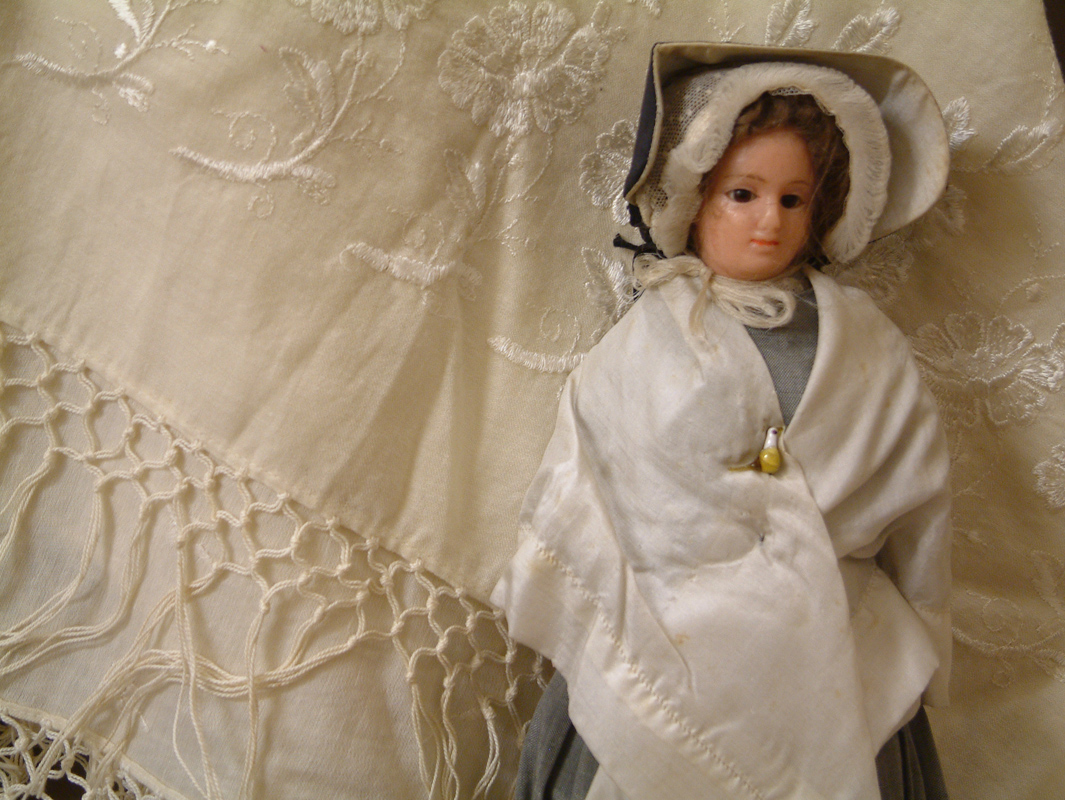
Dolls and textiles

With 50 dolls and 54 shawls already held by the Library, this gift of a shawl and doll fits perfectly. The doll’s bonnet and shawl are pinned with a delicate glass bird, and her wax head, glass eyes and bisque body indicate she is from the late 19th century. Our dolls range from traditional 19th-century examples to wood carvings made by prisoners of war on the Isle of Man during World War I.

Quaker doll and shawl

Quaker doll and shawl (Lib. Ref. LSR MO 729)

Plain dress was one of the distinguishing features of Quakers in the past – and quite a struggle for some to adhere to. While a distinctive form of dress has long gone, simplicity is still an important part of Quakerism. According to Quaker faith & practice, “The heart of Quaker ethics is summed up in the word ‘simplicity’ … Outwardly, simplicity is shunning super­fluities of dress, speech, behaviour and possessions, which tend to obscure our vision of reality” (Quaker faith and practice, 4th edition, 2009, 20.27).

Most Quaker women dressed in monotone colours without adornment. The shawls in our collection are an assortment of fabrics and colours (white, cream, grey, brown, blue and black). They feature simple designs and date from 1815 to the 20th century. This cream shawl is from the early 20th century and is embroidered with white silk thread flowers.

Photographs and slides dominate the visual resources collection, with at least 25,000 photographic prints individually catalogued and in albums, 9,000 35mm slides and 2,000 glass plate lantern slides.

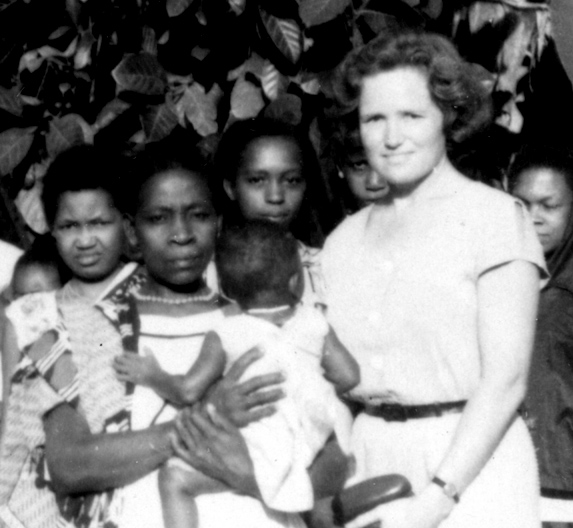
Olive Prescott collection of slides and photographs

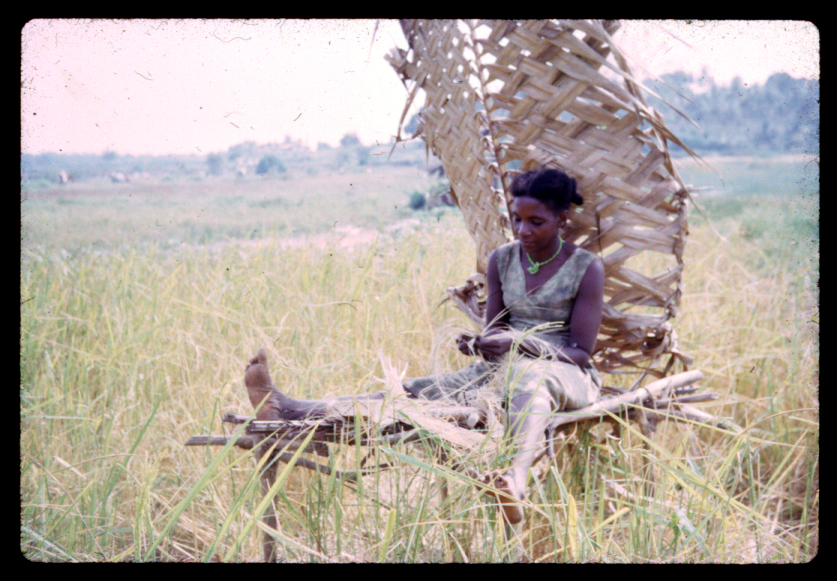
The Olive Prescott collection is a personal archive of slides and photographs from her time in Africa working for Friends Service Council (FSC) from 1963 to 1969. Olive Prescott (1931–2011) was a Quaker with a background in social work and publishing. She travelled to Kenya in March 1963 to assist Walter Martin, the FSC representative in Nairobi. As well as helping to run classes at the Mucii Wa Urata rural training centre and the Ofafa community centre, she was involved in the administration of work camps and committees for the Christian Council of Kenya, particularly in relief and refugee work. After several years of political unrest, Kenya and Zanzibar gained independence from colonial rule in December 1963. FSC’s Nairobi office closed in 1965.

Olive Prescott in Africa

Olive Prescott (Lib. Ref. LSF Photo Acc 1)

Olive was then seconded to East Africa Yearly Meeting of the Society of Friends, moving to Kaimosi in 1967 to serve as Literature Secretary. She worked in the bookshop and on the Mufrenzi magazine. She also researched a series of biographies of early African Friends and, before leaving FSC in 1969, wrote a book for people preparing for Quaker membership.

Woman plaiting mats

Woman basketweaving

If you want to find out more about the visual resources collection, or are considering donating visual material, please contact the Library, using the link on the right hand side of this blog page.

Posted in Exhibitions, New accessions | Tagged , , , , | Leave a comment

Goodbye to Volume H!

Some of the Library’s rarest printed items are ephemeral publications, pamphlets, broadsides and single sheet circulars, ranging from the 17th century to the present day. Their survival is unusual, and owes much to the way they have been stored, often bound together into guard books or tract volumes. These bindings keep the contents relatively flat, clean and dry, but present their own problems. A variety of differently sized items bound together, sometimes folded up to fit within the volume, can be vulnerable to dust, damage to protruding pages and tearing at folded edges when they are opened out for use.

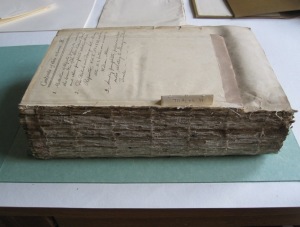
One of these tract volumes is – no, was – volume H, a four inch thick binding of 225 mainly late 18th to 19th century items.

Tract vol H uncased

Tract vol. H, uncased. Photograph from the conservator.

The volume was bound in 1951 to accommodate 225 separate publications – reports, posters, newspaper cuttings – of different sizes.  Very large sheets had been slit in two and each leaf pasted to a guard. Some items were directly sewn into the binding, others folded and sewn. With regular use by readers, new folds had been made and new sequences of folds attempted. Unfolding had become like solving a puzzle in an effort to prevent further tears along the weakened folds and crossings. Although the volume had a protective slip-case,  London’s sooty dust could be seen not only on the irregular top edges but drifting down between the individual sheets too.

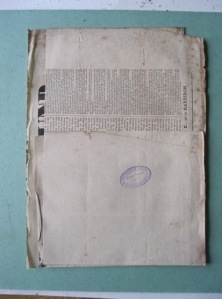
What kept researchers coming back to this volume was its contents. The spine read: “Tracts H – On slavery. The War Victims &c.”, and these miscellaneous contents included reports of the Friends War Victims Fund on the Franco-Prussian War of 1870/1, reports of the relief work Quakers carried out in Nantes, appeals for funds for child war victims in Eastern Europe (1876), and a tri-lingual poster for the Quaker Relief Fund for Distressed Peasantry.

War Victims Fund poster, Vol. H/38

War Victims Fund poster. Photograph from the conservator after disbinding and before unfolding and conservation
Ref.: Vol. H/38

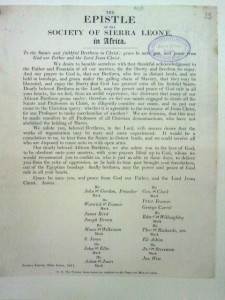
Among the slavery related publications were multiple issues of the British and Foreign Anti-Slavery Reporter of 1844, and surviving circulars from a wide range of anti-slavery organisations – local anti-slavery committees in Nottingham, Bradford, and Settle, the Society of Sierra Leone and the Quaker inspired Society for the Abolition of the Slave Trade, the first such committee.

Epistle of the Society of Sierra Leone (1811)

The epistle of the Society of Sierra Leone, in Africa : to the saints and faithful brethren in Christ [etc.] (1811)
Ref. Vol. H/75

Besides these, there were news clippings from the 1780–90s and appeals to boycott slave produced sugar.

East India Sugar Basins

East India sugar basins. B Henderson, china-warehouse, Rye-Lane, Peckham. – [London] Printed at the Camberwell Press, by J.B.G. Vogel [ca. 1828]
Ref.: Vol. H/22

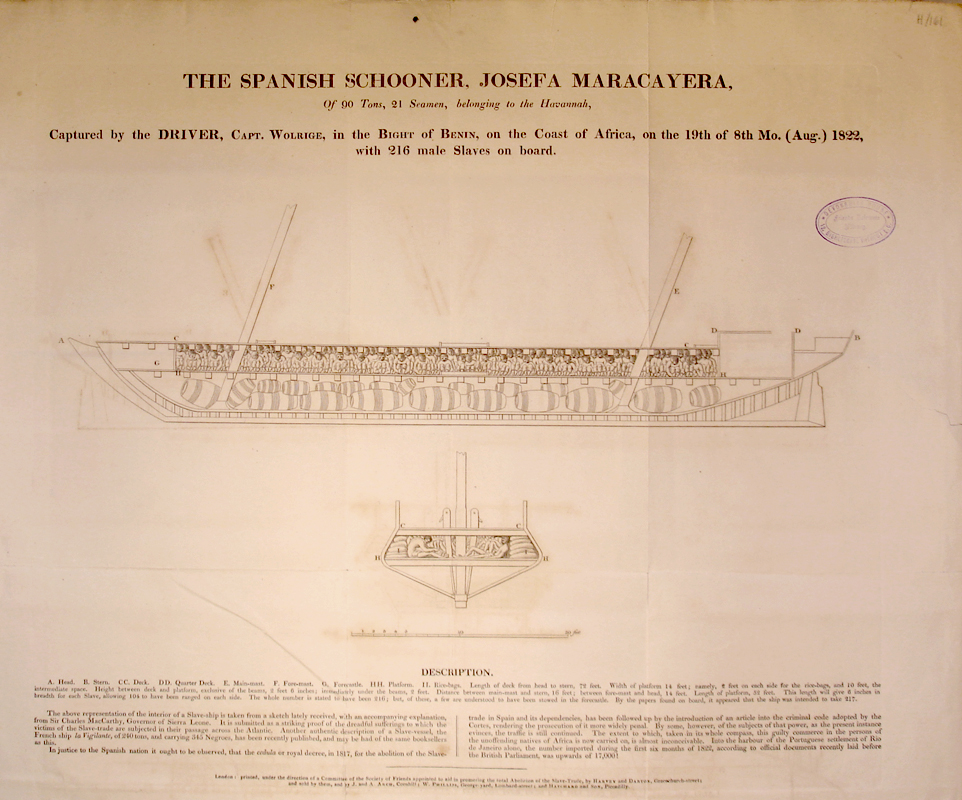
No less interesting were the publications showing diagrams of the lower decks of slave ships – vivid pictorial representations of the suffering conditions endured by the victims of the slave trade.

Plymouth Society for the Abolition of Slavery slave ship plan

Plymouth Society for the Abolition of Slavery. Plan of an African slave ship’s lower deck
(Plymouth : Trewman and Haydon, printers, [1789?])
Ref.: Vol. H/85

So what has become of Volume H?

Using funds from the BeFriend a Book appeal fund, this tired volume was finally dispatched to a conservator for full dis-binding and repair of the contents. After separation of each component item, the surface dirt was carefully removed, the dog-ears and creases eased away, and the tears and small paper losses made good with Japanese papers and wheat starch paste. Items which had been tipped, or glued together were separated, and the folded items flattened.

The separate items previously bound together are now individually stored in protective transparent sleeves and securely housed in appropriate sized boxes. Researchers can now examine the extraordinary slave ship plan published by the Plymouth Society for the Abolition of Slavery, or the plan of the Spanish schooner Josefa Maracayera, without dread of tearing – cleaned, repaired and far easier to handle.

Josefa Maracayera slave ship plan 1822

Cross section plan of a slave ship
[Plan of] the Spanish schooner, Josefa Maracayera of 90 tons, 21 seamen, belonging to the Havannah, captured by the Driver, Capt. Wolrige, in the Bight of Benin, on the coast of Africa, on the 19th of 8th mo. (Aug.) 1822 with 216 male slaves on board (London : printed under the direction of a Committee of the Society of Friends appointed to aid in promoting the total abolition of the slave-trade, 1822)
Ref.: Vol. H/161

Posted in Collection care | Tagged , , , , , , | 6 Comments