Library resources for researching World War I: prison experiences of conscientious objectors

Most of the men who found themselves imprisoned for conscientious objection during World War I were characterised as absolutist objectors. These men were not willing to participate in the war effort to any extent, turning down non-combatant duties and alternative work which would contribute to the war effort. The absolutists primarily consisted of members of the No-Conscription Fellowship, formed by Clifford Allen and Fenner Brockway, members of the Independent Labour Party  and other socialist groups, Quakers and members of other religious bodies such as the Jehovah’s Witnesses – or indeed those who counted themselves as members of more than one of these groups.
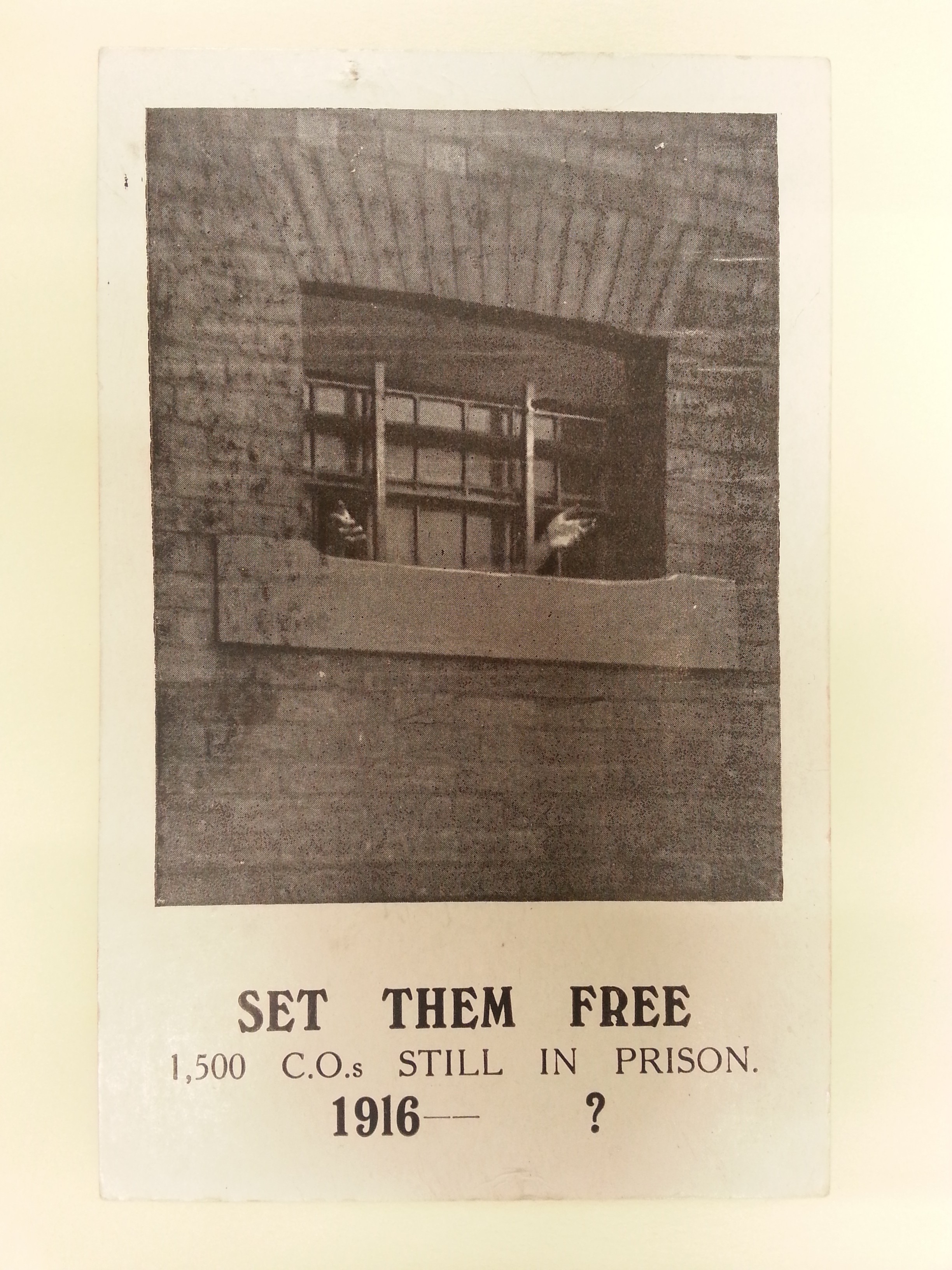
 

Set them free

“Set them free”. Postcard, unknown source, undated [1916-1918?]. Part of Rowland Philcox Papers (Library ref. TEMP MSS 197/5)

Our manuscript collection provides a real window into the experiences of these men, in the form of correspondence, diaries, accounts and official documents.

The Winchester Whisperer, the clandestine prison newspaper written by COs in Winchester Prison, has been getting a lot of attention recently in the media and rightly so – you can read an article about it here.

However, there are other less well known collections which paint a fuller picture of what life was like for imprisoned COs during the war. You can see a list of some of these  collections in our subject guide on Conscientious objectors and the peace movement in Britain 1914-1945, available on our website here: http://www.quaker.org.uk/subject-guides.

To highlight the collections we can look at some common themes which emerge from the material, mainly contemporary correspondence and diaries.

A challenge to the authorities

The absolutists really challenged the government’s enforcement of the Military Service Act and the procedures in local and central tribunals, military courts, and civilian prisons for dealing with these men. This is reflected in the manuscript collections as the men describe their treatment, being passed from pillar to post through the civil and military courts systems, from barracks, to civilian prisons, and to work camps. The initial attitude taken by the authorities is described by Cornelius Barritt (1883-1967):

“In the evening an officer visited me in my cell and asked ‘How long are you going to keep this up, you belong to King and country now and must do as you are told’, to which I answered ‘I shall keep this up as long as strength is given me to do so'” (Cornelius Barritt, Diary while in the hands of the military. Library ref. TEMP MSS 62/MISC/DIA/1)

Barritt was first tried in March 1916, then taken to France where he was brought before Field General Court Martial and sentenced to death on the 10th of June, later commuted to ten years penal servitude. He spent time in Winchester Prison, before being sent to work camps in Dyce and Wakefield. As an absolutist, he refused to participate in the work scheme and was sent back to Maidstone Prison, where he remained until 1919.
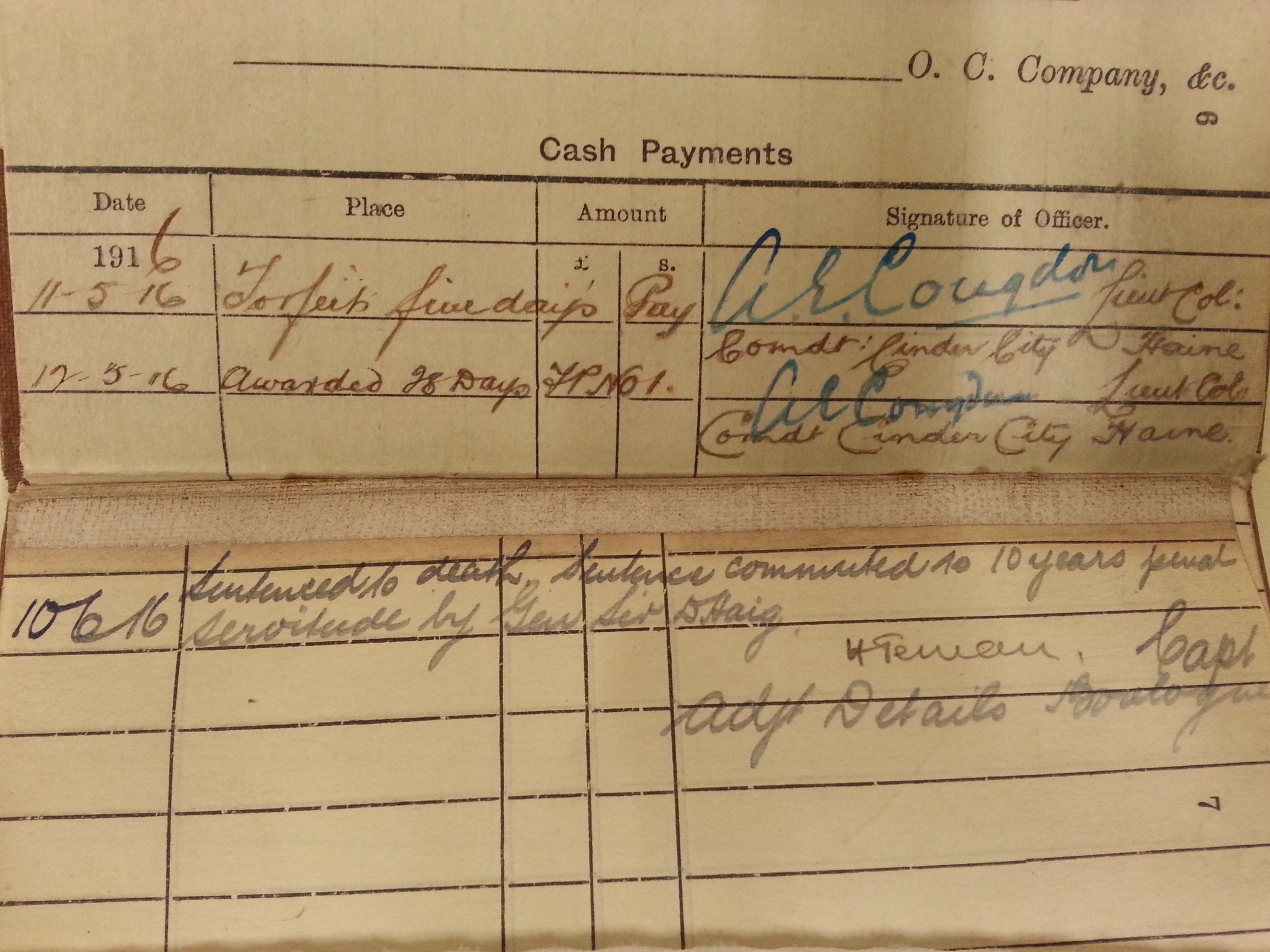
Cornelius Barritt's death sentence

Cornelius Barritt’s ‘soldier’s pay book’ showing his sentence: “Sentenced to death. Sentence commuted to 10 years penal servitude by General Sir D. Haig” (Library ref. TEMP MSS 62/COR/LT/4)

The government seemed to underestimate the power of these men to stick to their principles, and many of the collections describe soldiers, prison guards and judges gradually coming to respect the strength of those principles.

This recognition and ceaseless campaigning on their behalf led to attitudes softening somewhat in some government circles, and much debate in the cabinet over their treatment. Some COs were released in 1917 on medical grounds and certain privileges were granted to them in prisons.

As well as challenging authorities, the COs found it somewhat a challenge to organize a common strategy among them, as their ideas on the forms of objection differed and changed throughout the war. This is well reflected in the letters of Roland Philcox (1877-1965) and Joseph C. S. Elliott (TEMP MSS 197), who were active in the No-Conscription Fellowship and described in detail the range of attitudes of the men they encounter in prison. Philcox shows the uncompromising attitude some of the absolutists adopted:

“These N.C.C. [Non-Combatant Corps] men reported themselves in the ordinary manner, they are quite willing to do work but not killing. They are the shirkers and have let us down, for we stickers out are in a minority.” (Library ref. TEMP MSS 197/1)
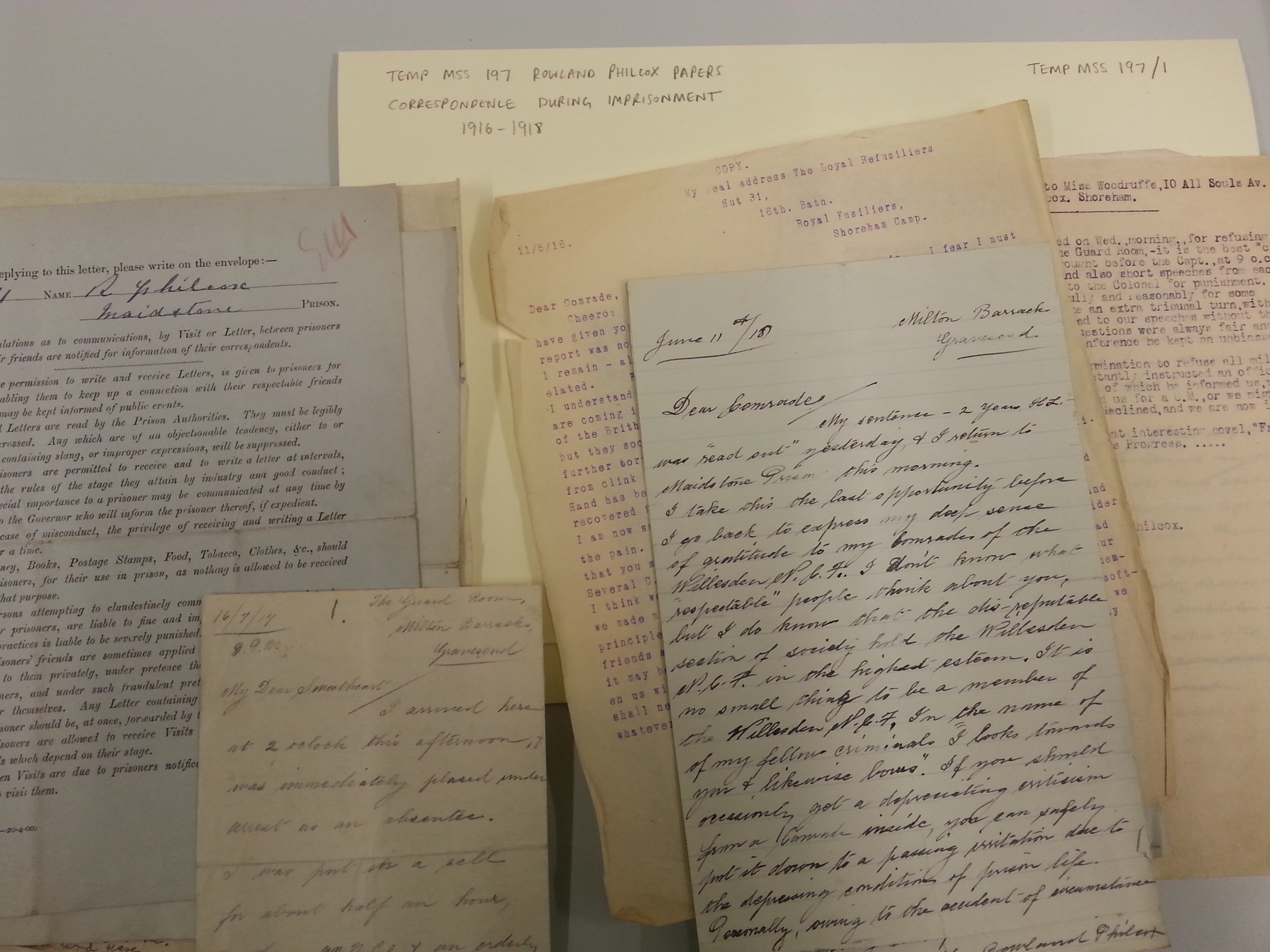
Rowland Philcox correspondence

Correspondence from Rowland Philcox during his imprisonment as a conscientious objector, 1916-1918 (Library ref. TEMP MSS 197/1)


A new generation of prison reformers

Another common thread running through the personal accounts of imprisoned COs in World War I is the insight into prison conditions they gain from their time in civilian prisons and how this develops into an interest in prison reform – carrying on a strong Quaker tradition.

Many of them describe in detail the difficulties of solitary confinement, poor sanitation, limited opportunity for conversation with fellow inmates, and – a constant feature in all the accounts – prison food, with Philcox (a vegetarian) even including a handwritten menu for Maidstone Prison! (Library ref. TEMP MSS 197/1)

Elliott, who rarely complains about prison conditions, describes an encounter in Mountjoy Prison to illustrate the attitude of the clerk, but it shows the toll the experience has taken on him physically:

“Just then another clerk said ‘You lost some weight in here!’ So the clerk said sneeringly:- ‘Yes that’s his disobedience; he would not have lost 3 stone if (he) did what he was told.’” (Library ref. TEMP MSS 197/2)

The men were often on punishment diet of bread and water for refusing to undertake tasks they felt conflicted with their beliefs.

The ultimate sacrifice

What emerges most strongly from the accounts and correspondence of these men is the strength of their conviction. They speak passionately and intelligently about their reasons for opposing the war.

Philcox expresses the strength of his conviction eloquently in an early letter when the men are being threatened with the death sentence in France:

“I expect my comrades at liberty are agitated by the news of our probable fate, but I suggest that they do not devote all their efforts to procuring our release. Remember that the ideas of patriotism and militarism are surrounded with the glamour of self-sacrifice which the heroism of innumerable soldiers has cast upon them – sacrifice hallows any cause…When the final hour arrives…the principles of International Fraternity will be placed on an equal footing to the prejudice of patriotism.” (Library ref. TEMP MSS 197/1)

In the papers of Arnold Rowntree MP (1872-1951), there is an extreme example of the hardship endured by C.O.s – a vivid demonstration that the path of the absolutist was not an easy one, taken by cranks and shirkers. The account tells how H. Firth arrived at the Dartmoor work camp malnourished after spending 8 months in Wormwood Scrubs and Maidstone Prisons. The men appealed on his behalf, on seeing his weakened state, but he was immediately put onto heavy quarry work. After one collapse, they moved him on to ‘whitewashing’ which was done through the night, from 7.30pm to 5.30am. He eventually ended up in the camp hospital after another collapse.

The account recalls:

 “He was in a very emaciated condition and complained then and repeatedly of great weakness and thirst….On January the 8th he again applied to the doctor, complaining of the cold, and was met with the usual taunt that it was selfish, and that the soldiers in the trenches had to put up with worse

On that day he (the doctor) met Firth’s request for eggs for food with the remark that they were all needed for wounded soldiers. Three eggs arrived the next day when Firth was dead, for he died at 8.55 am on Wednesday morning, February 5th. The previous evening, a friend suggested  that Firth’s wife should be telegraphed for, but the doctor replied that it was quite unnecessary. Death  was due to diabetes .”  (Arnold S. Rowntree Papers, Correspondence with conscientious objectors. Library ref. TEMP MSS 977/2/12)

The brief selection of highlights above just starts to scratch the surface of the amount of material we have which really gets inside the minds of conscientious objectors and makes their prison experiences vivid for today’s researcher.
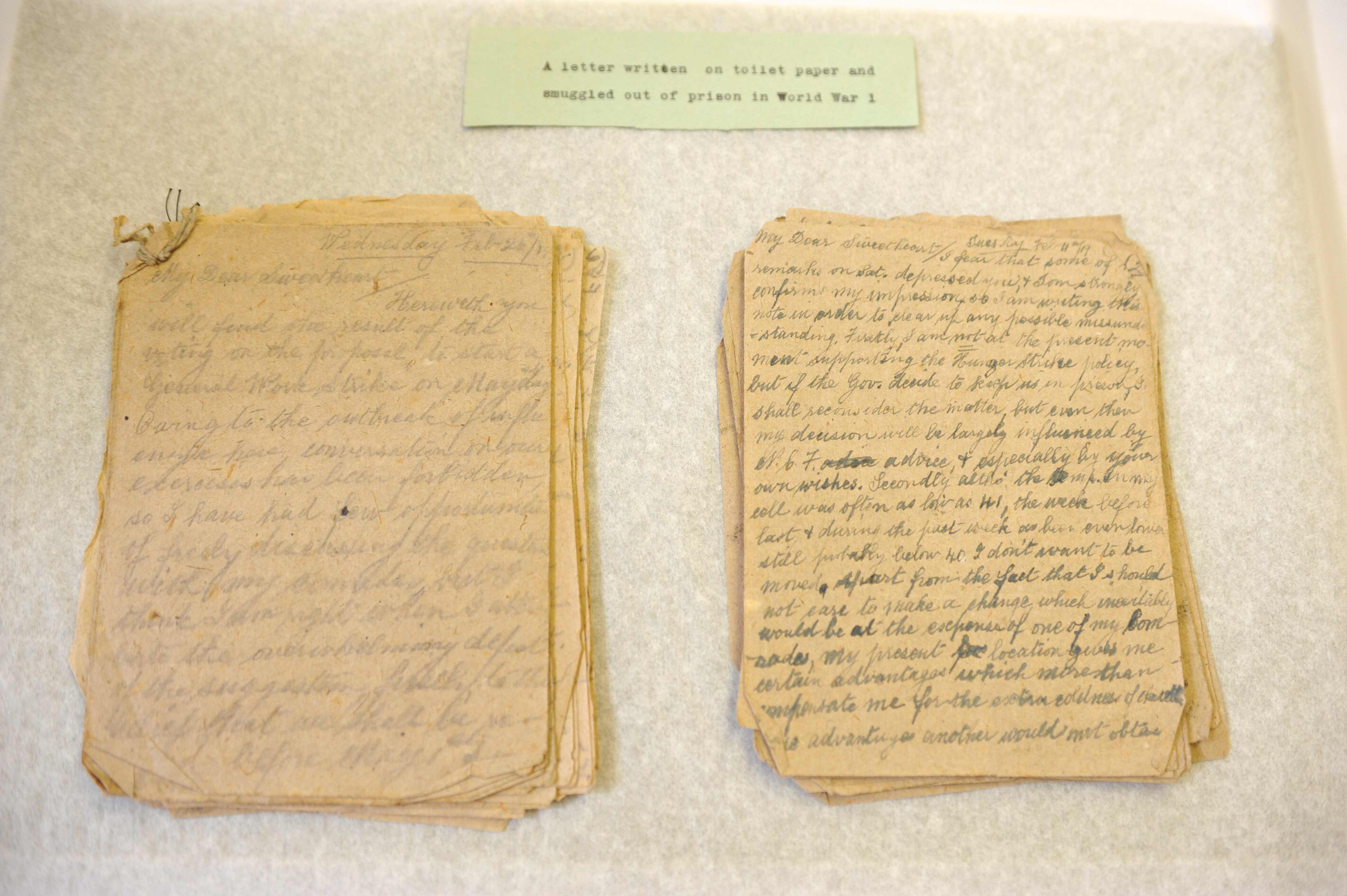
Rowland Philcox letters

Letter written on prison lavatory paper by Rowland Philcox and smuggled out of prison. Part of Rowland Philcox Papers (Library ref. TEMP MSS 197/1)
 

Posted in Guides | Tagged , , , | 5 Comments

Library resources for researching World War I: Friends Peace Committee

The first of our World War I resources blogposts focuses on the Friends Peace Committee, a committee of Meeting for Sufferings (the standing representative body of Quakers in Britain) that had already been in existence for many years before the outbreak of the War.

What was the Friends Peace Committee?

From its formation in the late 1880s, Friends Peace Committee was a vigorous Quaker committee with a strong outward looking character. Through a network of correspondents in Quaker meetings and active involvement with other peace organisations it aimed to establish local and international links with the wider peace movement.

When war was declared in 1914 the Peace Committee was already actively engaged in publishing and distributing peace literature – books, posters, postcards – campaigning against the growth in armaments and the threat of militarism, promoting arbitration, influencing public opinion and petitioning government.  As the literature being distributed shows, Quakers were ready to speak out on social and economic issues – “The armaments of the world… increasingly enrich the war traders and absorb the earnings and energy of the peoples in unproductive labour. They provoke suspicion and distrust and endanger the outbreak of devastating war” (report of Peace Committee for the year 1913-1914, London Yearly Meeting Proceedings, p.116).

The Peace Committee strongly urged Friends to become involved in other peace organisations and activities, locally, nationally and internationally. Its own publications show a perhaps surprising willingness to appeal to its audience in non-denominational, sometimes purely lay, terms.

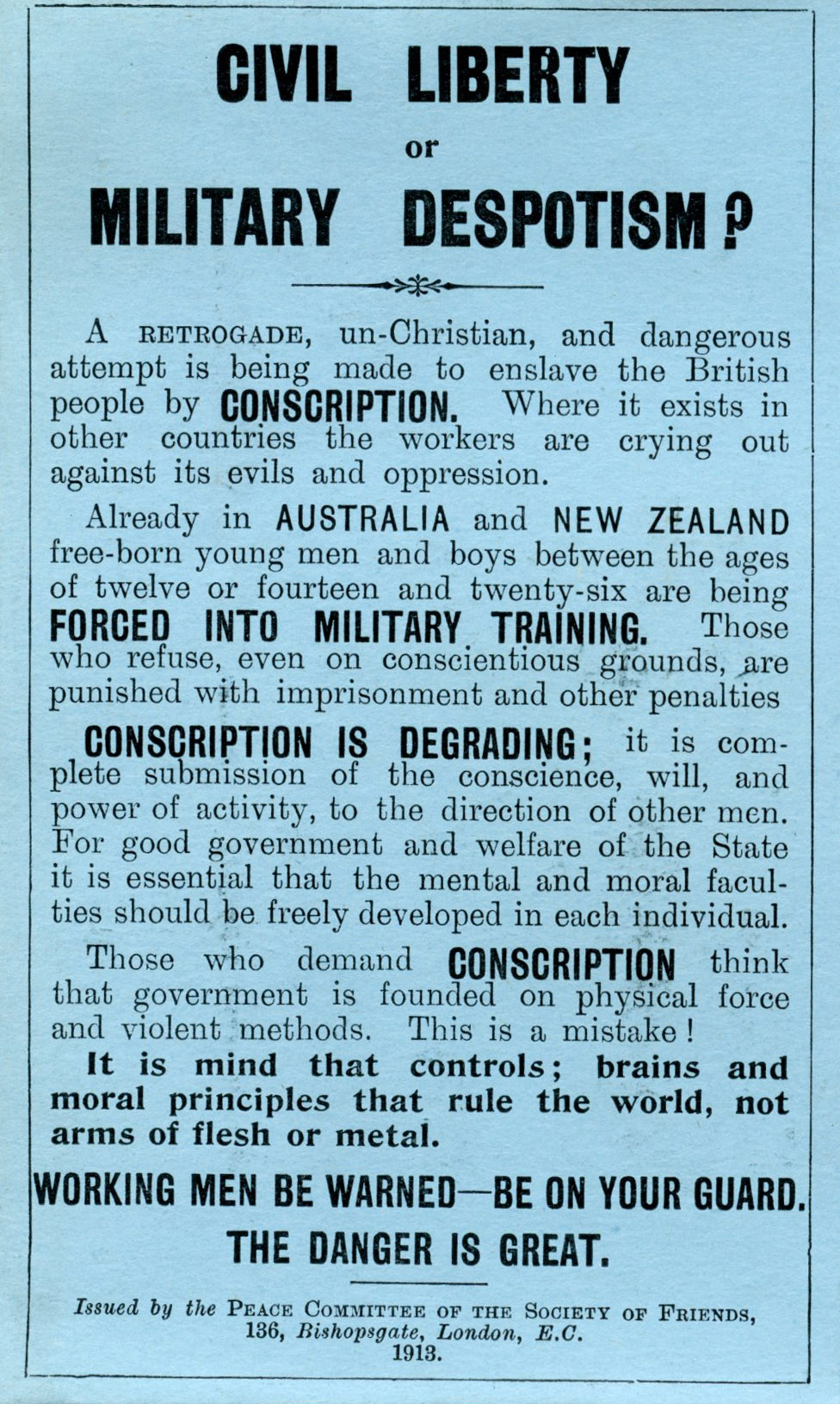
Civil liberty (Peace Committee, 1913)

Civil liberty or military despotism, postcard issued by the Peace Committee of the Society of Friends, 1913. Library ref.: Vol. T/218-219i

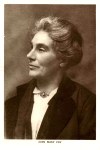
The Peace Committee was concerned to involve young Friends, and its membership was not limited to those already serving on the Meeting for Sufferings. Women had played an important role in the Committee from the beginning, including some indefatigable campaigners, such as Ellen Robinson (1840-1912), and later, during the War, Marian E. Ellis (1878-1952) and Joan Mary Fry (1862-1955).


What sources does the Library hold on the work of Friends Peace Committee during the First World War?

Peace Committee archives: minutes

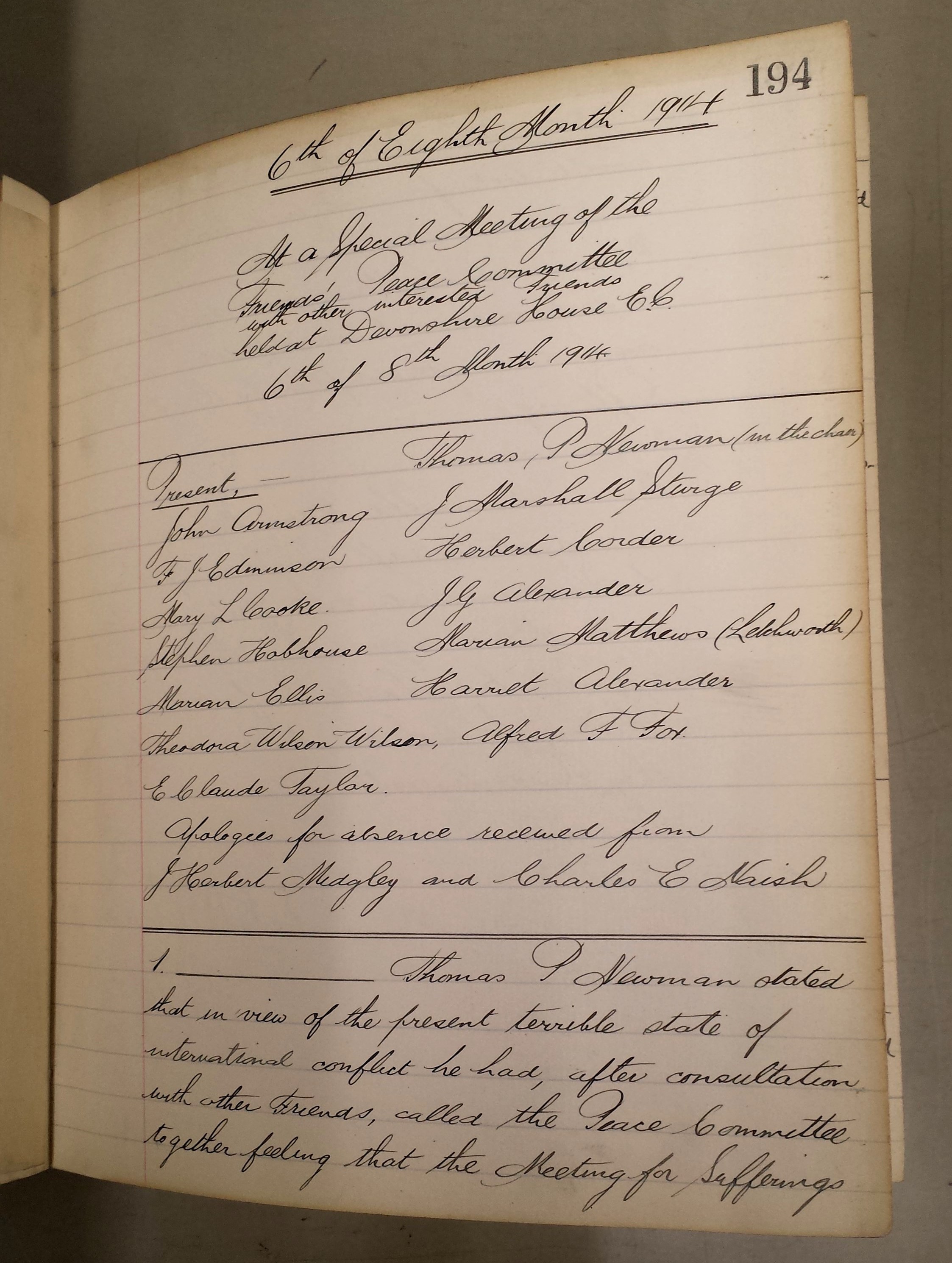
Peace Committee minutes 6 Aug 1914

Peace Committee minutes 6 August 1914 ( PE/M5, p.194)

The Library holds the archives of Friends Peace Committee from 1888 to 1965,

when its work was taken over by the new Peace & International Relations Committee. The World War I years are covered by two minute books for the years 1912-1916  and 1916-1921.

In the first year of the War a War Sub-committee was formed, with a membership extending outside the Peace Committee. Its records consist of one minute book recording eight meetings between 2 January and 2 November 1915.

Publication and distribution of peace literature was an important part of the Peace Committee’s activity, and mentioned regularly in its minutes and reports. Its Literature Sub-committee maintained a separate volume of minutes for the years 1912-1915.

Archives of the Peace Committee and its sub-committees during the years of World War I:

  • Peace Committee minutes (1912-1916)  (reference PE/M5)
  • Peace Committee minutes (1916-1921)  (reference PE/M6)
  • Literature Sub-committee minutes (1912-1915)
  •  War Sub-committee minutes and papers (1915)


Peace Committee reports

The Peace Committee’s annual reports to Meeting for Sufferings are published in the printed Proceedings of London Yearly Meeting (the annual gathering of British Quakers, now known as Britain Yearly Meeting).

  • Report for year 1913-1914              Yearly Meeting Proceedings 1914 p.111-117
  • Report for year 1914-1915              Yearly Meeting Proceedings 1915 p.10-16
  • Report for year 1915-1916              Yearly Meeting Proceedings 1916 p.17-21
  • Report for year 1916-1917              Yearly Meeting Proceedings 1917 p.51-55
  • Report for year 1917-1918              Yearly Meeting Proceedings 1918 p. 39-41
  • Report for year 1918-1919              Yearly Meeting Proceedings 1919 p. 57-60

The peace testimony, war and the question of service in wartime were obviously dominant concerns for London Yearly Meeting during the war years. The printed Proceedings record minutes on these subjects sent up for consideration by quarterly meetings around the country, as well as minutes and public statements of the Yearly Meeting itself.

Reports of other Quaker committees are also of interest for understanding the role of the Peace Committee: it would be mistaken to see its work in isolation from that of the new committees which sprang up in response to the needs of the times, sharing both members and interests, such as the Service Committee, the War Victims Relief Committee and the Emergency Committee for the Assistance of Germans, Austrians & Hungarians in Distress (the latter two of which eventually merged).  These organisations will be the subject of future blogposts of their own.

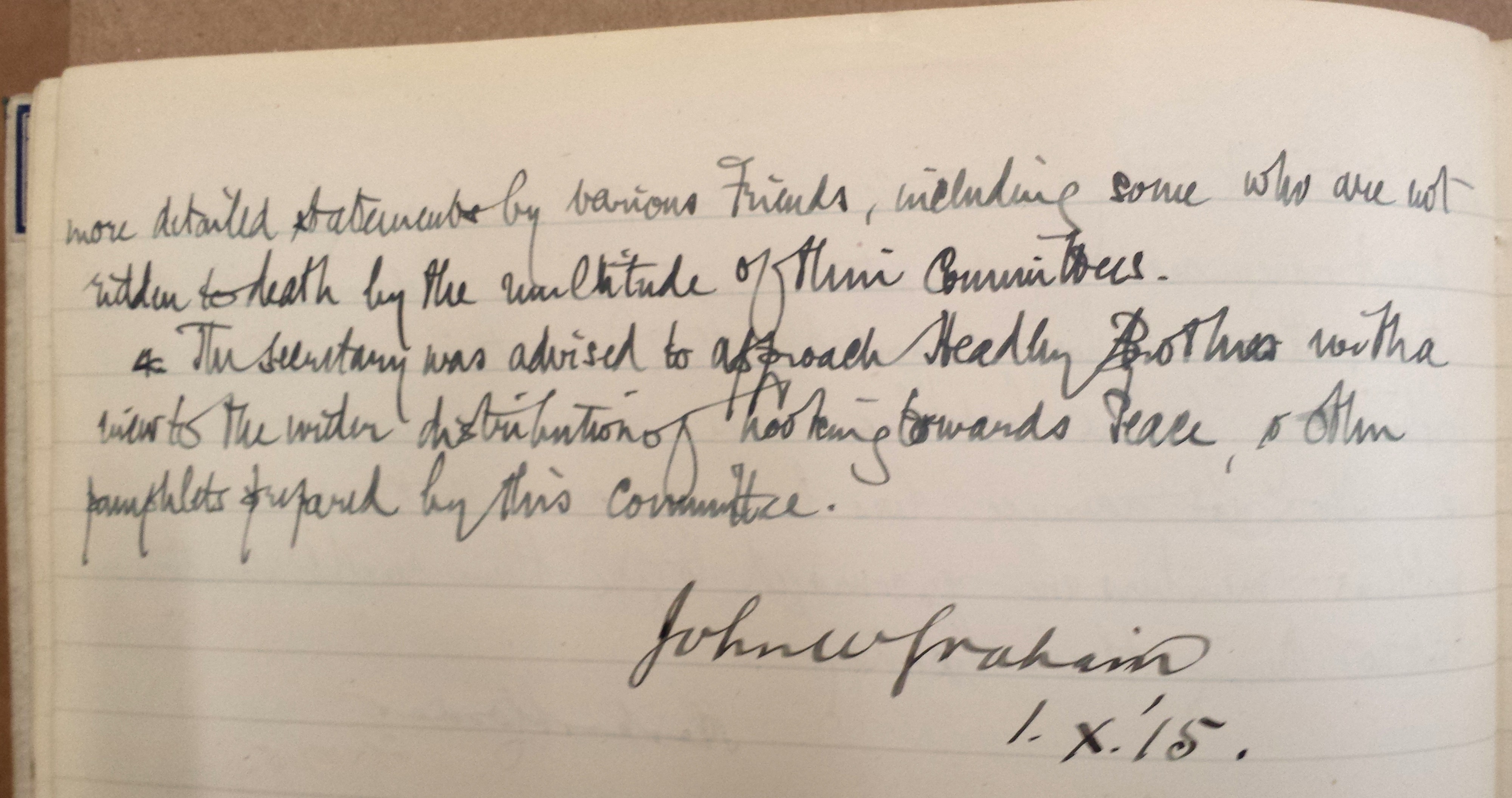
War Sub-committee minute 3, 2 Nov 1915

Extract from War Sub-committee minute 3, 2.ix.1915, referring to service of its members on a “multitude of committees”

An index was issued with each year’s printed Yearly Meeting Proceedings, printed at the front of each year.  The Library also holds a cumulative typescript index covering the period 1907-1932 (unpublished; available in the Library reading room).

Peace Committee membership records

Peace Committee was one of the larger central committees, with an expanded membership varying from 35 to 42 during the period of the First World War. Names of individual members were published in the printed annual lists of members of Meeting for Sufferings and its committees. A month by month record of appointments made by Meeting for Sufferings can be found in the minutes of Meeting for Sufferings. The Library has compiled an index of all Friends who served on the Peace Committee, including birth and death dates and dates of service (unpublished; available in the Library reading room).

Suggestions of Friends to serve on Peace Committee or its sub-committees also came from the Committee itself, and the Committee’s minutes are the main source of information about attendance of other Quakers who weren’t actually members of the Committee. For instance, on 6 August 1914, an emergency meeting of Peace Committee “with other interested Friends” was held, with Thomas P. Newman (in the chair), John Armstrong , J. Marshall Sturge,  F. J. Edminson, Herbert Corder, Mary L. Cooke, J. G. Alexander, Stephen Hobhouse, Marian Matthews (Letchworth), Marian Ellis, Harriet Alexander, Theodora Wilson Wilson, Alfred F. Fox, and E. Claude Taylor.

Peace Committee publications

Publications of the Peace Committee between 1914 and 1919 are included on the Library’s online catalogue, including books, pamphlets, circulars and postcards. To find full details, you can search the catalogue by organisation or by publisher, and limit your search by date.

The Peace Committee also produced a series of posters, some of which survive in our picture collection.

Further sources

Horace G. Alexander. “A nearly forgotten chapter in British peace activity – 1915.” Journal of the Friends Historical Society, vol. 55, no.5 ( 1987), p. 139-143. First hand account of the work of the War Sub-Committee by Horace G. Alexander, who served on it as a young man.

Margaret Glover. Images of peace in Britain from the late nineteenth century to the Second World War. PhD thesis, University of Reading, 2002.

Thomas C. Kennedy. British Quakerism 1860-1920: the transformation of a religious community.  Oxford University Press, 2001. Especially chapter 9, “A ghoulish terror of darkness” p.312-387.

Thomas C. Kennedy. “Many Friends do not know where they are.” Quaker theology, no. 11 (2005).  (Available online here).

Paul Laity. The British Peace Movement 1870-1914. Oxford University Press, 2001.  Origins of the Friends Peace Committee (p. 118-123) and the pre-war peace movement (p. 176-215).

Posted in Guides | Tagged , , , , | 8 Comments

Library resources for researching World War I

The horror of the First World War made such a profound impact that responses to it a century later are still powerful. Historians, journalists and members of the public are engaging in passionate debate about the war and its causes – and their significance for the 21st century world; libraries, museums and cultural institutions are marking the anniversary with a wave of events and exhibitions; local people are exploring the ways in which events of 100 years ago affected their own towns and villages; schools are commemorating former pupils among the war-dead.

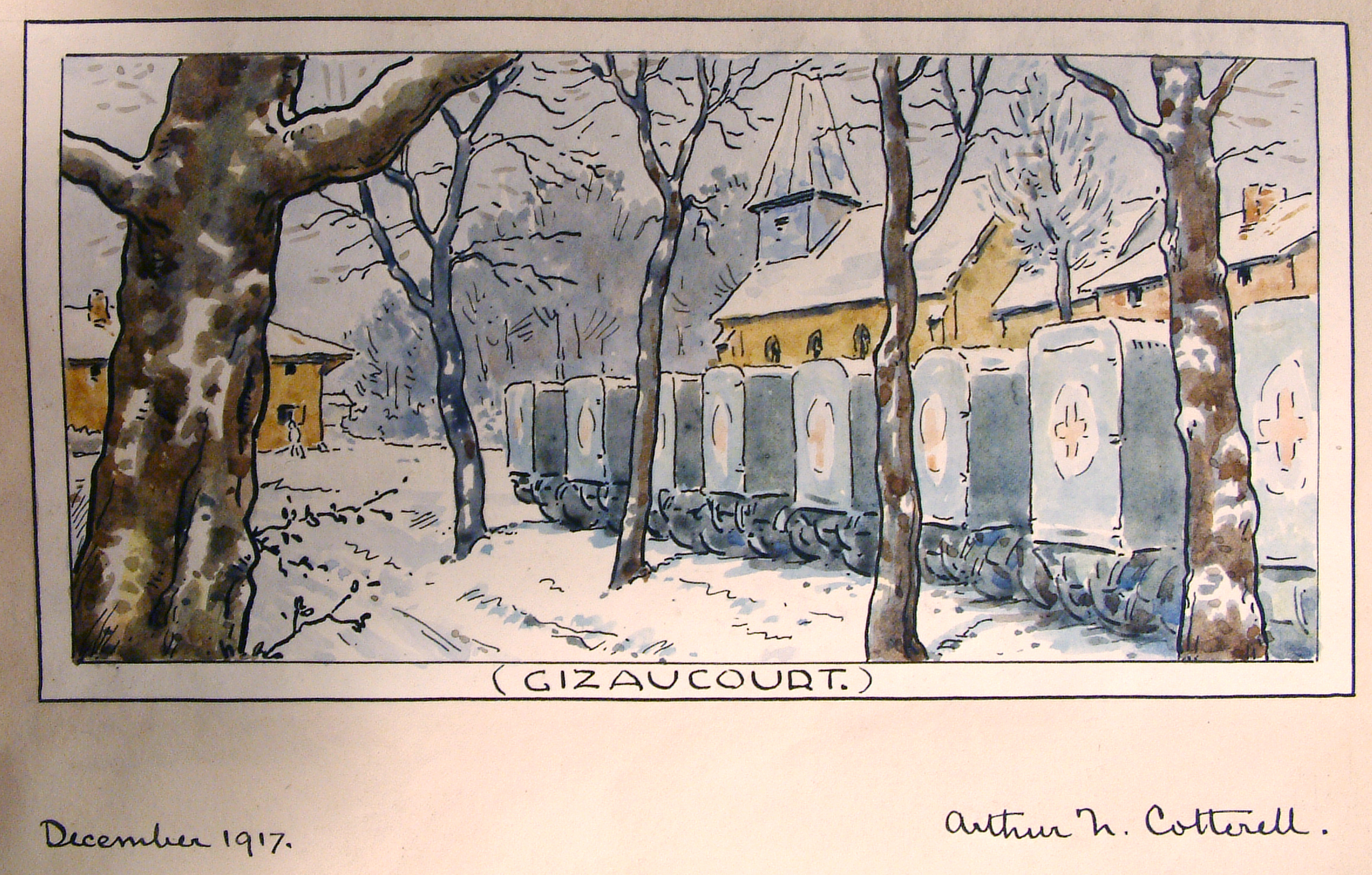
Cotterell, Ambulances at Gizaucourt, winter 1917

Ambulances, Gizaucourt, December 1917. Watercolour by Arthur Cotterell. In: Autograph book of Friends Ambulance Unit members 1917. Reference: MS VOL S 284

Many Quaker meetings around the country are also marking the centenary – as an opportunity to speak out about remembrance, reconciliation and paths to non-violence. To support them, Witnessing for peace on the centenary of World War I: a resource pack for Quaker Meetings has been produced, available online on the Quakers in Britain World War I centenary webpage at the end of February (also available free in hard copy – request a copy by email: quakercentre@quaker.org.uk, or by post from: WWI Resource Pack, Quaker Centre, Friends House, 173 Euston Road, London NW1 2BJ).

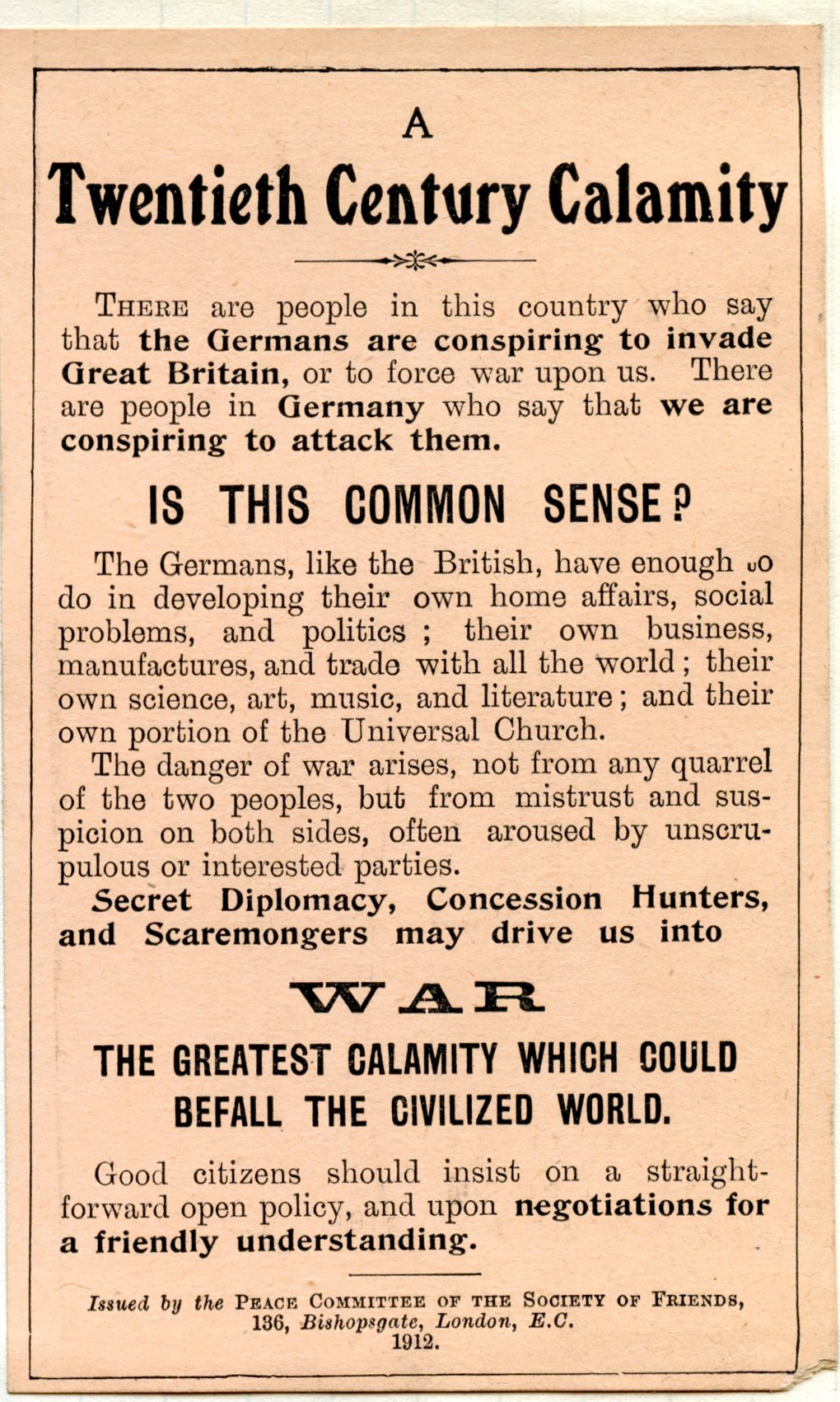
Twentieth century calamity. Peace Committee 1912

A twentieth century calamity. Postcard issued by the Peace Committee of the Society of Friends, 1912. Reference: Vol. T/218-219d

Among other things, the pack will include an updated Library guide to Quakers and World War I, listing some of the major printed and archival sources held here on Quakers’ peace witness and service during the war and its aftermath.

Use of the Library’s collections by readers and enquirers researching the period has already soared, as might be expected. After all, we hold the records of centrally organised British Quakers’ work for peace and for the relief of wartime suffering. Our collections include:

  • archives of various Yearly Meeting committees that spoke up for peace and      international conciliation and supported the witness of conscientious objectors to military service
  • archives of Quaker organisations set up to provide medical care and relief for the      victims of the conflict
  • personal papers of individual campaigners, conscientious objectors and relief workers
  • contemporary pacifist publications, campaign literature, appeals, reports, published      accounts and histories of the work
  • photographic archives of the Friends Ambulance Unit (1914-1919) and the Friends      Emergency & War Victims Relief Committee (1914-1924)
  • paintings and sculpture depicting and commemorating Friends involvement


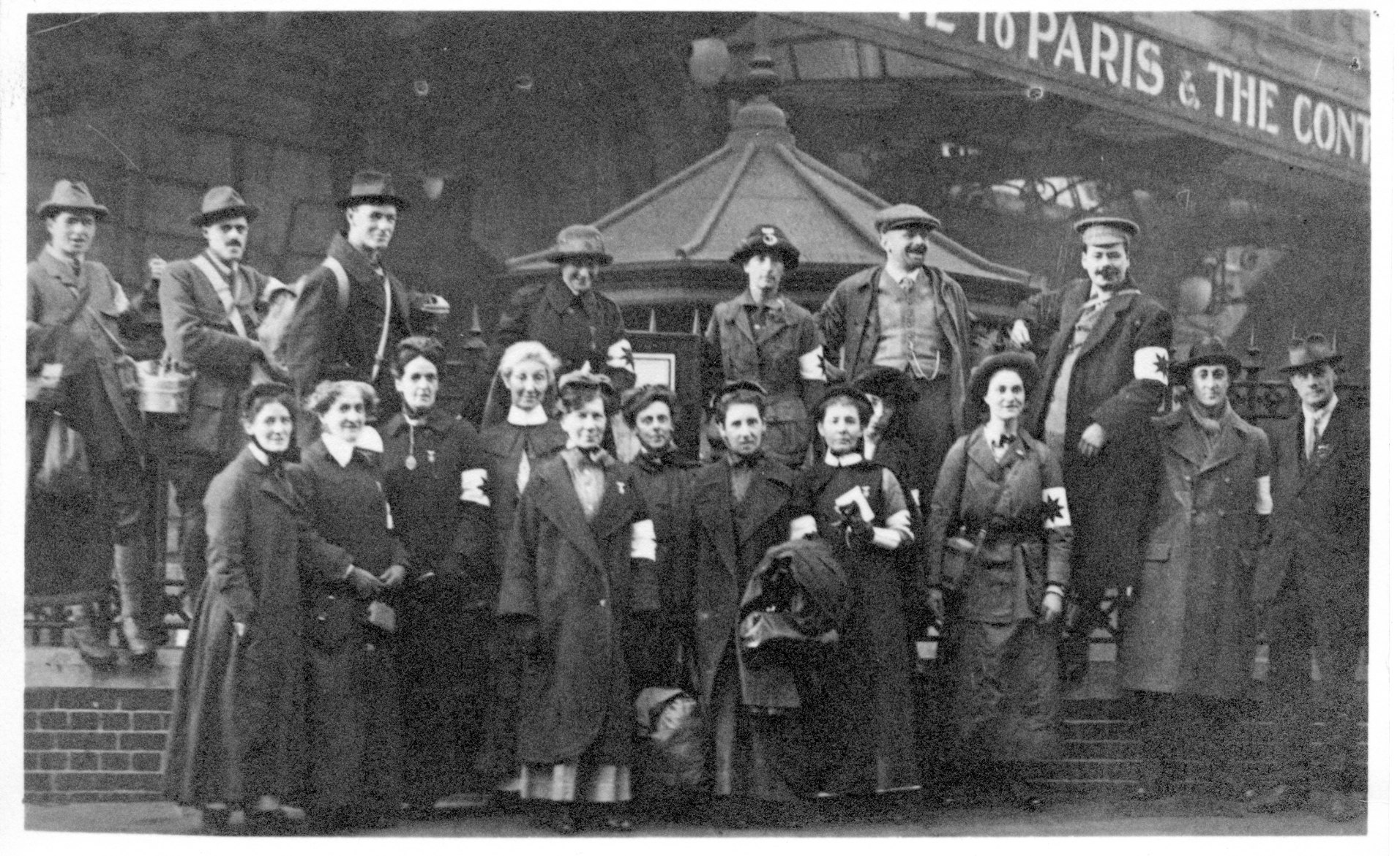
FWVRC workers

The first party of Friends ready for service under the War Victims Relief Committee, at Victoria Station. Photograph, FEWVRC archives 1914

As a further aid to researchers, over the coming months this blog will explore some of the Library’s World War I resources in greater detail. Expect to see blog-posts on the Friends Peace Committee, Friends Service Committee and other wartime committees; the archives of the Friends Ambulance Unit (1914-1919); the Friends Emergency & War Victims Relief Committee (1914-1923) cataloguing project funded by the Joseph Rowntree Charitable Trust; unpublished diaries and other papers of conscientious objectors; printed sources and photographic collections. We will also bring you news about World War I collections fully catalogued for the first time.

Together with the forthcoming launch of a new online archive catalogue this spring, we hope these blog-posts will provide valuable guidance for Library users researching all aspects of Quakers and the first global war.

Posted in News | Tagged | Leave a comment

Horses – bits and bots: the writings of Bracy Clark, F.L.S.

It’s the Chinese Year of the Horse – not much Quaker material there you might well think. If you were researching horses and equine veterinary practice, our Library would hardly be your first port of call. You might – perhaps – have heard of the trouble the Quaker chocolate families got themselves into by owning a “racing  newspaper” which promoted gambling, or come across remonstrations against the sport of horse racing from Quakers like Thomas Cash (To those inhabitants in and about Wilmslow, who have lately been the cause of great uanity and uuickedness … by horse races, 1799), but you’d not think there would be much else.

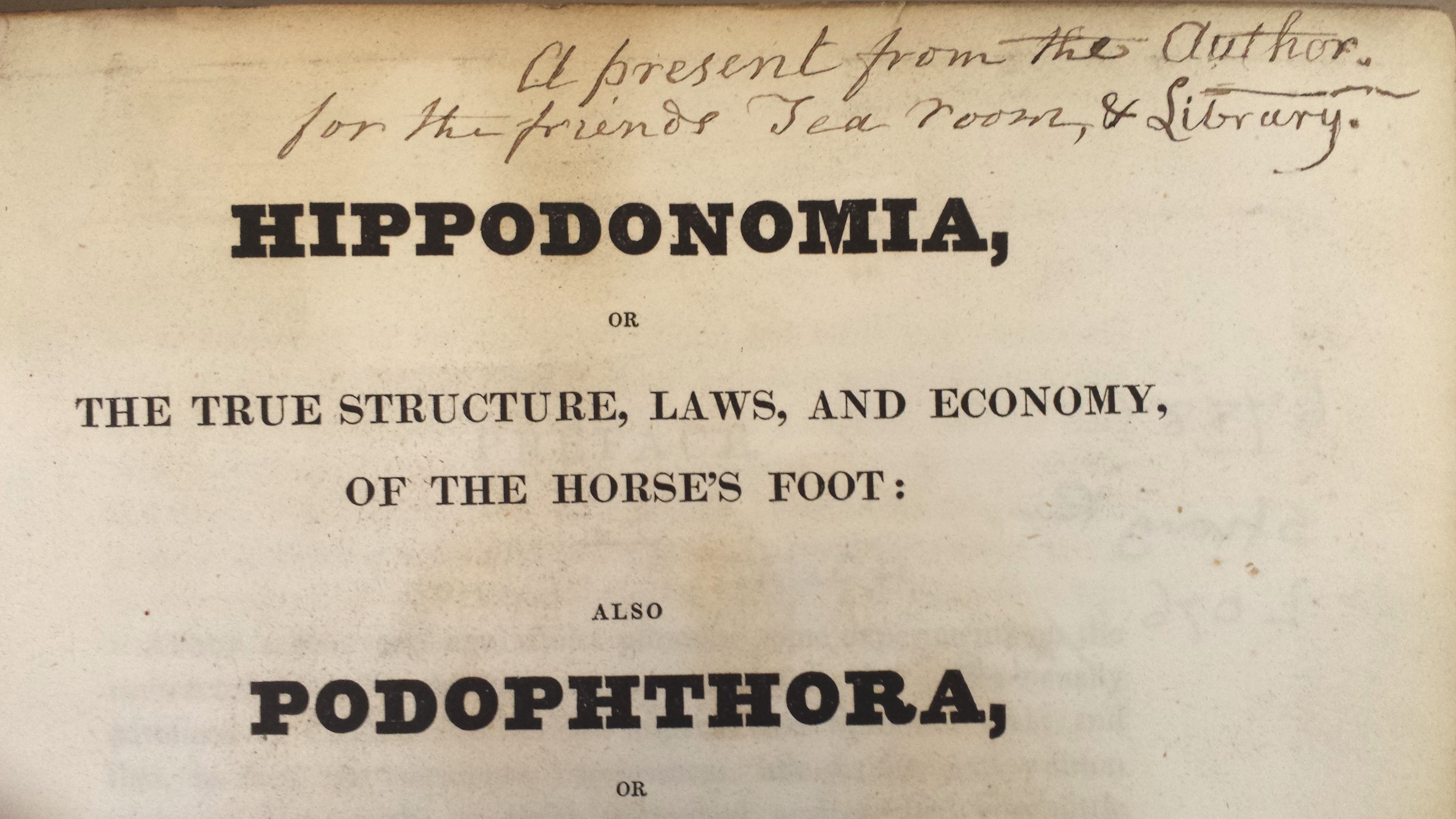
However, the Library does have in its collections two surprising volumes containing 36 separate and varied works on horses by Quaker Bracy Clark (1771-1860), accessioned in 1925 but presented many years earlier by the author to Friends’ Tea Room and Library (later the Friends Institute, Devonshire House).

Bracy Clark presentation inscription

Volume one of Bracy Clark’s publications on horses, presented to the Friends’ Tea Room and Library – inscription on first title page.
Reference L 076.1 CLA. Copy no. 6788

The individual items in the volumes have recently been added to our on-line catalogue, as part of the retrospective cataloguing project. All told, Bracy Clark wrote around fifty treatises on the history, care, diseases and treatment of horses, published from 1807 to the 1840s.

Bracy Clark (1771-1860) was born to John Clark and Hannah Hitchman of Chipping Norton, Oxfordshire. His father, a Quaker in the leather trade, died when Bracy was just two. He was educated at the school run by the Quaker Thomas Huntley at Burford, then apprenticed to another Quaker, Joseph Tresher, a surgeon, during which time he studied Greek, chemistry and natural history, and even started the first cricket club in Worcester.

He qualified as a veterinary surgeon at the newly established veterinary school in London, as a pupil of the eminent Scottish surgeon John Hunter FRS (1728-1793). During his lifetime Bracy Clark “devoted an enormous amount of time and labour to the subject of the horse’s foot and the horse-shoeing”.

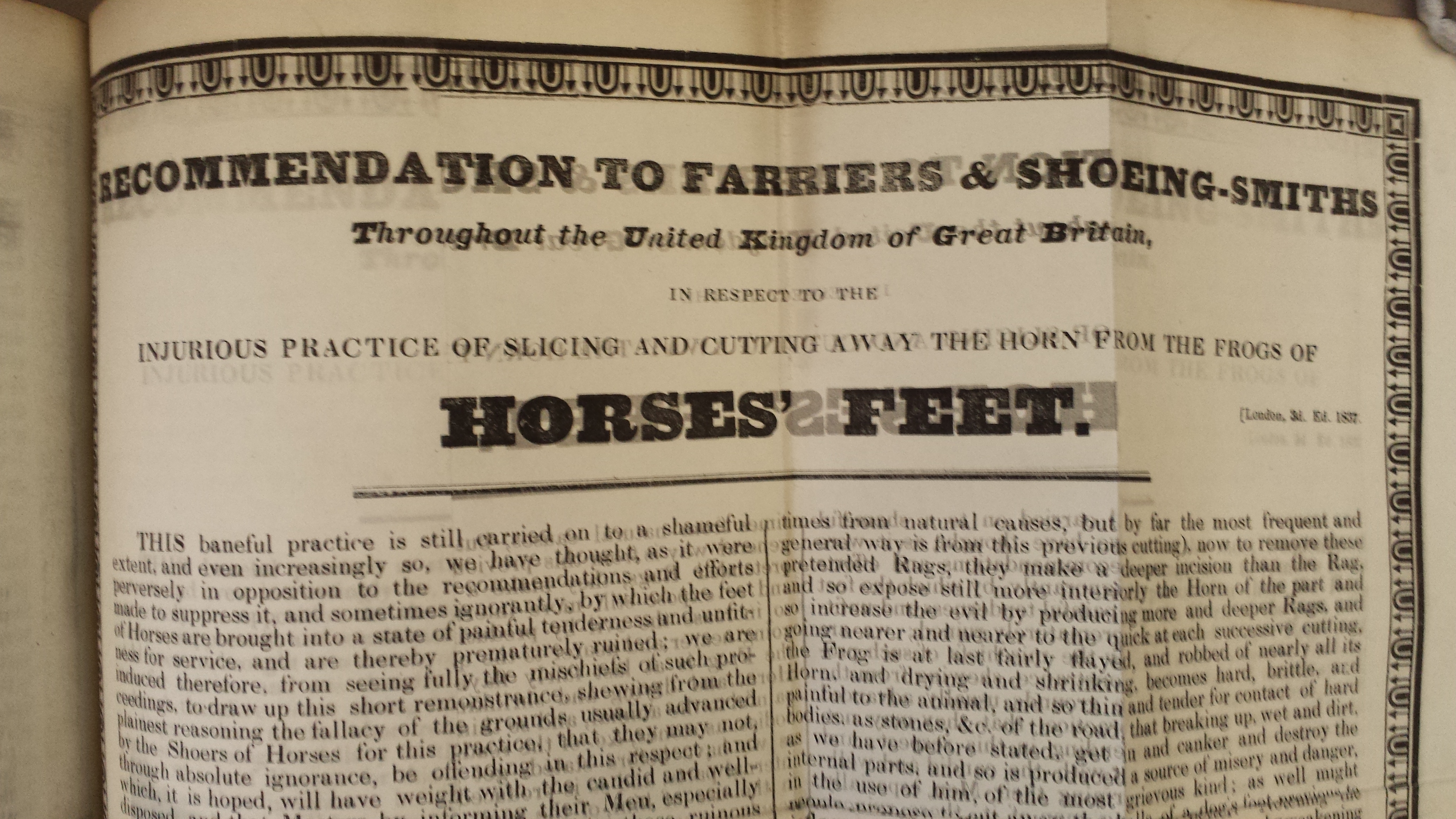
Bracy Clark, Recommendation to farriers & shoeing-smiths throughout the United Kingdom. 3rd ed (1837)

Clark, Bracy. Recommendation to farriers & shoeing-smiths throughout the United Kingdom. 3rd ed (1837)

He was a member of the Linnæan Society, the Paris Académie des Sciences, the Natural History Society of Berlin and Copenhagen, the Royal Agricultural Society of Stuttgart, and in 1817 was made an honorary member of the Natural History Society of New York. He was one of those many nonconformist contributors to Abraham Rees’s Cyclopaedia (published as a weekly serial between 1802 and 1820), writing on the anatomy of horses, bits, bleeding, blindness, blisters, bots, broken wind, canker, corns, curb and collar (Do all the bad things that go wrong with horses begin with B or C?).

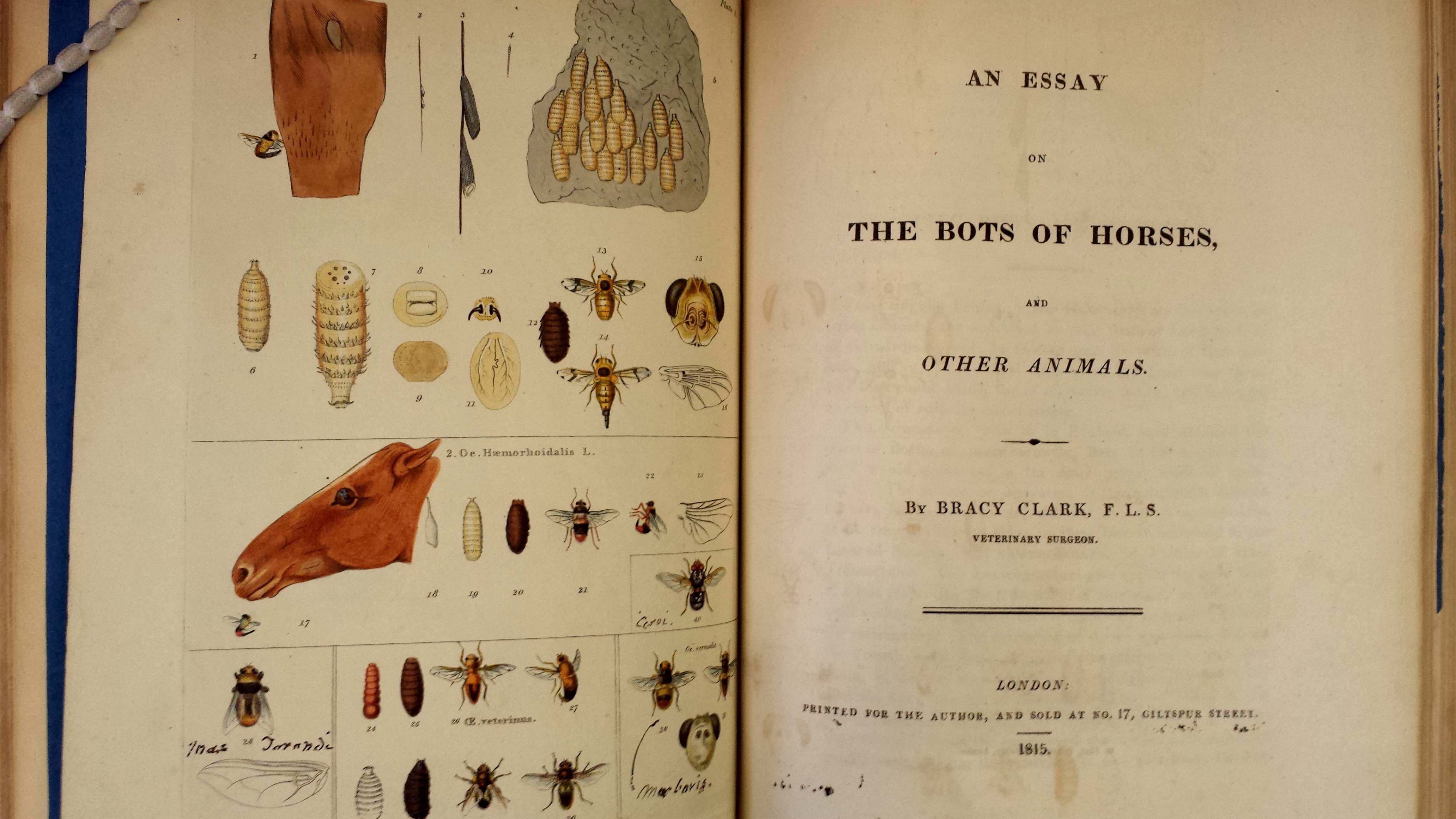
Bracy Clark. An essay of the bots of horses and other animals (1815)

Clark, Bracy. An essay of the bots of horses, and other animals (1815). Title page and frontispiece

He was very concerned with the health of horses’ hooves, the circulation of blood, how to cure cracked hooves and, particularly, new shoeing techniques. For the latter significant discoveries he was ridiculed by many, including members of the Royal Veterinary College.

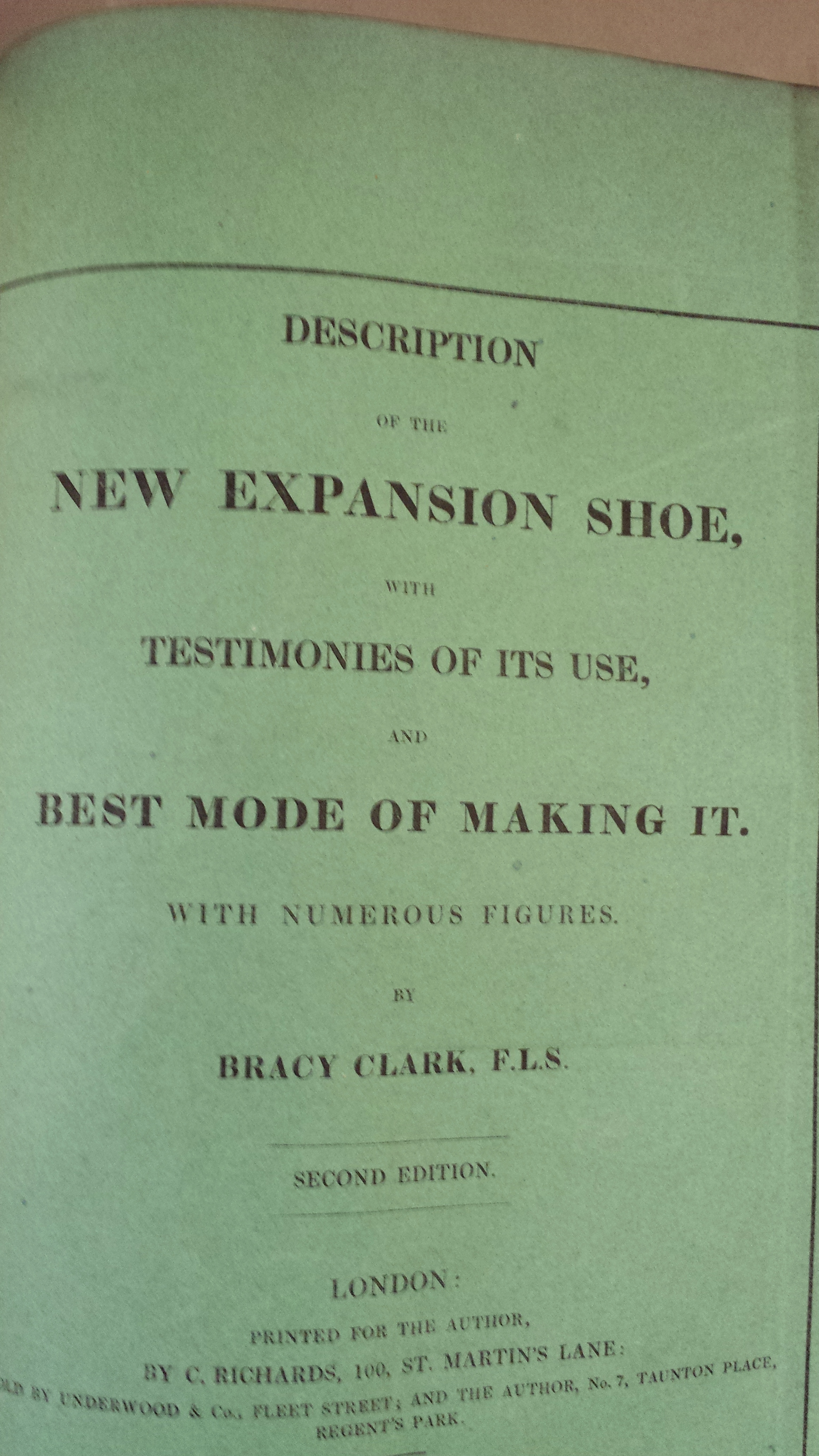
Bracy Clark, A description of a new horse shoe which expands to the foot invented by Bracy Clark (1827). Front cover

Clark, Bracy. A description of a new horse shoe which expands to the foot invented by Bracy Clark (1827). Front cover

Shortly before his death, his nephew James Hurnard relates, he sold to the Veterinary College of Edinburgh the skeleton of the celebrated, undefeated race-horse Eclipse (“Eclipse first and the rest nowhere”), which he kept in his study. Hurnard went on to write a splendid equine elegy to his uncle – the unsung Hampden of his day:

To Bracy Clark, F.L.S.

Descendent not unworthy of a sire!
The Hampden of the common where he dwelt,
Bracy, this tribute of a deep, heartfelt,
And honest admiration, I desire
To offer to thy name. The world has dealt
Unkindly with thee; and the heart must melt
To see a genius, which could not tire,
Cramped, like the hoof within its iron belt.
But so it is; the dead, whom we admire,
At whose proud tombs past centuries have knelt,
Were, when alive, the men the world could pelt,
And see in chains or banishment expire.
One comfort still remains to gild our earth,
Men cannot crush the consciousness of worth.

What finer tribute to a horse lover?

Posted in Highlights, Projects | Tagged , , , , | 3 Comments

Readers’ stories: researching the India Conciliation Group

Sue SmithThe fourth in our series of readers’ stories is from Sue Smith who has recently completed a Postgraduate Certificate in Historical Studies at the University of Oxford. Sue is a member of Oxford Quaker Meeting and co-clerk and resource person for Quaker Peace & Social Witness Turning the Tide programme.

Sue is especially interested in the history and practice of nonviolence, and other conscience driven forms of resistance to authority and power.

It was the little bits of paper that got me.  Often a couple of inches square, hardly more.  Handwritten by Gandhi, to members of the India Conciliation Group (ICG) on their visits to his ashram.  They were so brief, but they made the wonderful mix of humour, tact and utter honesty that was Gandhi’s hallmark come alive. It was as if he was in the room when I read them.  They are in amongst the ICG papers in Friends House Library.

I came across them while researching for a dissertation on what Quakers were doing in India in the 1930s and 1940s. My parents were in the Friends Ambulance Unit in Bengal during the Second World War, and I wanted to know: what contribution, if any, did Quaker work make to Indian independence?

I had never heard of the India Conciliation Group before, but from my research I learned a lot about  other people’s perceptions of what Quakers do out there in the world, then and now.  The ICG attempted to mediate between British political decision-makers and Indian independence leaders. They made personal contact with everyone they knew with political influence, in Parliament, the Cabinet, in other churches, lobby groups, and women’s organisations. ICG members knew and admired Gandhi and were supportive of his work, although sometimes their worries about his methods speak out from the letters they wrote to him. Horace Alexander, the best known figure in the group, and also the head of the FAU for a period, remarked wryly that he had been “out-Quakered by a Hindu”.

I had imagined that Gandhi had always been a popular figure among Quakers – how could he not be?  He was a practitioner of nonviolent methods, the inspiration for pacifists, a key figure in the India independence struggle.

Many British Quakers welcomed him, but others were uneasy about his use of civil disobedience campaigning as a strategy to hasten Indian independence. Was he not provoking violence in the Salt Marches, and other campaigns, and damaging his own cause? Surely conciliation between the British Raj and Indian nationalists would be a better approach?  Quakers are usually supportive of the value of individual pacifism, but, historically, when nonviolent methods have been used to further political ends, many have become uneasy.

Quakers were seen by all sides in this struggle as a good thing, but not all parties quite understood what they were trying to do.  Some politicians at the time found them irritating.  Some Indian independence leaders were infuriated by their attempt to be even-handed. But when Indian independence was finally achieved in 1947 the new leaders of India courted them assiduously, and towering figures like Nehru (himself a proponent of nonviolence) privately acknowledged their influence in the wave of optimism that accompanied the post-war establishment of the United Nations.

My dissertation, Goody-goody fellows? Quakers and the end of empire in India, is held in the Library at Friends House and is also published online as a British Empire at War Research Group Paper (BEAW research paper number 3). You can find out more about the papers of the India Conciliation Group (TEMP MSS 41-52) from the Library.

For more information about  Friends and nonviolence today, see http://www.turning-the-tide.org/, or contact Steve Whiting, TTT Programme Manager  in Quaker Peace and Social Witness Department, at 0207 663 1061

Posted in Readers' stories | Tagged , , , | 6 Comments

Some new fruits of research in the Library’s collections

snowOver the past year the blog has focused on both well used and less known parts of the collections and reported some of the work we do to preserve and make them better known.

We highlighted a few of the commonplace books in the manuscript collections, a rare early 20th century periodical, the records of not one, but two Quaker sporting teams, an 18th century joke book and some Chinese pamphlets. There was news of two projects relating to 20th century relief work – cataloguing the papers of Quaker Dorothy Henkel and a collaborative microfilming project with the US Holocaust Memorial Museum – as well as the conservation of an outsized tract volume containing a rich trove of anti-slavery campaigning literature. Items from the Library’s picture collection starred in a post about research for the Quaker Arts Network’s 2014 calendar, “Inspired by worship”, and we showed you some of the silhouettes and our own stumbling attempts at “scissors art”.

The blog did also feature some of the wide variety of users of the Library’s collections and services: two of our readers wrote this year about what using the Library has meant for their research (Bill Chadkirk on The Elbow Lane Scandal and Esther Sahle on Eighteenth century London – a foreign country).

The final post of 2013 seems like a good time to celebrate some of the fruits of all this research. Each year there is a great crop of books, chapters, articles, conference papers and theses written by people who have used the Library. Others produce websites, exhibitions, broadcasts, plays and teaching material. And they use images from the collections to illustrate their work. Seeing the broad range of outputs of your research is awe inspiring.

So this is our chance to congratulate and thank you, especially those who present the Library with copies of their work. To all of you – you know who you are – thank you!

Below is just a small selection of works by Library users donated to the Library this year.

Blackheath Quaker Meeting.  Our story: minutes to remember. London: Blackheath Quaker Meeting,   2013
Ellis, Peter and King, Roy.  Extra-churchyard burials at Winchester Street, Andover: excavations in 2002. In: Hampshire studies (2013)
Greenwood, Martin.  Pilgrim’s progress revisited: the nonconformists of Banburyshire 1662-2012. Charlbury: Wychwood Press, 2013
Guibbory, Achsah.  Christian identity, Jews, and Israel in seventeenth-century England. Oxford: Oxford University Press, 2010
Inspired by worship : Quaker Arts calendar 2014. Quaker Arts Network, 2013
Jacobs, Mary.  Manhood and Interregnum: a study of the first Quakers, 1647-1660. Thesis (M.A.) Kings College, 2013
Kramer, Ann.  Conscientious objectors of the Second World War: refusing to fight. Barnsley: Pen and Sword Social History, 2013
Longhurst, Liz.  A Memoir of William Drewett (1834-1900): a memoir of a Victorian Quaker from Luton, a miller and an engineer. Reading: Dreamcatchers, 2013
Marshall, Tim.  Quaker clockmakers of north Oxfordshire. Mayfield, Ashbourne: Mayfield Books, 2013
McMahon, Elisabeth.  Slavery and emancipation in Islamic East Africa: from honor to respectability. Cambridge: Cambridge University Press, 2013
Meggitt, Justin.  Early Quakers and Islam: slavery, apocalyptic and Christian-Muslim encounters in the seventeenth century. Uppsala: Swedish Science Press, 2013
Oldfield, J. R.  Transatlantic abolitionism in the age of revolution : an international history of anti-slavery, c.1787-1820. Cambridge: Cambridge University Press, 2013
Peters, Kate.  The dissemination of Quaker pamphlets in the 1650s. In: Roeland Harms, Joad Raymond and Jeroen Salman (eds). Not dead things: the dissemination of popular print in England and Wales, Italy, and the Low Countries, 1500-1820. Leiden: Brill, 2013
Pretus, Gabriel.  Humanitarian relief in the Spanish Civil War (1936-1939). Lampeter; Lewiston: Edwin Mellen Press, 2013
Smalley, Roger.  Agitate! Educate! Organise!: political dissent in Westmorland from 1880-1930. Kendal; Carlisle: Cumberland and Westmorland Antiquarian and Archaeological Society, 2013
Smith, Susan.  Goody-goody fellows?: Quakers and the end of empire in India. Thesis (Postgraduate Certificate in Historical Studies) University of Oxford, 2013
Sowerby, Scott.  Making toleration: the repealers and the Glorious Revolution. Cambridge, Mass.; London: Harvard University Press, 2013
Tusan, Michelle.  Smyrna’s ashes: humanitarianism, genocide and the birth of the Middle East. Berkeley, Ca.: Global, Area, and International Archive; University of California Press, 2013
Tyzack, Charles.  Nearly a Chinese: a life of Clifford Stubbs. Hove, Sussex: Book Guild Publishing, 2013
Vigus, James.  “That which people do trample upon must be thy food”: the animal creation in the journal of George Fox. In: C. Muratori and B. Dohm (eds.), Ethical perspectives on animals in the renaissance and early modern period. Firenze, 2013
Waterson, M. and Wyndham, S.  Constancy & change in Quaker philanthropy: a history of the Barrow Cadbury Trust. The Trust, 2013

Finally, here’s to all our readers and supporters, and to an equally fruitful year to come!

Posted in New accessions | Tagged , | 1 Comment

Chinese translations

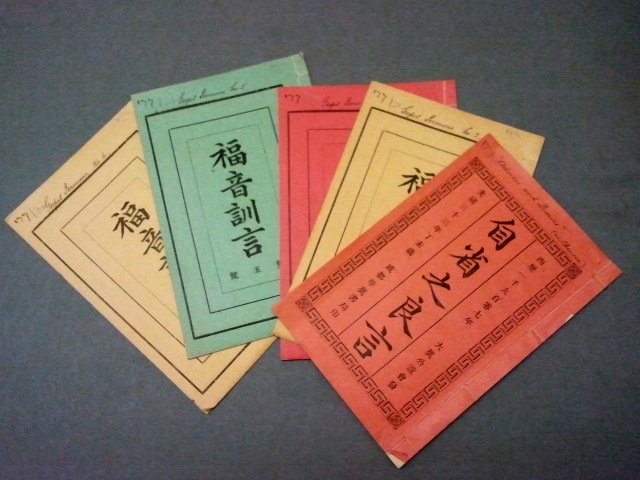
Work to add all the Library’s printed materials to our online catalogue continues, reaching into some less visited corners of the collections. In the angle of the reading room gallery sits a collection of Quaker texts translated into foreign languages for use in the mission field. Among them are various volumes of early 20th century Chinese books and pamphlets translated by one Isaac Mason (1870-1939).

Isaac Mason Chinese tracts

Tracts translated into Chinese by Isaac Mason (Library ref. Box 177)


Early Quaker works had been translated into Latin, Dutch, French, Hebrew, Polish and even Arabic, for diffusion throughout Europe and the near East. In the 19th century many works began to be translated into Scandinavian languages, and the Society of Friends’ annual epistle appeared in German translated by the Recording Clerk himself. Isaac Mason was responsible for the earliest  transmission of Quaker writings to a Chinese audience: his career as a missionary and translator is a fascinating one.

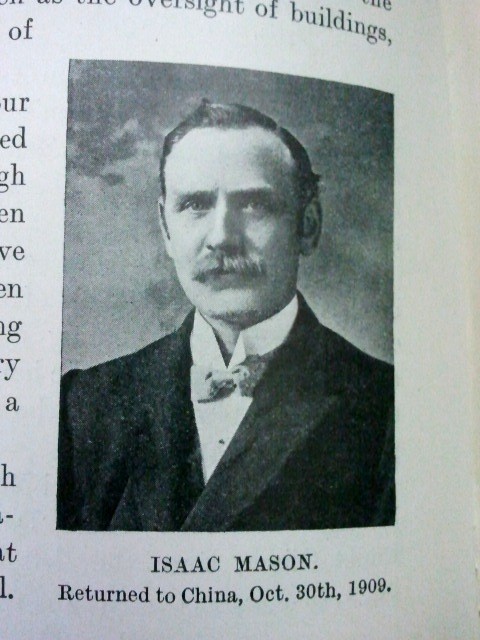
Isaac Mason in Sichuan

Isaac Mason in Sichuan. From: Davidson, Robert J. and Mason, Isaac, Life in West China: described by two residents in the province of Sz-chwan (1905) p. 211

Isaac was born in Holbeck, Leeds, in January 1870 and joined Quakers through his connection with the Great Wilson Street Sunday School and Adult School. He proved “headstrong and difficult”, a thorn in the side of the staff, but, on the point of being expelled, he came under the influence of Caroline Southall in the Adult School and became intensely loyal to her. She and other Leeds Quakers offered their service with the Friends Foreign Missionary Association (FFMA) in China. Mason volunteered too, but was only accepted a year later.

Esther Mason

Esther Mason. In: Friends Foreign Mission Association Annual report (1909)

After a further year of working as an iron moulder in Leeds and studying in his free time, he moved to London, where he started work at the Barnet Grove branch of the Bedford Institute, became engaged to Esther L. Beckwith, and finally went out to join the FFMA in Chungking (Chongqing) in 1894. He and Esther settled in T’ung Ch’wan, Szechwan Province (Tongchuan District, Sichuan) and did pioneer work at She Hong and Suining. Together they passed safely through some turbulent times – local riots,  the anti-missionary Boxer Uprising and the Revolution of 1911 (Xinhai Revolution).

Isaac Mason

Isaac Mason. In Friends Foreign Mission Association Annual report (1909)

Isaac Mason or Mei I-seng as he was known in China, mastered the language with unusual quickness. After 22 years in West China, he moved to Shanghai, where his interest in the production of Friends’ literature in Chinese flourished. He translated for the Christian Literature Society of China short lives of Quakers such as William Penn, John Bright, John Howard, Stephen Grellet and parts of John Woolman’s Journal. He also tackled Sir George Newman’s Health of the state, dozens of religious books and pamphlets and helped compile a Chinese dictionary of the Bible. Many of his pamphlets reflect his interest in Islam in China. Among the children’s books are The Swiss family Robinson, and Lamb’s Tales from Shakespeare.

Like some other contemporary Christian missionaries Isaac Mason had a particular interest in Chinese Muslims, and he was elected as a Fellow of the Royal Geographical Society in 1921. His election proposal stated that “Mr Mason has spent many years in China, travelled in the interior, investigated Chinese Mahommedanism, is the Secretary of the China Branch of the Royal Asiatic Society, and is in every way eligible for election as a Fellow. He is the author of several books in Chinese and English” (proposed by Zwemer and seconded by Heawood, the RGS Librarian; thanks to the Royal Geographical Society Library for this information).

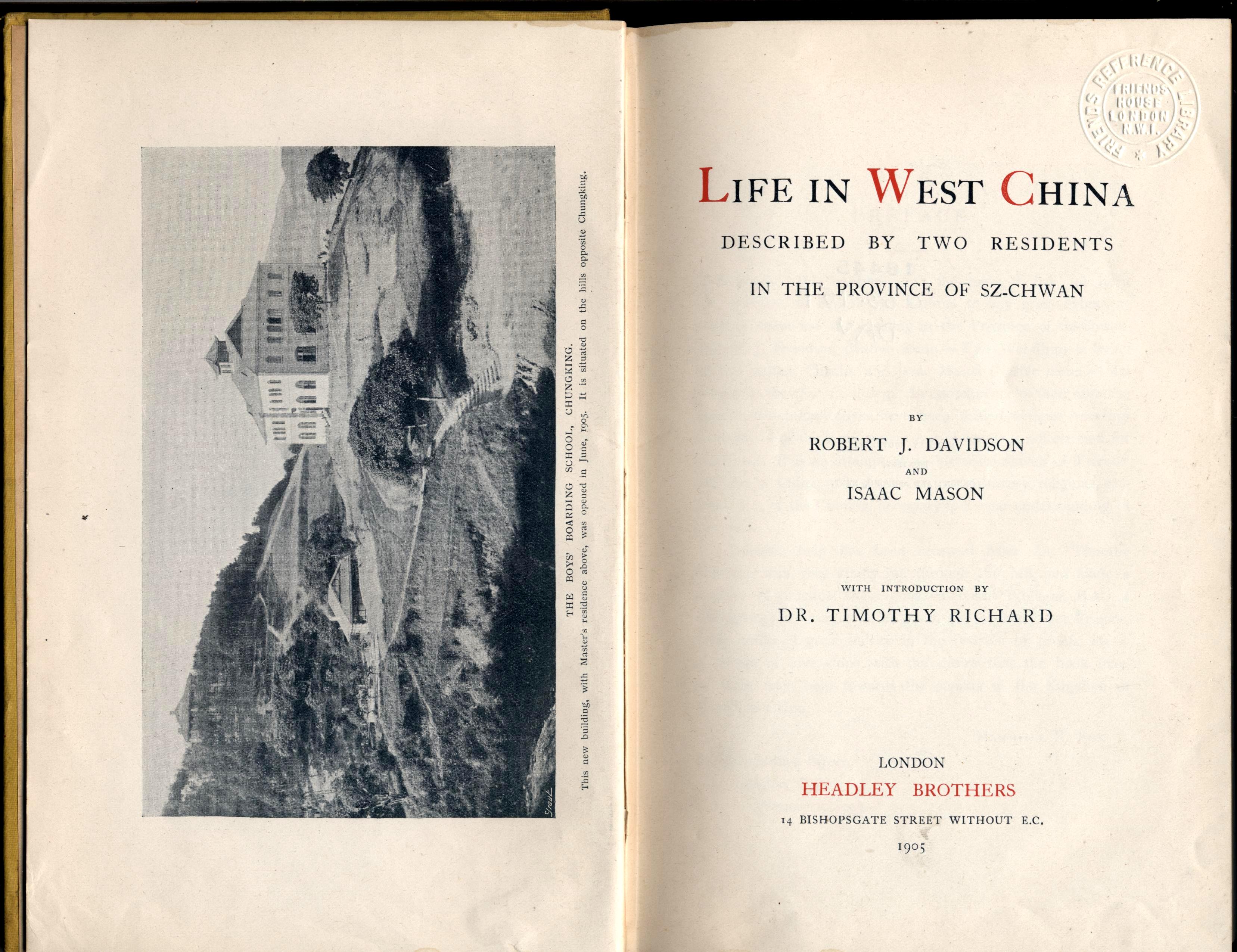
Life in West China

Davidson, Robert J. and Mason, Isaac, Life in West China: described by two residents in the province of Sz-chwan (1905). Title page

One of the bonuses of this Library’s retrospective cataloguing project has been the opportunity to provide better catalogue entries for foreign language publications – often poorly identified in the former card catalogue, or simply not catalogued at all.  In adding this small collection of Chinese tracts to our online catalogue we faced considerable linguistic challenges. We did have help though – sometimes the original English titles were printed in English on the reverse of the title page, and occasional manuscript notes on the items themselves were invaluable. A few had explanatory notes from Isaac Mason himself.

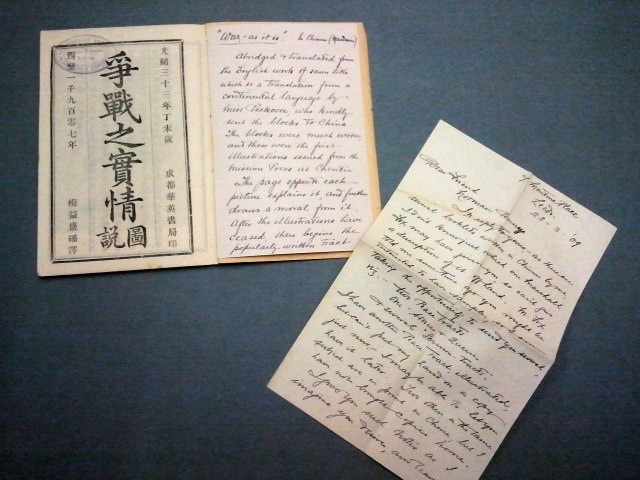
War as it is

The Library’s copy of War as it is, translated by Isaac Mason, with note by translator and accompanying letter to the Librarian, Norman Penney 23/3/1909

Though cheaply produced, the books and pamphlets are delightfully different from their English equivalents. In many of them, each “leaf” is in fact a single sheet printed on one side only (as was traditional in Chinese book production), to make two “pages” of text with bold black borders, then folded in half to make a double sided page.

Page structure

Sheet printed on one side and folded to make double sided page

More on Isaac Mason and Quaker missionaries in China

Friends in China (Library of the Society of Friends online exhibition, 2008)

Tyzack, Charles Friends to China: the Davidson brothers and the Friends’ mission to China 1886-1939. York: Sessions, 1988

Davidson, Robert J. and Mason, Isaac Life in West China: described by two residents in the province of Sz-chwan. London: Headley Brothers, 1905

Obituary for Isaac Mason in The Friend, vol. 97, no. 14 (April 1939) p.276-7

Travel letters of Isaac Mason 1915. Unpublished journal letters of Isaac Mason to a group of Friends in Leeds and Peckham, 1915, describing a journey to China, including letters from United States, Japan, Shanghai and other Chinese cities. Library of the Society of Friends, Library reference Temp MSS 601

Posted in Highlights | Tagged , , , , | 4 Comments

Quakers, relief and rescue in 1930s and 1940s Europe: a collaborative microfilming project with the US Holocaust Memorial Museum

Since 2006 the Library has been involved in a collaborative microfilming project with the US Holocaust Memorial Museum (USHMM). The Museum, based in Washington DC, is the most comprehensive institution of its type in the world.

Its primary mission is to advance and disseminate knowledge about the tragedy of the Holocaust, to preserve the memory of those who suffered, and to encourage its visitors to reflect upon the moral and spiritual questions raised by the events of the Holocaust as well as their own responsibilities as citizens of a democracy. The USHMM teaches millions each year about the dangers of unchecked hatred and the need to prevent genocide. It undertakes leadership training, education programmes, exhibitions and commemorations. As a memorial, it works against genocide through its Genocide Prevention Task Force, training foreign policy professionals.

The USHMM also collects archival material relating to the Holocaust from all over the world, and in 2006 it approached the Library of the Society of Friends to request access to British Quaker archive collections. It had already cooperated with the American Friends Service Committee (AFSC), the main American Quaker organisation assisting refugees and war victims, which had provided a considerable quantity of lists, images and data to the Museum, including refugee case files 1933-1958 and records relating to humanitarian work in France.

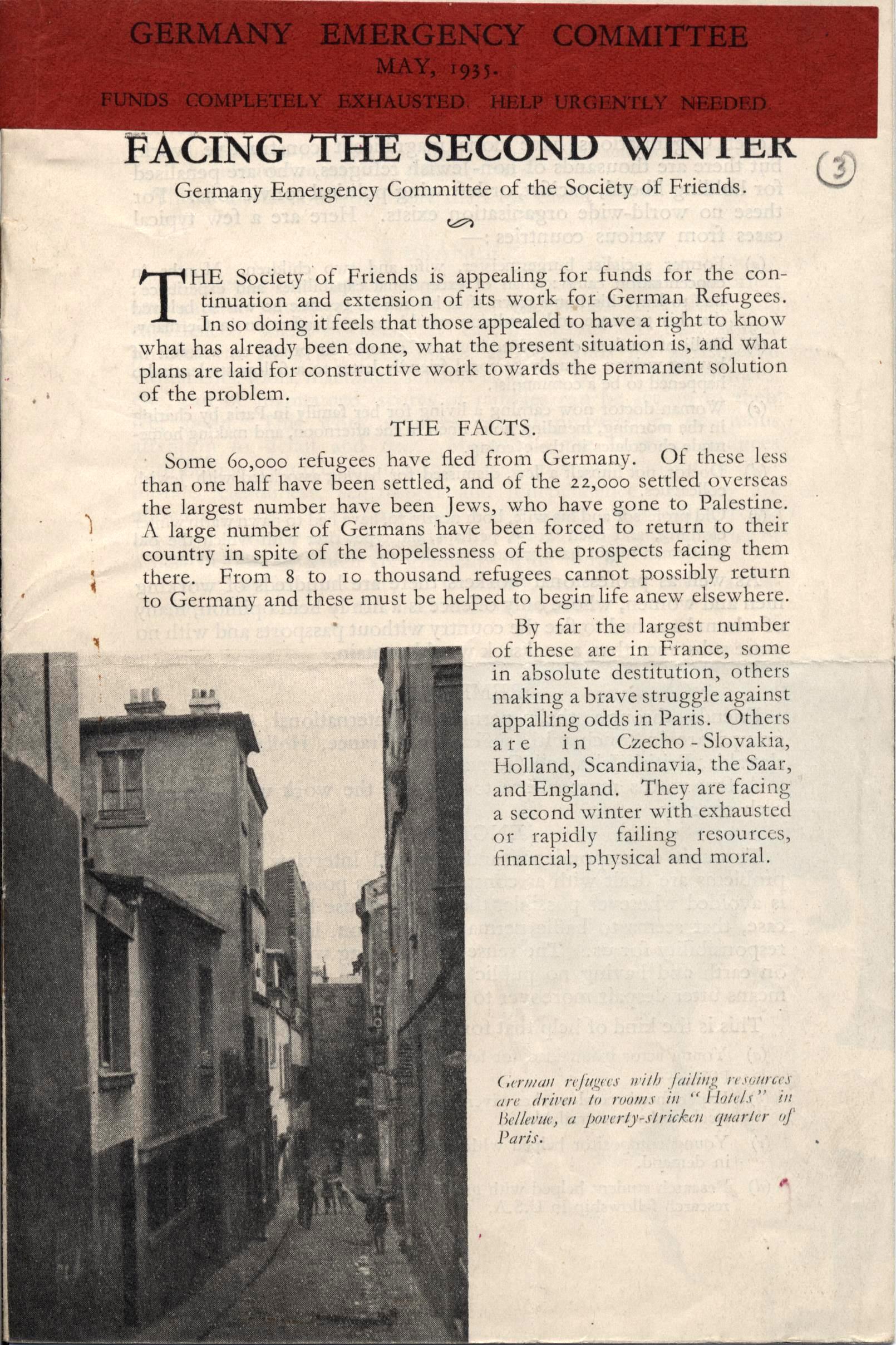
Facing the second winter

Facing the second winter (London: Germany Emergency Committee, November 1934). With attached appeal dated May 1935

Substantial British Quaker work was done from 1933 onwards in relation to Nazi and Fascist Europe. This work included reporting on conditions inside Germany after the Nazi Party gained power in 1933, particularly in relation to political prisoners and their families, providing assistance to the prisoners and families, supporting the small community of German Quakers, assisting Germans, Austrians, Czechs, Poles and others suffering persecution, prosecution, imprisonment or exile for political, racial and religious reasons, and helping refugees and dependants arriving in Britain with employment, sponsorship, training, education, and re-emigration matters. In the UK there were also Quaker efforts for the welfare of those foreign refugees and UK residents who had been detained as “Enemy Aliens” soon after war was declared.

 This Quaker work was done principally by three committees – Friends Committee for Refugees and Aliens (originally known as the Germany Emergency Committee), Friends Relief Service, and Friends Service Council (the international department of the Society of Friends in Britain at the time). 
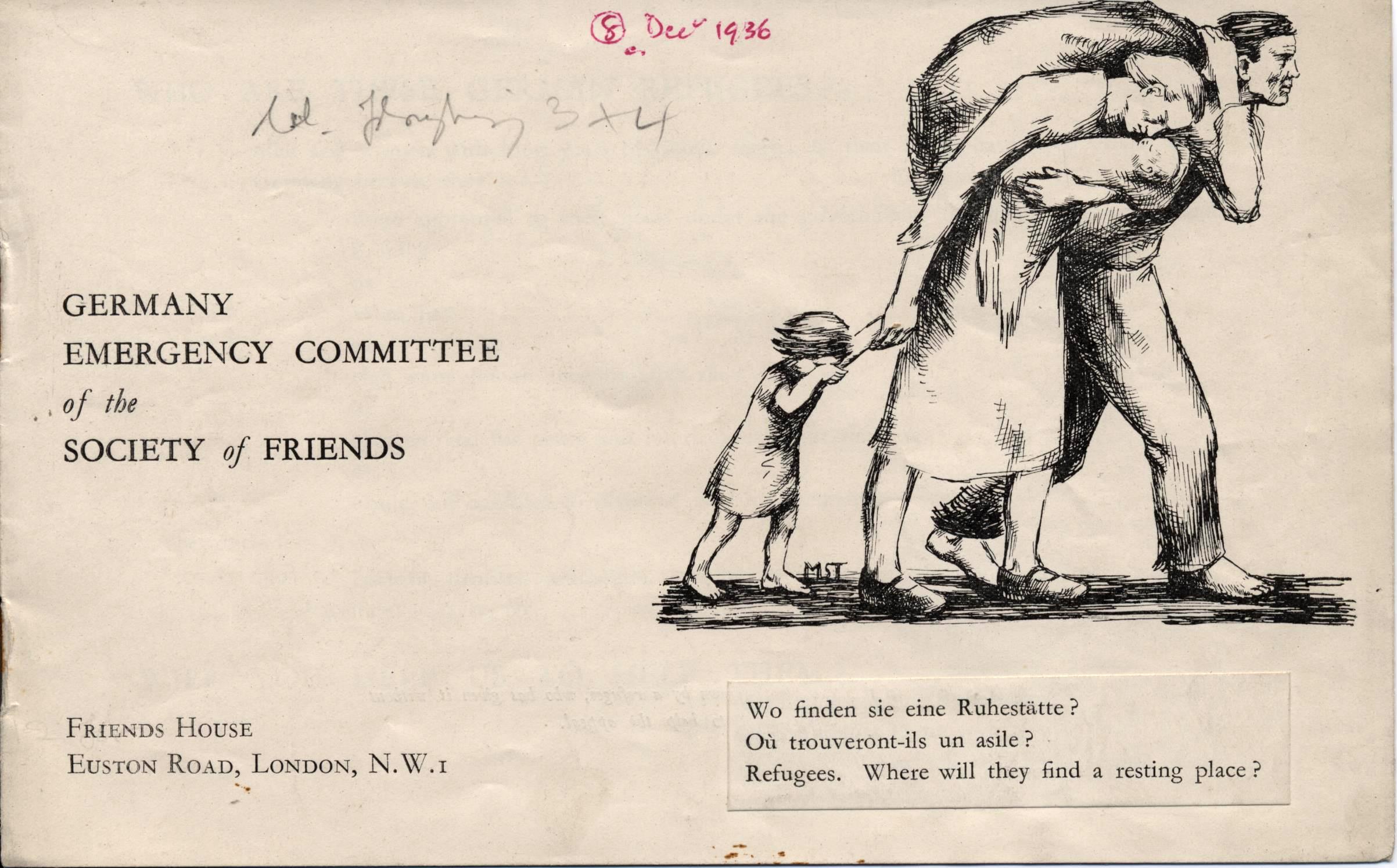
Wo finden sie eine Ruhestätte?

Germany Emergency Committee of the Society of Friends: wo finden sie eine Ruhestätte? (London: Germany Emergency Committee, December 1936)

During World War II and its immediate aftermath British and American Quakers also assisted civilian populations in many areas of Europe and elsewhere. This work from 1933 into the post-war period was recognized by the award of the Nobel Peace Prize in 1947 (see our online exhibition at http://www.quaker.org.uk/nobel-peace-prize-1947 ).
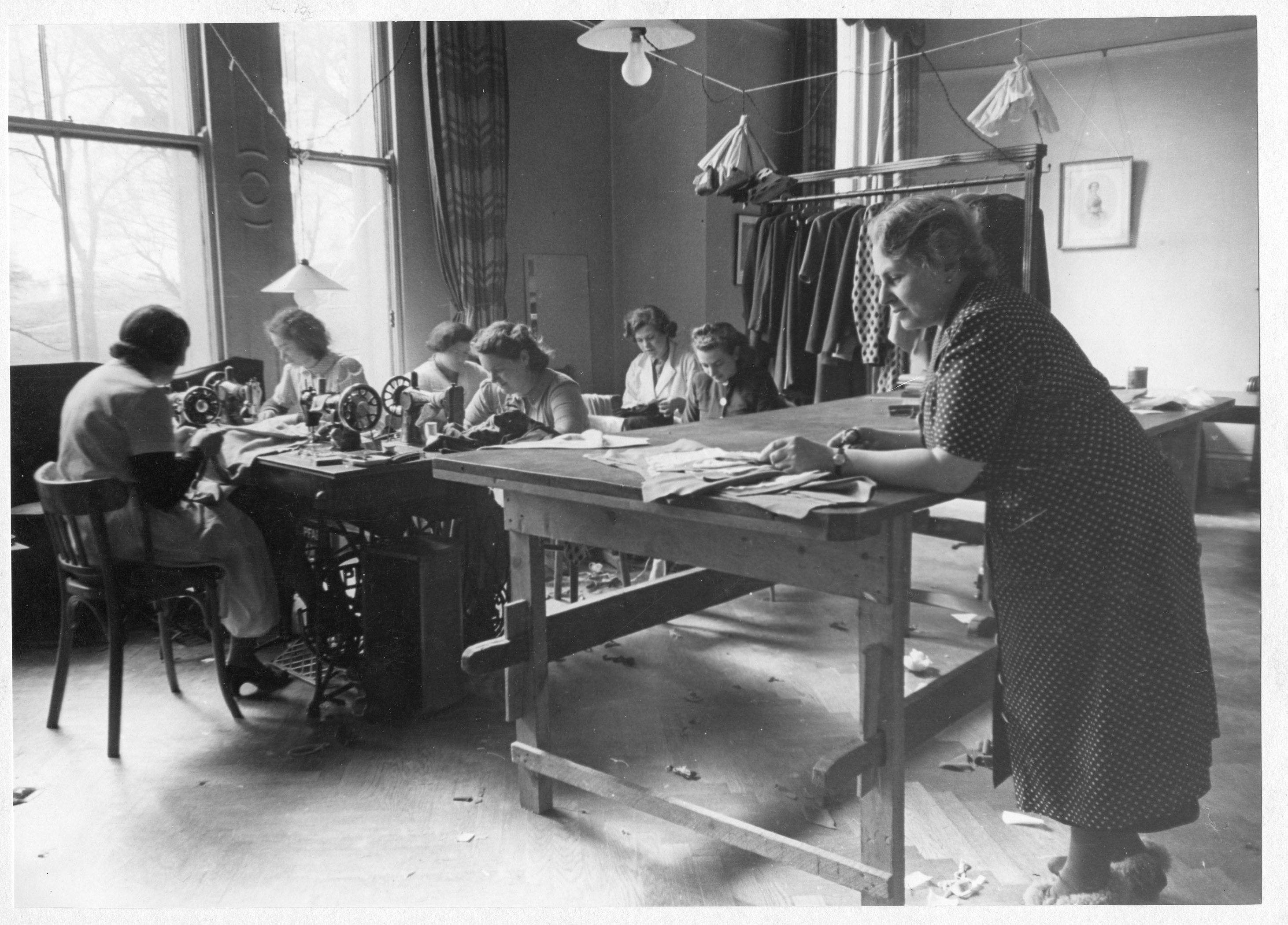
Knitting at the Germany Emergency Committee workroom

Refugees knitting at the Germany Emergency Committee workroom, ca. 1939 (Library ref. Box FRS/1992/9 Germany Emergency Committee photographs)

The Library’s collaborative project with USHMM began with a survey of our holdings and an inspection of large numbers of publications, minute books and file series by the USHMM’s British research assistant. This formed the basis of the ongoing microfilm project to produce master negatives (retained by the Library) and positive microfilm copies (sent to the USHMM for use in its library and research facilities). This long-term project has involved Library staff in the careful preparation of materials for microfilming, checking lists against records, page-counting, checking for filing-order and physical condition, as well as preparation of film titles, specific volume or file titles, headers and other markers.

Refugees at work in the Germany Emergency Committee workroom

Refugees at work in the Germany Emergency Committee workroom, ca. 1939 (Library ref. Box FRS/1992/9 Germany Emergency Committee photographs)

So far at least 20 volumes of minute books and pamphlets, and 14 boxes or part-boxes of archives have been microfilmed. There are approximately 9 boxes (4000-5000 images) still to be filmed.

Among series already microfilmed are –

  • Friends Committee for Refugees and Aliens (Germany Emergency Committee) minutes, publications, administrative and correspondence files on conditions and individuals in Germany in the 1930s and assistance to refugees, internees and others during World War II.
  • Friends Service Council annual reports and internal correspondence files on British Quaker workers’ and local Quakers’ activities in assisting refugees and other victims of Nazism in (and from), China, Austria, France, Germany, Poland, Switzerland and Scandinavia from around 1933 onwards.
  • Palestine Watching Committee and Friends Service Council Middle East files material on Palestine and the Middle East, reporting on the pre-war situation there, and undertaking assistance after World War II.

The project will not only make World War II Quaker materials more widely available for public research, but will help to educate people in the prevention of genocide and hatred. The Library looks forward to continuing its work with the USHMM. For more information about the project, please contact the Archivist (library@quaker.org.uk)

Posted in Projects | Tagged , , , , , , | 17 Comments

Artists inspired by worship

Linda Murgatroyd of the Quaker Arts Network writes about a selection of images of Quaker worship that she researched for the 2014 Quaker Arts Network calendar, Inspired by worship

My recent researches in the Library for visual representations of Quaker worship have caused me to reflect in new ways about what I know of our Quaker history, and what everyday Quakerism was really like at different times in the past. Looking at pictures of Quaker worship has offered a different lens.

I saw several paintings of Quaker worship in the Library during my visits, few of them well known or widely available. Diversity of style and period was an important criterion in the selection made by the calendar’s curating group (Penny Robbins, Anne McNeil and myself), as well as the quality of the pictures. About half of the pictures we chose were from the Library’s picture collection.  Not all the paintings mentioned in this blog were used in the calendar.

Heemskerk Quaker Meeting

Quaker Meeting, oil painting by Egbert van Heemskerk (Library ref. Pic F051)

Some of the earliest depictions of Quaker meetings for worship were by Egbert van Heemskerk (1634/5-1704), a Dutchman who painted scenes of ordinary life in the Rembrandt tradition. Heemskerk was not a Quaker, but something drew him to make several oil paintings of meetings for worship, mainly in the last two decades of the 17th century. Several of these are in the Library. These early meetings appear fairly chaotic: they are often in homes or taverns, and people from all social classes are standing or sitting wherever they can. All of them feature a woman standing and speaking – which of course was heretical in the view of most Christians of the day, but signalled Friends’ belief that all people could be in direct communion with God.

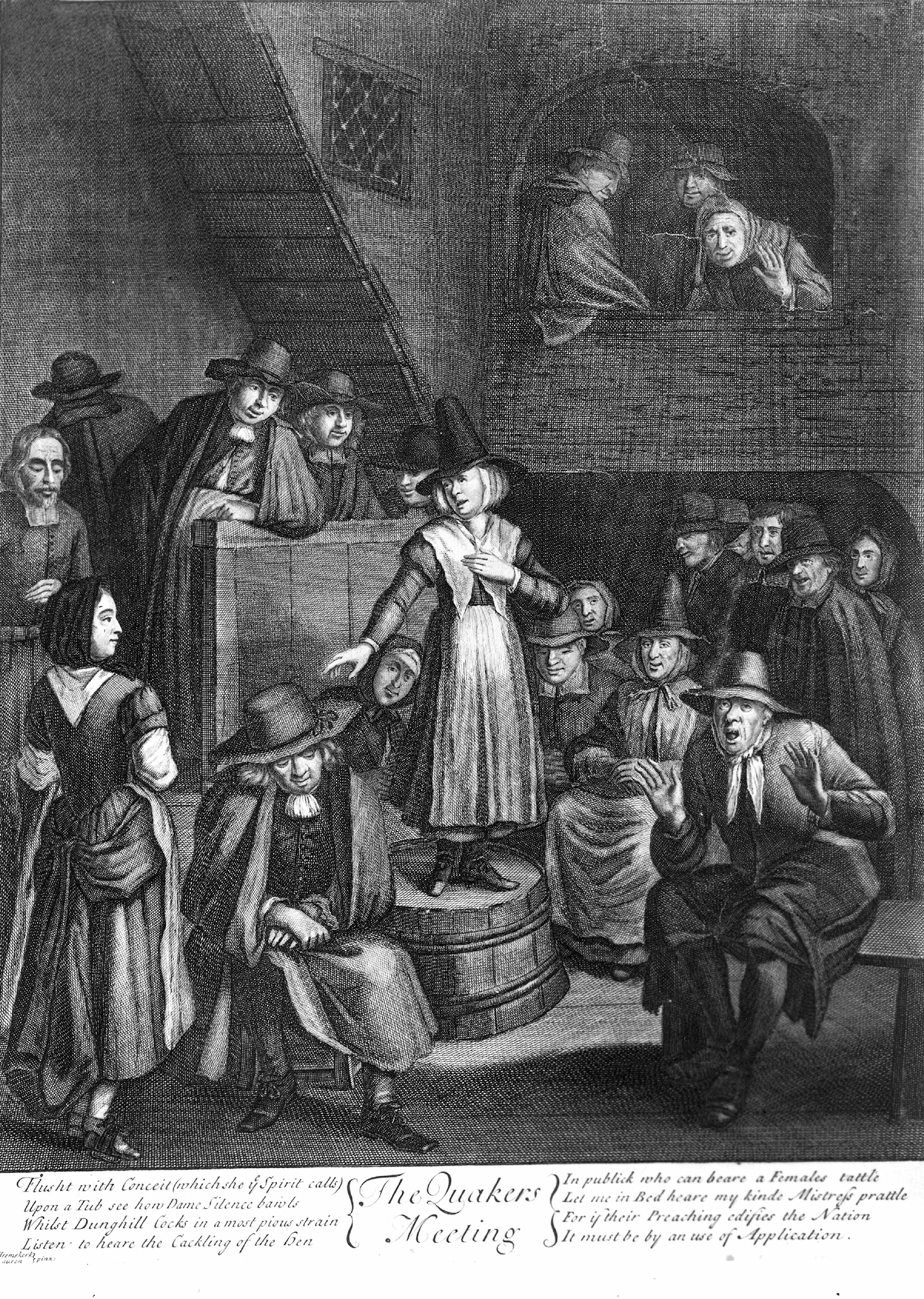
Quakers Meeting Heemskerk/Lauron

Quakers meeting after Egbert van Heemskerk, engraved by Marcel Lauron, 1690s (Library ref. Pic 88 AXL 70)

Several printmakers made satirical prints based on Heemskerk’s Quaker meeting paintings. They altered details and caricatured faces, adding lewd gestures or satirical verses. The Quaker Arts Network calendar includes an engraving based on Heemskerk by Marcel Lauron (famous for his “Cryes of London” prints). The verse below the image condemns women’s speaking in meeting, referring to “the cackling of the hen” and saying “In publick who can beare a Females tattle, Let me in bed heare my kinde mistress prattle.”

Gracechurch Street Meeting

Gracechurch Street Meeting (Library ref. Pic F072)

The painting of Gracechurch Street Meeting from the 1770s by an unknown artist forms a stark contrast with the earlier Heemskerk. This was a purpose-built meeting house, and by this time meetings were much more formal –  women seated on separate benches from the men, with elders and ministers facing the other Friends. About as many women were elders or ministers as men. All are wearing headgear except the male Friend who has taken his hat off to minister. In the upper galleries are some visitors or attenders, whose dress is rather fancier and in brighter colours than the Quakers – though the Friends wear browns and pinks as well as the grey for which they came to be known. Light from above plays an important part in this picture; perhaps the new skylight planned for the Large Meeting House at Friends House is not such an innovation after all!

Lucas Earith Monthly Meeting

Earith Monthly Meeting, oil painting by Samuel Lucas (Library ref. Pic F066)

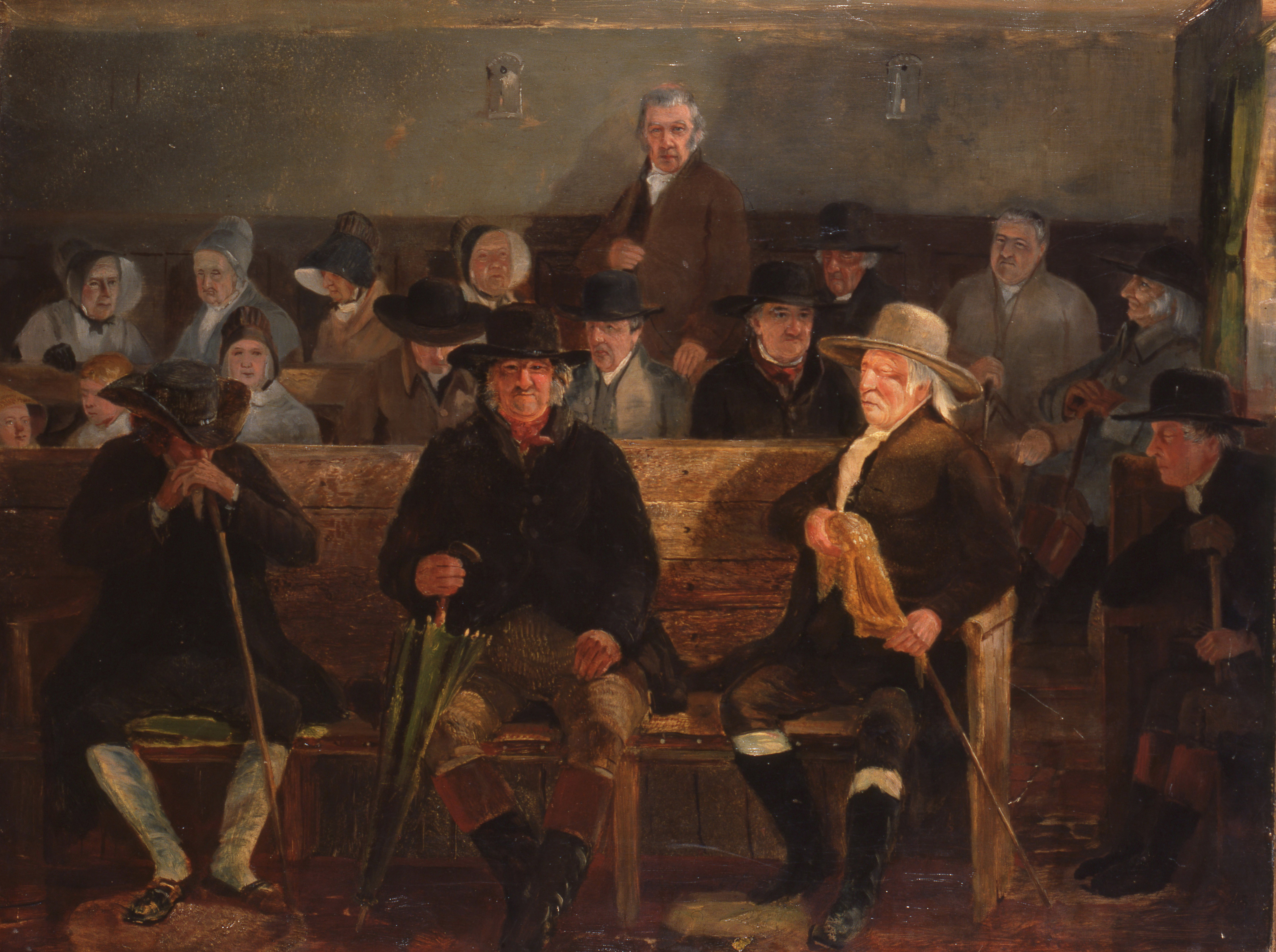
Some sixty years passed before the next painting in our calendar was made, this time of a meeting at Earith.  It depicts a pastoral visit to Friends in East Anglia.  The Friend standing to minister is one of the Yearly Meeting committee visitors. Many of the Friends portrayed are identifiable, including the local farmers on the front bench.

Lucas Yearly Meeting 1840

Yearly Meeting 1840, oil painting by Samuel Lucas (Library ref. Pic F035)

Lucas’s painting of London Yearly Meeting (1840) makes an interesting contrast with the depiction of the rural meeting at Earith. In Earith, everyone wears hats (except the person standing to speak), walking sticks and umbrellas abound, and women and men are seated on the same benches – though gathered  at different ends . There are rather more men than women – presumably it would have been harder for women and children to travel the distance to monthly meeting (by horseback or on foot), though a few children are present.  In the Yearly Meeting painting, only men are portrayed, as there were separate women’s and men’s yearly meetings until near the end of the nineteenth century. Dress is more formal than at Earith and about half the men are hatless.

Samuel Lucas (1805-1870), was a member of Hitchin Meeting. A brewer by trade, he was a keen amateur painter in watercolours and oils, exhibiting at the Royal Academy from time to time, and specialising in landscapes later in life. Samuel’s wife and children also painted, as did other members of his family.

Chelsea Meeting, by Nelson Dawson

The Chelsea Meeting, watercolour by Nelson Dawson (Library ref. Pic F128)

Nelson Dawson’s lovely little watercolour of “The Chelsea Meeting” was painted in 1891. It feels to me very like some meetings today. Everyone is seated, men and women together. This painting was of the meeting held at 48 Cheyne Walk, home of Caroline Stephen, whose influential book Quaker Strongholds opened the way for a Quakerism that goes beyond Christianity.

Nelson Ethelred Dawson (1859-1941) started life in Lincolnshire and trained as an architect but moved to London to study painting in 1885. He married Edith Robinson, a birthright Friend, and later joined the Society himself. He and Edith went on to become key figures in the Arts and Crafts Movement, specialising in jewellery and metalwork, and Nelson founded the Artificers Guild in 1901. He returned to painting a few years later, exhibiting widely, and was particularly noted for his maritime scenes. His work is represented in a number of museums and galleries around the country.

Perkin Centring down

Centring down, acrylic by John Perkin (Library ref. Pic F234)

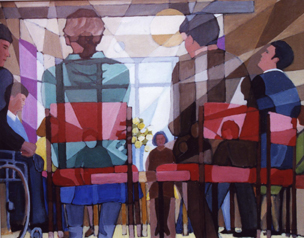
Finally, John Perkin’s painting “Centring Down”, currently hanging above the Library’s enquiry desk, was one of the inspirations for the whole calendar.  John was a keen painter, mainly of landscapes and community scenes. In his last years he made about a dozen paintings of Quakers at worship. John had hoped to exhibit them together at Friends House, but died in 2012 before this was possible.  The calendar includes three of these paintings, illustrating different aspects of Quaker meeting for worship.

Research for this calendar has taught me much and also raised new questions. It suggests that despite Quaker reservations about the arts, some Friends have been serious artists throughout our history. It’s interesting to reflect that despite disapproval in some quarters, it seems to have been acceptable for people to paint pictures of Quaker meetings for worship. It’s hard to know how closely the portrayals  resembled actual meetings, especially as the early paintings are clearly composed and painted in the studio and designed to give particular messages about Quakers.

Making these images was often the artists’ particular ministry and their form of witness. Looked at in a different way, each of these pictures can draw us into stronger connection with Quakers past and present, and can help bring the spirit of worship into our everyday lives.

The Inspired by Worship calendar is on sale from the Quaker Arts Network http://www.quakerarts.net/ as well as from the Quaker Bookshop at Friends House.

Postscript: You can read about the recent conservation of two of the paintings discussed by Linda Murgatroyd in past issues of the Library newsletter: one of the Library’s four Heemskerk paintings  in the Autumn/Winter 2011 issue and the Gracechurch Street Meeting painting in the Spring/Summer 2010 issue of the former Library newsletter.

Posted in Guest posts | Tagged , , | 5 Comments

Howzat: some cricketing Quakers

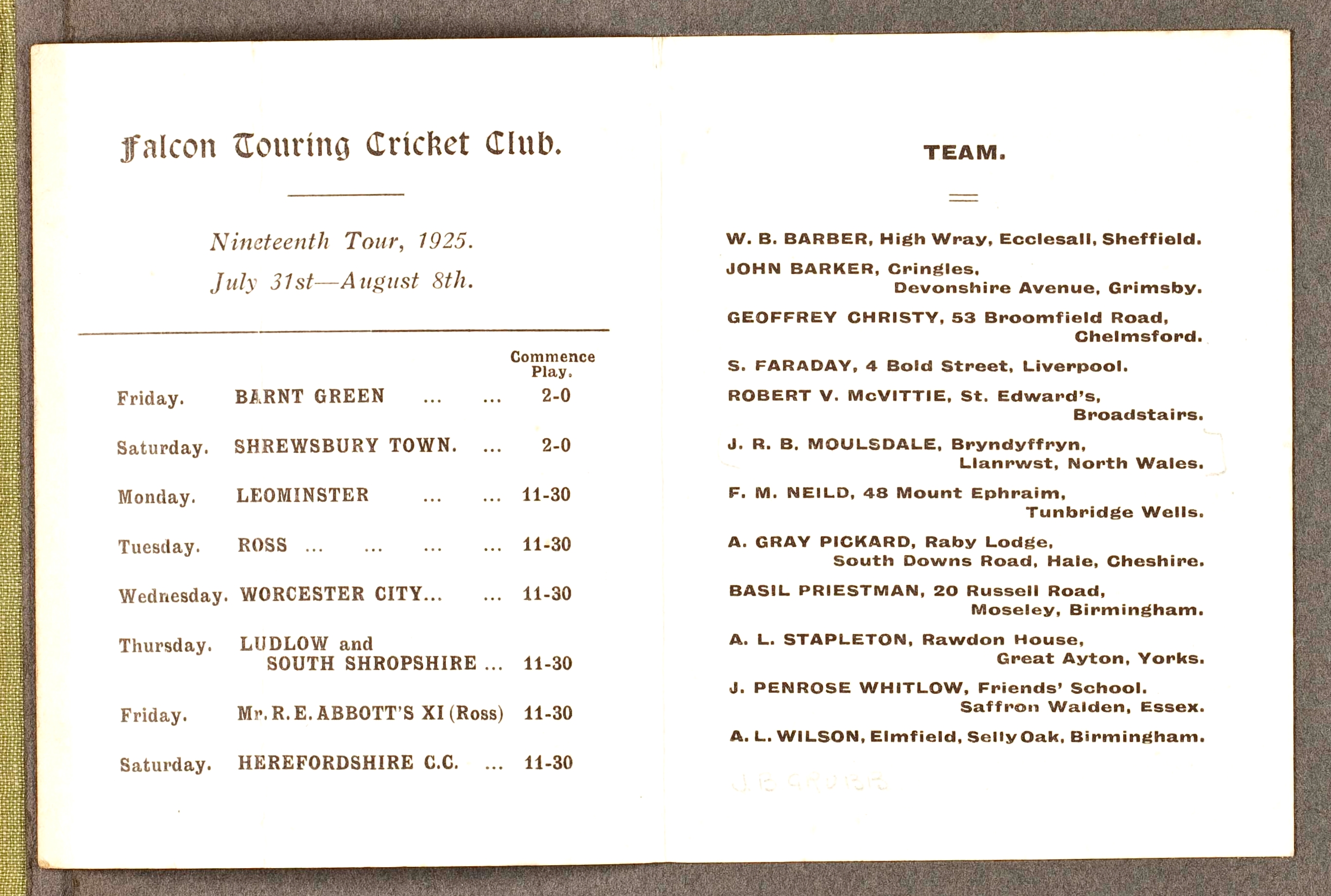
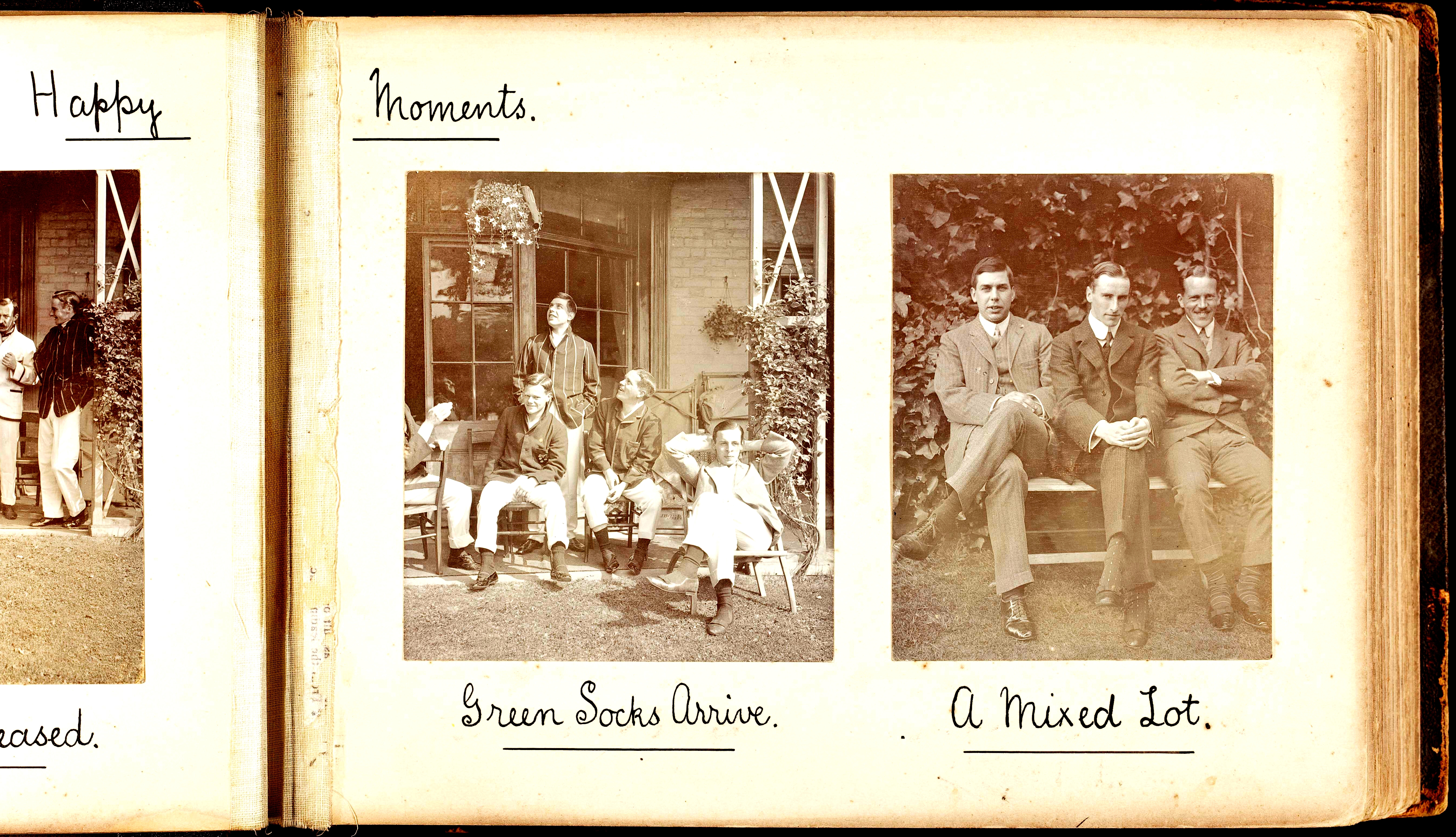
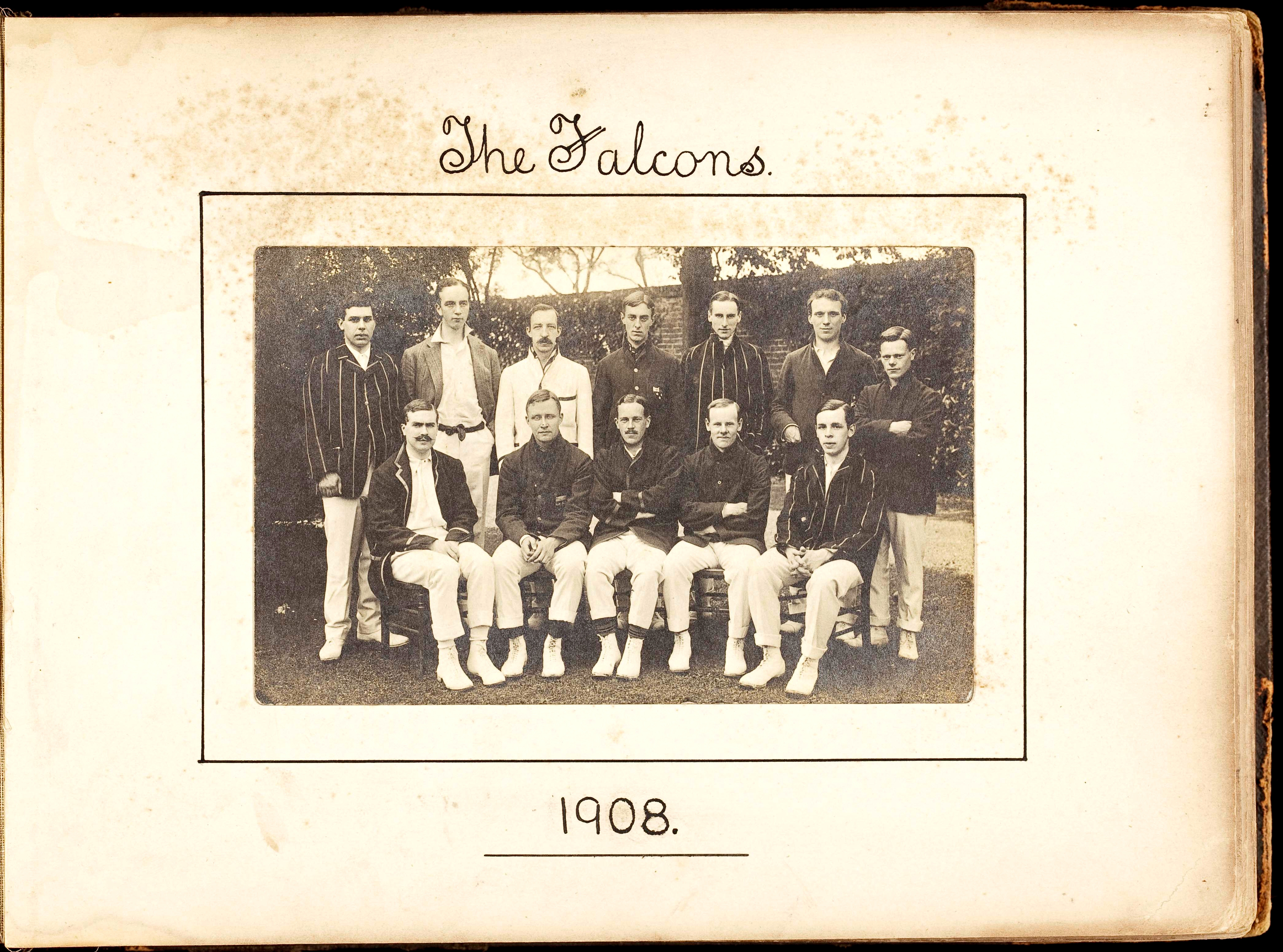
While summer and the cricket season are still in full swing, you may enjoy some of these photographs from the records of the Falcon Touring Club, a Quaker cricket team. Dating back to 1902, the club drew its members mainly from those who had attended Quaker schools.

The founders were three young Friends from York – Stephen Priestman, Thomas Twyman and I. Gray Wallis. It occurred to them that a week’s cricket tour would make an enjoyable holiday. Little could they have known that the team would continue to tour until the 1990s, with a special centenary reunion in 2002.

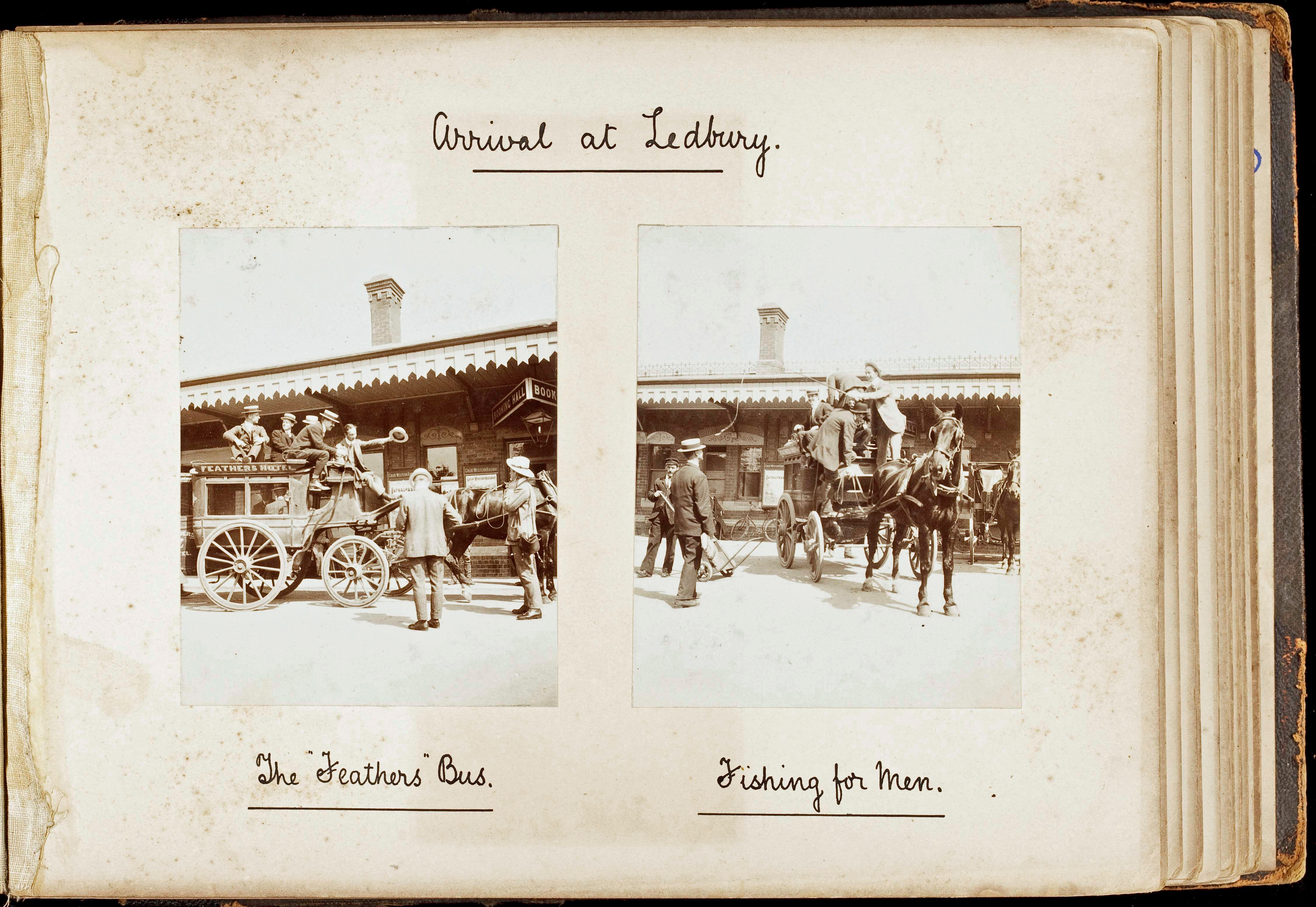
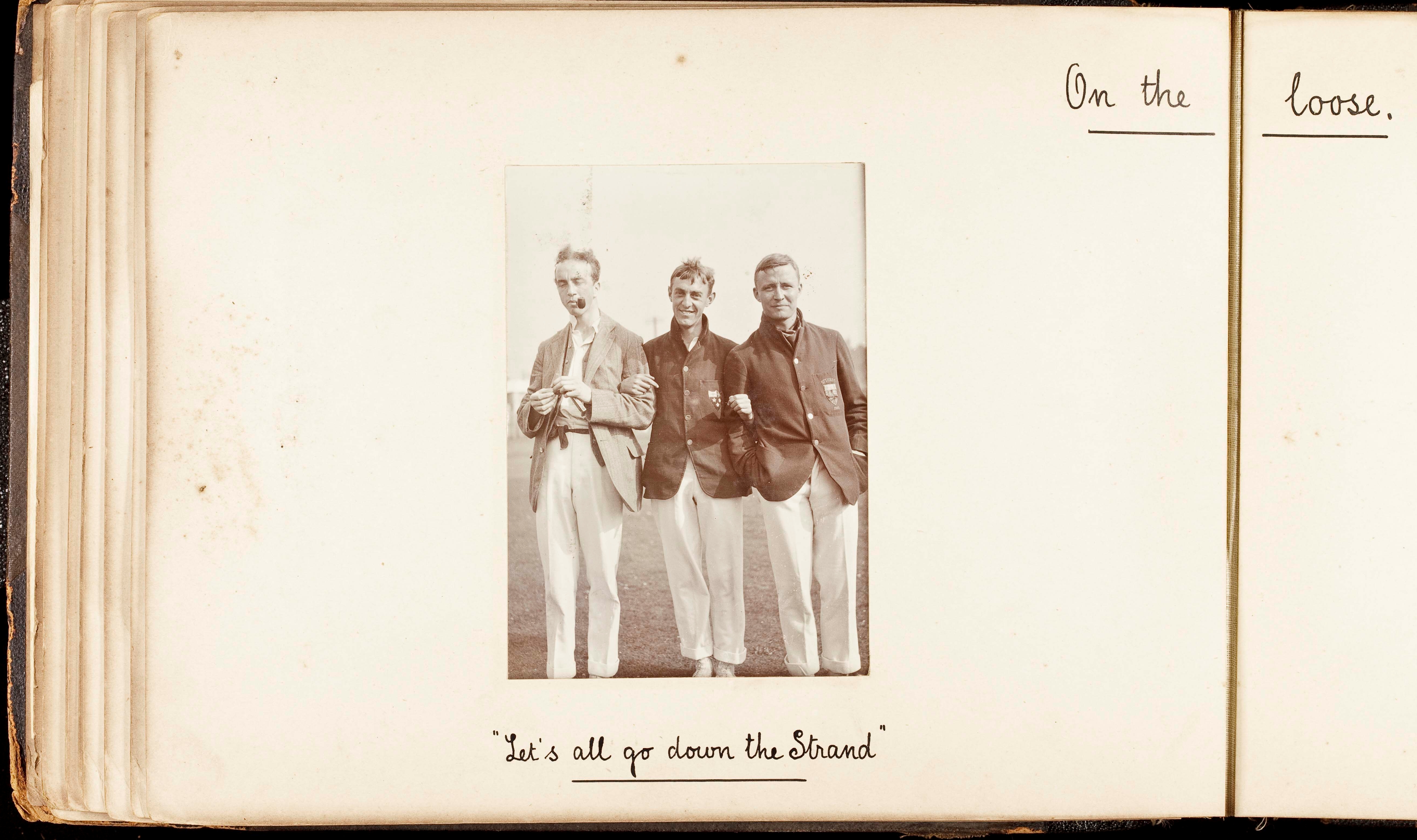
Falcons 1908 - Arrival at Ledbury-editThe records of the Falcons here in the Library include seven albums of photographs and some press cuttings, covering the period between 1907 and 1932, and seven score books covering the period between 1935 and 1983, with a few gaps.

Falcons 1908 - editIt’s also possible to glean much about the club from the pages of The Friend – which for many years carried an annual report on their activities – and from the magazines produced by the old scholars’ associations of Quaker schools.

So what sort of organisation was it? And did it do more than just play cricket?

Each year the players came together, usually in August, to tour in the Herefordshire and Shropshire areas. The cricket was clearly memorable, but to many of the players it was the friendship and having a good time that was of greatest importance. An advertisement for new players in The Friend was entitled ‘Howzat for a holiday?’ and in 1927 the paper reported the club’s 25th anniversary.

Falcons 1908  - On the Loose 1The team clearly built up relationships with local Friends and members were keen to renew acquaintances each year – although there was at least one occasion when they were not allowed to return to the same lodgings! The Falcons’ archives include some correspondence on this.

One year the weather was good in Ross on Wye – it was a lovely ground and a good wicket. An elderly Friend, then a widower, spontaneously invited the whole team to lunch, without a word of warning to his housekeeper.

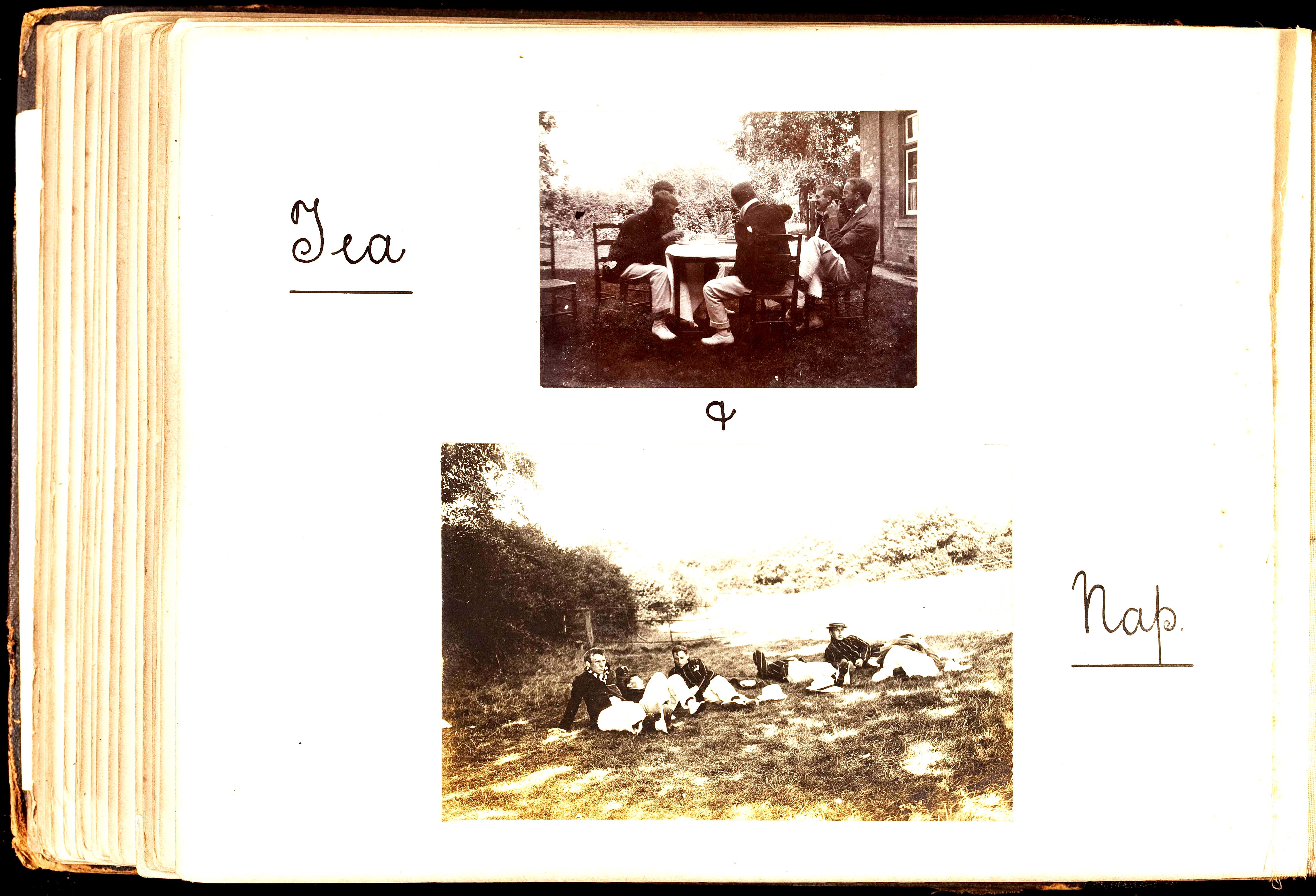
Falcons 1908 - Tea 1 - editBut the weather wasn’t always good and this is recorded in the score books, where the description varied from “wonderful” to “bloody awful”. Despite bad weather at Ross on Wye in 1963, the team enjoyed themselves in other ways. Some of them were “beginning to bat like golfers” and “assisted by a large lunch at the Royal Hotel” they were all out for 99. Later that day they had their Annual Dinner at the Axe and Cleaver in Much Birch, six miles south of Hereford.

In 1976 the team was based at The Farm in Shobdon and took an interest in local history, visiting local churches and castles and the historic meeting house at Almeley. They also played snooker, bar billiards and darts!

The records may be of interest to family historians, especially the score records which record players’ names and give a full picture of the games played. The photograph albums contain some local press cuttings which include names, but these cover only part of the years the club was in existence. It would be a relatively easy job to check local papers for the areas during August.

Falcons 1923 - card inside

Not all of the club’s members were Friends, but it was clearly held in high esteem. In 1938 The Friend had this to say:

It is stated on good authority that whilst the team do not claim to be a branch of the Society’s extension work, they have a reputation in the area of the Western Quarterly Meeting where they play, of being “keen, good cricketers, surprisingly punctual and still more surprisingly sober for a touring team”. Perhaps that is why one of their old opponents, a recently retired Test Match selector, told the Captain this year that: “This Quakerism is an excellent thing”

Falcons 1908 - Happy Moments 2

Posted in Highlights | Tagged , , , | Leave a comment