
Abstract
In September 1821, a catastrophic fire broke out on Gracechurch Street in London, destroying several commercial and residential buildings, including the prominent Quaker meeting house. This article revisits the fire through contemporary reports and explores its lasting effects on the Religious Society of Friends in the City of London and surrounding areas. Examining archival material preserved at Library of the Society of Friends, it highlights the survival of key records, introduces archive conservation techniques, and draws on contemporary events to underline the endurance of Quaker recordkeeping.

Boxed volume of Gracechurch Street Monthly Meeting Minutes (1791-1793) alongside a bookmark depicting Gracechurch Street meeting house produced by the Library of the Society of Friends.
Introduction
In May 2025, a cataloguing initiative at the Library of the Society of Friends (LSoF) shed new light on material from the Gracechurch Street Quaker Monthly Meeting. This work formed part of a wider ambition to improve access to and understanding of early London Quaker records. The project involves extracting information currently embedded in PDF documents attached to legacy catalogue descriptions and using this data to build a structured and searchable catalogue hierarchy for meeting records. This undertaking not only adheres to archival standards of description but also makes it easier for researchers to trace the administrative and spiritual life of London Quaker meetings across time.
As part of this initiative, the LSoF—where London Quaker meeting records are held on deposit—has begun the task of systematically re-cataloguing the collections, starting at the level of monthly meetings. As such, the Gracechurch Street Monthly Meeting was one of the first selected for this work. The choice was initially practical: the records were accessible and relatively compact, making them a manageable starting point. However, the re-cataloguing process soon uncovered a compelling historical narrative.

Metal chest with the label “Gracechurch Street MM Burnt registers”.
Within the 18th-century minute books and correspondence were a small group of documents showing unmistakable signs of fire damage. These records had been preserved among otherwise routine papers and volumes and had not previously been flagged as exceptional. It is fortunate then, that the project has resurfaced records which bear a physical testament to the fire that destroyed the Gracechurch Street Meeting House in September 1821.
The cataloguing of these records provided a valuable opportunity not only to assess their physical condition and implement appropriate conservation and access measures, but also to revisit the historical circumstances of their creation and near-destruction.
Gracechurch Street Meeting’s Place in Quaker Life
Gracechurch Street Meeting played a central role in the religious and communal life of London Quakers. As one of the most prominent meeting houses in the city, it became a key gathering place for influential members of the Society of Friends. The meeting also hosted the Society’s Reference Library[1] and was the site of significant events, including the being host to the last sermon to be given by George Fox[2]. Its importance is further underscored by the fact that it succeeded the Bull and Mouth meeting, which had been the largest early Quaker meeting in London. This continuity reflected the growth and institutional development of the Quaker movement in the capital. The Gracechurch Street Meeting attracted many well-known and active Friends, serving not only as a spiritual centre but also as a place where Quaker organisation and discipline were strengthened and maintained.
The Fire and Immediate Consequences
The fire was reported in contemporary newspapers, including The Guardian[3], which chronicled the fire’s progression and the attempts to contain it. The blaze began in the early hours at the rear of Mr. Ryan’s cheesemonger’s shop and spread rapidly to adjoining buildings. Despite the prompt action of a watchman, efforts to extinguish the fire were quickly overwhelmed.
While occupants of nearby homes and businesses managed to escape with their lives, attempts to preserve property were less successful. As firemen worked to rescue items from the Quaker meeting house, its front wall collapsed, burying four men. One died at the scene, another succumbed soon after, and a third’s body was not recovered until the following day.
The destruction of the meeting house marked more than the loss of a building; it represented the dislocation of a historic religious community within London. Though the physical structure was lost, the community’s response was swift and grounded in their testimony of resilience and mutual care.
Archival Survival and Conservation
Among the debris, records from the Gracechurch Street Monthly Meeting were recovered. These documents were retained and, in subsequent years, transferred to LSoF with the latest being by gift in 1908. Their survival offers a rare, tangible connection to the fire and to the continuity of Quaker recordkeeping tradition.
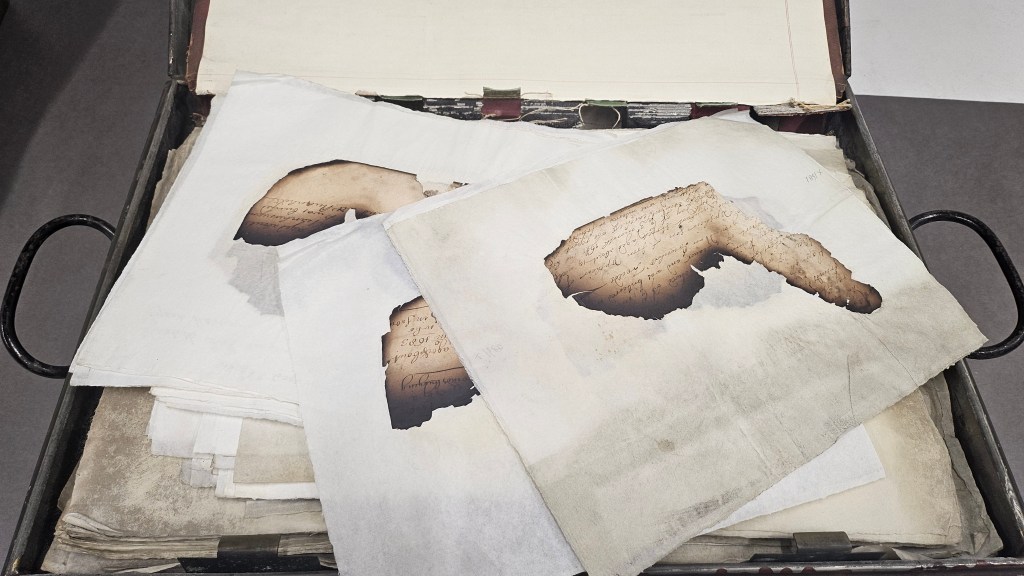
Loose leaves of paper pasted with burnt sections of Gracechurch Street burial notebook (1711 – 1733).
There is little historical documentation about the immediate treatment of these fire-damaged records in the 19th century. It is likely that they were simply pasted into volumes in order to keep their original order intact and stored with minimal further intervention. Their condition today, though bearing visible scars, shows that they were highly valued and preserved with enough care to avoid total deterioration.
In the present day, these materials would be maintained according to current best practices in archival conservation. Techniques used to stabilize fire-damaged documents include low-humidity drying and soot removal through micro-vacuuming. Today, we typically expect that fire-damaged materials will also be water-damaged due to sprinkler systems or firefighting efforts. Very wet documents should not be separated immediately and instead should be interleaved every 2 cm with absorbent materials like paper towelling, blotting paper, or photocopy paper. As these become saturated, they must be replaced to reduce moisture buildup, whilst airflow from fans or open windows can assist with drying.
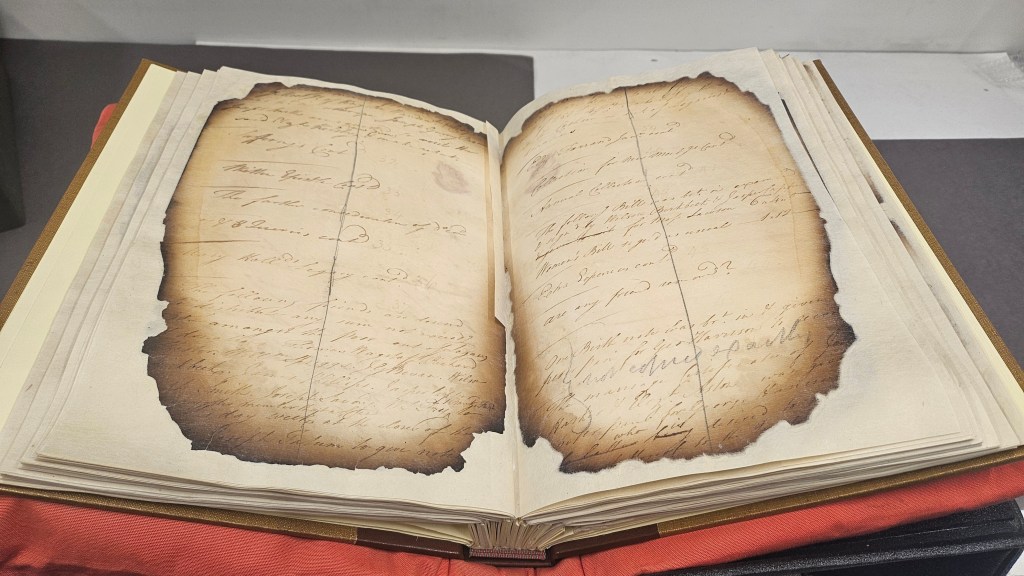
Volume pasted with burnt pages from Gracechurch Street Monthly Meeting Minutes (1791-1793).
Once the paper begins to dry and regain strength, individual pages can be separated using a blunt knife, starting from the least burnt edge. Freed pages should be laid flat on absorbent paper and turned regularly until completely dry.
After wet materials are under control, soot can be removed from dry pages using a soft brush and a vacuum nozzle covered with gauze, or with a kneadable eraser for more stubborn residue, although charred areas should be avoided due to their fragility.
If drying cannot be done immediately, documents can be frozen in small bundles wrapped in greaseproof paper for later recovery[4].
At LSoF, these records have been catalogued taking into account any need to limit physical handling. Importantly, the damage they sustained has not been obscured; instead, the burn marks and smoke staining serve as physical testimony to the historical event they endured.
The conservation status of these records reflects both their practical function as sources for historical research and their symbolic value as material witnesses to the fire – a vivid reminder of the fragility of knowledge and memory as well as the enduring efforts to preserve it.
Legacy and Relocation
The 1821 fire did not just destroy buildings; it catalysed a wider shift within the Quaker community. For decades, Gracechurch Street had been a centre of Quaker worship and social life. However, even before the fire, demographic and cultural changes were prompting many Friends to relocate from the bustling commercial heart of the city to more suburban environments. The fire accelerated this movement, particularly toward Stoke Newington, which by the mid-19th century had become a thriving Quaker enclave.
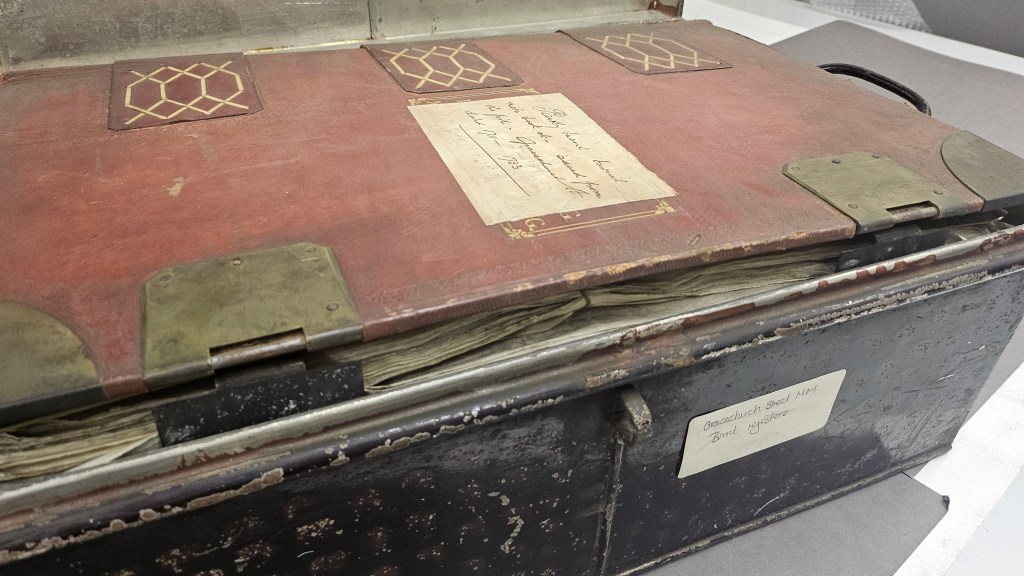
Volume with hand-written label “Partially burnt note book etc - saved from the fire Gracechurch St dated 1711-1733”.
Though the Gracechurch Street Meeting was eventually rebuilt, its role within the broader London Meeting network evolved. The fire thus served as both a rupture and a turning point in the spatial and institutional development of Quakerism in the capital.
Conclusion
The 1822 fire at Gracechurch Street is emblematic of both the hazards of urban life in Georgian London and the fortitude of the Quaker community. These records offer more than administrative data; they are artifacts of disaster, resilience, and remembrance. Their rediscovery as part of the cataloguing project has not only increased their accessibility but reintroduced a powerful story of faith and survival into the historical record.
This incident also resonates with present-day events. In April 2025, Westminster Meeting House, another central London Quaker site, was subject to a police raid despite the building being widely recognised as a space of peace, nonviolence, and sanctuary[5]. While the physical damage was minimal, the intrusion provoked national discussion about the protection of sacred and community spaces. For many Quakers, it echoed the long history of state pressure that Meetings and the premises that house them have endured.
Together these episodes, separated by just shy of 200 years, demonstrate that meeting houses are not merely architectural heritage sites but living testimonies to Quaker witness. They have served as spaces for worship, refuge, dissent, and healing. Whether threatened by fire or state incursion, their endurance and the records they create continue to embody the values of integrity, peace, and community. Preserving their stories is thus essential not just for historical memory, but for the ongoing life of the Quaker tradition in an often-turbulent world.
The catalogue of the collection can be viewed here: https://quaker.adlibhosting.com/Details/archive/110001799
[1] Littleboy, Anna L. The Journal of the Friends Historical Society, Vol. 18 No. 3-4 (1921) Devonshire House Reference Library. https://journals.sas.ac.uk/fhs/article/view/3725/3676
[2] Inward Light. The Death & Burial of George Fox .https://inwardlight.org/transformation/change/the-death-burial-of-george-fox/
[3] The Guardian. From the Archive: Fire on Gracechurch Street. September 15, 1821.https://www.theguardian.com/news/1822/sep/15/mainsection.fromthearchive
[4] National Archives of Australia. Recovering fire-damaged records.https://www.naa.gov.au/information-management/storing-and-preserving-information/preserving-information/recovering-fire-damaged-records
[5] Townsend, Mark. Police Raid on Westminster Quakers During Protest Sparks Outrage. The Guardian, 21 April 2024. https://www.theguardian.com/uk-news/2024/apr/21/police-raid-on-westminster-quakers-during-protest-sparks-outrage
 Quaker Strongrooms